The Current That Reads You
The scientist's name was Priya, and she was frustrated in the specific way of a person who was sure the machine was fine.
"It's the size of a candy bar," she said, holding it up. "It reads the DNA of everything in one drop of creek water. Bacteria, fish that swam past an hour ago, tree roots. It's supposed to."
"But it's not," Maya said.
"It's giving me garbage. Look."
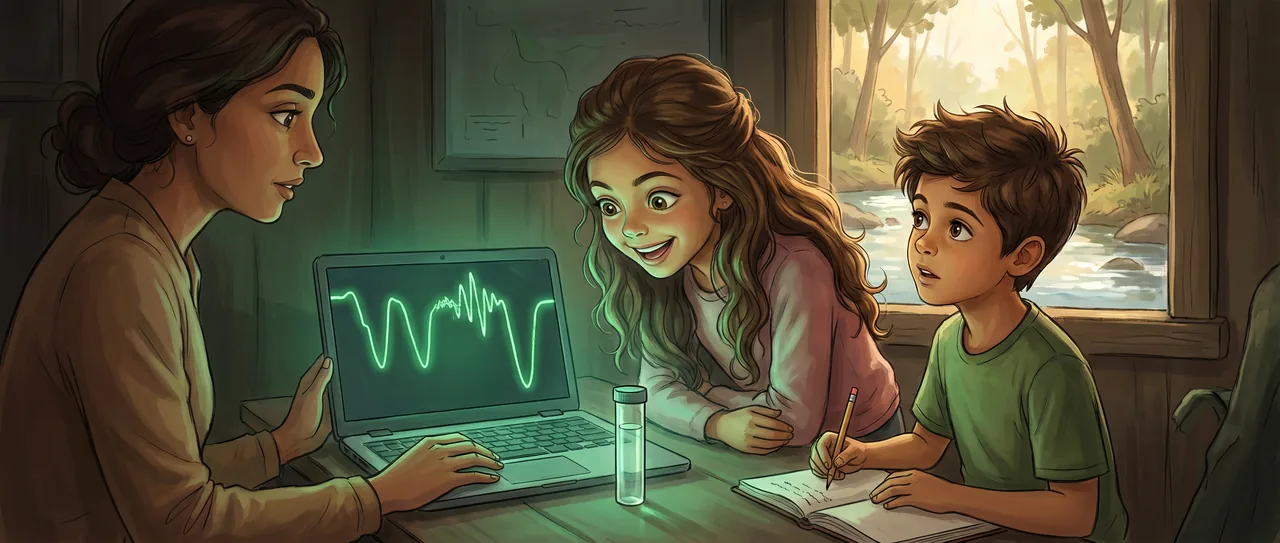
On her laptop a line of current jittered up and down. Not flat. Not clean. Just a nervous green wire going somewhere.
Soren leaned in. He had his notebook open already. "What is the line, though. What am I looking at."
"Electricity," Priya said. "There's a tiny hole in that chip. A protein, a pore, smaller than anything you could see. Salt water sits on both sides and we push a current through the hole. Then DNA threads through, one base at a time, and each base is a different shape, so each one blocks the hole a little differently."
"So the current dips," Soren said slowly.
"The current dips. A dips one amount. T dips another. Four letters, four dip sizes. The machine reads the dips and spells the DNA back out."
Maya was already looking at the green line and not at Priya. "So the letters ARE the wiggles."
"The letters are the wiggles," Priya said. "When it works."
"Why doesn't it work?"
Priya threw up her hands. "I've reloaded it three times. Fresh water, fresh reagents. It reads for ten seconds and then it goes to noise."
Soren watched the line. Ten good seconds, he counted. A clean rhythm, up and down, up and down, like careful handwriting. Then a shudder, and the handwriting fell apart into scribble.
"It's not random," he said.
Priya looked at him. "What?"
"The garbage part. Watch it twice." He pointed. "It does the same thing every time. The scribble has a shape. If it were broken it would break differently each time. This breaks the same way."
Maya's whole body went toward the screen. "Play it again."
Priya played it again. Ten clean seconds. Then the shudder. Then the scribble, and the scribble did the exact same dance it had done the first time, a fast tremble that got wider and wider and then snapped back.
"That's a letter," Maya said.
"That's not a letter," Priya said. "There are four letters. Four dip sizes. That's a mess."
"You said each base blocks the hole a certain amount because of its shape," Maya said. "What if something's going through that's a different shape? Something the machine doesn't have a dip size for. So it doesn't know what to call it, so it panics."
Priya opened her mouth. Closed it.
Soren was writing fast now, the pencil scratching. "The clean part first," he said. "Then the weird part. Every time in that order. So the weird thing comes AFTER the normal DNA. It's attached to the end of it. Or the middle."
"There are only four bases," Priya said again, but quieter, like she was arguing with herself.
"Are there," said Maya.
And Priya went still. "There are more than four," she said. "There are. Cells add little tags onto the bases sometimes. A methyl group. A tiny chemical flag stuck onto a C. It's still a C but it's wearing a hat." She was talking fast now. "The cell uses it to mark which genes to switch off. It's called methylation. And a base wearing a hat is a different shape than a base with no hat."
"So it blocks the hole differently," Soren said.
"So it makes a dip the machine wasn't told about," Maya said.
"The software throws out anything it can't spell," Priya said. "I set it to reject noise. I told it there are four letters. So when a fifth shape comes through, the good sequencing turns to garbage and I assumed the machine failed." She pressed both hands flat on the table. "It didn't fail. It was reading something I told it wasn't real."
Maya was grinning. She couldn't help it. "You can hear the hats."
"You can hear the hats," Priya breathed.
Soren looked up from the notebook. "Wait. If the current can feel a hat on a base. A single chemical flag on a single letter, going through a hole smaller than a speck." He stopped. He was working it out with his mouth. "Then the machine isn't spelling the DNA. It's touching it. Feeling the shape of it as it slides past. Like reading with a fingertip."
"Yes," said Priya.
"And two people can have the exact same DNA letters," Soren went on, slower, "the exact same spelling, and different hats. Because they lived different lives. Because one of them got sick, or was cold a lot, or something switched a gene off."
"Yes," Priya said. "The hats change. The letters don't."
Maya had gone quiet. She was looking at the green line as it ran again, clean and then trembling, clean and then trembling.
"So the machine reads what you're spelled with," she said. "And it reads what happened to you on top of that. Both. In the same wiggle."
Priya nodded. She reached over and changed one setting on the laptop. Stop rejecting the noise. Show me everything.
The green line ran. And where the scribble had been, a new dip appeared, deeper than the others, steady and clear, a fifth shape the machine had never been allowed to say out loud before.
"There it is," Priya whispered. "There's the fifth one."
Maya looked at the drop of creek water still sitting in the little tube. One drop. A frog that passed at dawn, a bacterium, a leaf. All of them threaded one letter at a time through a hole she would never see, and every letter of every one of them wearing whatever the world had done to it.
"Can you tell what happened to the frog?" she asked. "Just from the hats?"
Priya laughed, a shaky laugh. "I don't know. Nobody's read all of them yet. There might be more than five. There might be a lot more shapes than anybody has counted."
Soren stopped writing.
He looked at the tube of creek water, and then at the pore he could not see, and then he added one more line to the page and set the pencil down, and did not pick it up again.
The green line kept dipping, patient, counting shapes nobody had names for yet.
Read the interactive version, listen to the narration, and earn a gold star →
A science-verified short story for curious kids · Curiosity Land