The Coin That Was Not the Coin
The rain came down so hard that Maya and Soren ducked into the first open door they saw, which turned out to be Petrasek's, a shop that fixed clocks and sold old things nobody's grandmother wanted anymore.
Old Petrasek waved a hand at them without looking up. He was hunched over a workbench with a magnifying visor pushed up on his forehead, arguing quietly with a pocket watch.
"Don't touch the jar," he said. "Everything else, fine."
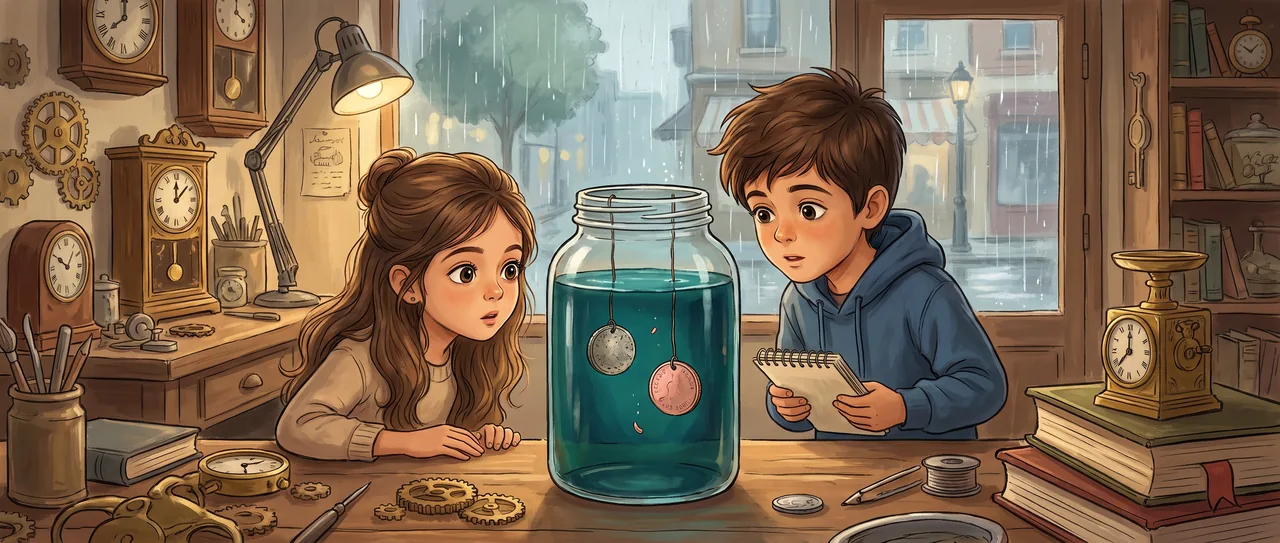
The jar sat at the end of the bench. It was the blue-green of a swimming pool photographed in a dream, and two wires went down into it, one clipped to a little battery box, the other to something Maya couldn't see under the surface.
"What's in it?" she asked.
"A copy being made," Petrasek said, still not looking up. "Slowest photocopier in the world. Leave it alone."
Maya leaned over the jar. Soren leaned over the other side. In the liquid hung two objects on wires. One was an old coin, worn smooth, a face you could barely read. The other was a coin too, hanging beside it, and it was the wrong color, pinkish and raw, like something newly born.
"There's two coins," said Maya.
"There's one coin," said Petrasek. "And one that's becoming."
Maya looked at Soren. Soren was already looking at the pink one.
"It's growing," he said. "Slowly. That side's rougher than it was a second ago."
"You can't see it grow," Maya said.
"I can't see the minute hand move either," Soren said, nodding at the clocks all over the walls. "Doesn't mean it isn't."
Petrasek made a small pleased sound and finally pushed his visor down at them.
"The old coin is a mold, in a manner of speaking. It's got a mirror of itself pressed in wax, and the wax is painted so electricity likes it. That," he pointed a screwdriver at the pink one, "is what's collecting."
"Collecting what," said Maya.
"Copper."
"From where?"
Petrasek tapped the battery box. "From the water. The water's full of copper. Not chunks. Loose copper, atom by atom, floating around wanting somewhere to land. The battery makes one place friendly and one place unfriendly. Copper lands on the friendly one."
Soren went very quiet and then said, "One at a time?"
"One layer at a time," said Petrasek. "Skin after skin after skin. Faster than my minute hand. Slower than you'd like."
Maya crouched until her eyes were level with the jar, so the two coins hung against the blue-green like planets.
"So the new coin isn't shaped like the old one," she said slowly. "It's shaped like the space next to the old one."
"Say that again," said Soren.
"The copper doesn't know it's making a coin. It just lands wherever it's allowed. Every dent in the old one, the copper fills the dent. Every bump, it goes around the bump." She held her hands up, cupping something invisible. "It's not copying the picture. It's pressing itself into every single scratch. Even the ones too small to see."
Petrasek stopped arguing with the watch entirely.
"The forger's problem," he said, "is that a forger copies what he can see. This copies what nobody can see. Down to the fingernail marks of the man who struck the original two hundred years ago."
Maya stayed crouched. "How small do the scratches go?"
"Smaller than the scratches," said Soren, and everyone looked at him. "If it's landing one atom at a time, then the layer's one atom thick. So it can copy anything bigger than an atom. Which is basically everything."
The rain drummed. A dozen clocks disagreed about the time.
"There's a thing I read," Soren went on. "About circuit boards. The tiny copper lines in a phone. I read they're grown, not carved. I didn't get it." He looked at the pink coin. "They're grown like this. In a bath. Landing one layer at a time where the electricity says it's allowed."
"Same trick," said Petrasek. "Same trick that made every copper line in the machine in your pocket. Same trick they used in eighteen-forty-something to copy statues so museums a thousand miles apart could own the very same thing. Not a photo of it. It."
Maya stood up fast.
"Wait," she said. "Wait. If the copy has every scratch the original has. Every atom-sized scratch. Then which one's the real one?"
Nobody answered.
"No, actually," she said. "You can't tell. Can you. You'd need a scratch that's on one and not the other, and there isn't one, because it copied all of them."
Petrasek smiled, and it was not the smile of a man who was going to help her.
"That," he said, "is the question that got a lot of museum men very upset in the last century."
Soren was turning the idea over. "But the copy's copper and the original's silver. So you could tell by the metal."
"Fine," said Maya. "Plate the copper one in silver. Same trick. Land silver on it, one layer at a time, until the outside's silver too."
She said it and then heard herself say it and stopped.
"Then you couldn't tell," Soren said quietly. "Not from the outside. Not from any scratch. Not from the metal. You'd have two things that are the same all the way down to the atom, and one of them just happened first."
"One of them happened first," Maya repeated. "That's the only difference. Not what it is. Just when."
Petrasek pulled his visor back down over his eyes, done with them, happy.
"Now you understand why I said leave it alone," he said. "It's a philosophy machine. Bad for business."
Maya leaned back over the jar. The pink coin hung there in the blue-green, patient, gathering itself out of the water one skin at a time, becoming something already ancient before it had finished being new.
Soren took his notebook out of his coat and stood there with it open, not writing yet, watching the two coins hang side by side in the light.
A single fleck rose off the pink coin, drifted, and settled back down.
Read the interactive version, listen to the narration, and earn a gold star →
A science-verified short story for curious kids · Curiosity Land