Fifty-Three Months
The video was old and cheap-looking, which was the first thing Soren liked about it.
He had found it while looking for something else. A university had put up years of rover footage from a canyon off the coast, camera after camera pointed at rock and water and nothing. Most people would click away. Soren opened the notes file first, the way he always did, and the notes file was where he found the number.
Fifty-three months on the same ledge. One animal.
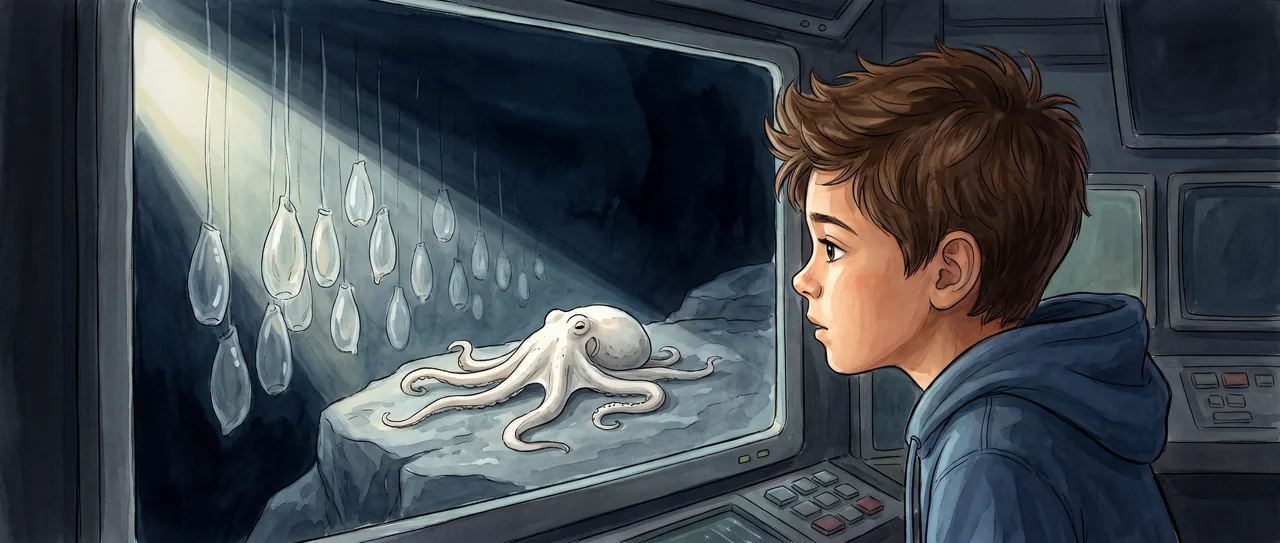
He scrolled to the first clip. There she was, a pale octopus the color of a peeled almond, pressed against an overhang thirteen hundred meters down. Under her body he could just make out the eggs, hanging in rows like tiny glass teardrops. She had her arms curled over them. The timestamp in the corner said April.
The clip was two minutes long. She did almost nothing. She breathed. Once, she lifted an arm and let water move through the eggs, then set the arm back down.
Soren clicked the next clip. Same ledge. The timestamp said the next month.
He understood that he was supposed to skip ahead. That was what the footage was for, probably, so a scientist could jump from month to month and measure how things changed. But skipping felt wrong, like reading the last page. So he watched them in order.
Month by month, the water stayed cold. He looked it up. About three degrees down there, barely above freezing, dark enough that the rover had to bring its own light. The eggs got a little bigger. The rows got clearer. Inside a few of them, near the top clips, he thought he could see something folded and waiting.
And the octopus got paler.
He almost missed it because it happened so slowly. But he had watched the first clip maybe six times before he moved on, and he knew what she looked like on the first day. Now her skin had gone from almond to bone. Her eyes seemed to sink back into her head. Her arms, which had been round and full, looked thinner where they crossed the eggs.
Soren stopped the video.
He went back to the notes file and read the whole thing this time. The scientists had come back to this ledge over and over across four and a half years. Every visit, the same octopus. Every visit, the same eggs, further along. And every visit, she had not moved and she had not eaten. They never once saw her leave to hunt. They never saw her take the crabs they left nearby.
Four and a half years without eating. He sat with that. He tried to imagine one day without eating, and could not really do it past dinnertime.
She was not sick. Nothing was hunting her. She was doing the thing on purpose, if purpose was even the right word for something that far down. She was staying.
He reached for the notebook on the desk and wrote the number thirteen hundred, and then the word cold, and then he stopped writing because his hand did not know what came next.
Soren went back to the clips. Now that he knew, he could not unsee it. Each month she spent herself a little more. She was not being worn away by the water or the dark. She was being spent by the eggs. Everything she had was going into keeping them clean, keeping them moving, keeping the water fresh over them so they would not rot or suffocate in the still cold. Her body was the only weather those eggs would ever get.
He thought about how long four and a half years was. He had been in second grade four and a half years ago. He had learned to ride a bike and lost teeth and moved houses and gotten a scar on his knee that was now old and white. A whole slab of his life. And the entire time, in the dark under all that water, this one animal had not moved off her rock.
He watched the light come on in each clip and thought about how she had seen that light dozens of times, the rover arriving out of the black, a bright rude visitor, and she had never flinched away. She had a thing to guard. The light did not matter next to the thing.
Soren scrolled toward the last clips.
The timestamp said the final autumn. The rover light came up. He leaned in close to the screen without deciding to.
The eggs were different. They hung slack now, most of them, the way a coat hangs when the person has stepped out of it. Empty cases. Somewhere in the black around the ledge, hundreds of tiny octopuses were drifting off into the water, each one already able to hunt, already carrying everything she had spent to make.
And the octopus was gone from the overhang.
Not exactly gone. He found her at the bottom of the frame, loose against the rock, pale as paper, her arms no longer curled around anything. She had lasted exactly as long as they had needed her. Not one month less. She had timed the whole four and a half years of her one body to end at the same moment they began.
Soren did not click away.
He played the last clip again from the start, and this time he was not watching her. He was watching the empty egg cases, and the dark beyond them, where the water went on and on with no light in it at all. Somewhere out there the small ones were spreading into a canyon so big and so cold that a person could put every year of their life into it and it would not notice.
He thought about the scientists who had come back, again and again, across almost five years, just to look at one ledge. Just to make sure they were there when it finished. He thought that most people would find that a strange way to spend your time. Coming back to the same dark rock to watch an animal do almost nothing.
He did not find it strange. He found it like the only sensible thing anyone had ever done.
He wrote the number fifty-three in the notebook, and under it, hatched, and he pressed the pen a little harder than he meant to on the second word.
The clip ran to its end. The rover light held for one more second on the empty cases, swaying very slightly in a current he could not see, and then the footage cut to black and the little counter said there were no more clips.
Soren opened the notes file again, found the coordinates of the ledge, and started copying them down.
Read the interactive version, listen to the narration, and earn a gold star →
A science-verified short story for curious kids · Curiosity Land