The Wet Batch
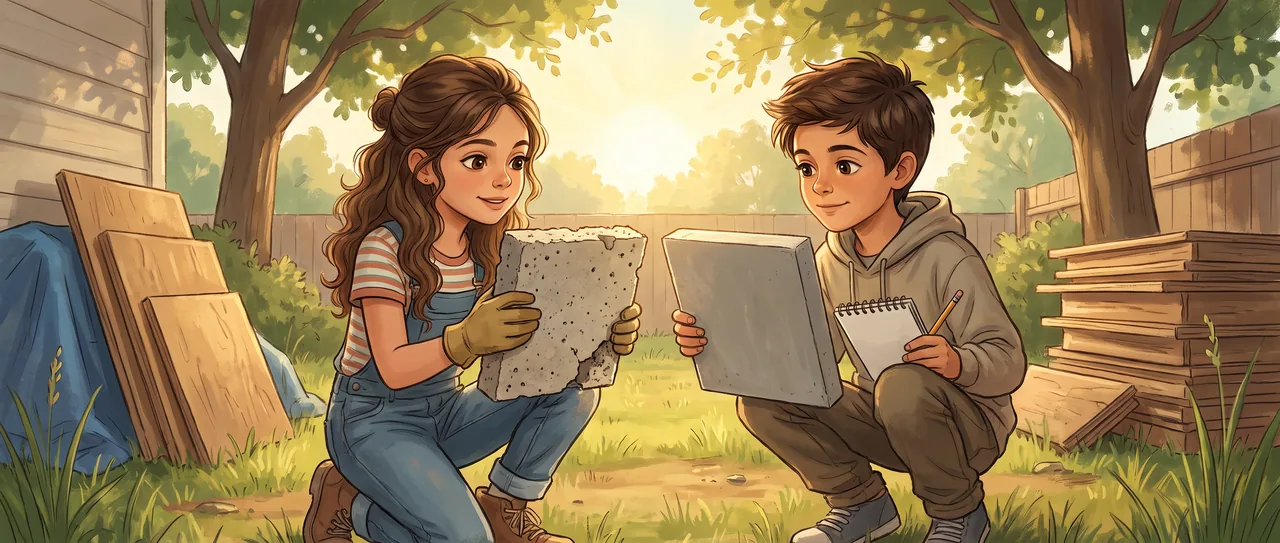
The first slab came out perfect. The second one crumbled at the corner when Soren tapped it with a screwdriver.
"Same bag," Maya said. "Same cement. Same everything."
"Not same everything." Soren was crouched over the two forms they had built out of scrap plywood. The telescope mount needed a heavy base, heavy enough that wind wouldn't wobble the view, so they had mixed two batches over two afternoons. "The second one was easier to pour. Remember? It went smooth like pancake batter."
"Because I added more water."
"You added more water."
"It was too stiff the first day. My arms were dead from stirring." Maya knocked on the good slab. It gave back a hard, flat sound, like a plate. Then she knocked on the crumbly one. It answered soft and dead, like knocking on a stale loaf. "Why would more water make it weaker? Water isn't in it. It dried out."
"That's the thing." Soren pressed his thumbnail into the bad corner and a little grit came away. "It dried out, but where did the water go?"
"Into the air."
"And what's left where the water was?"
Maya stopped. She looked at the crumbly corner, at the tiny holes in it, holes so small they were almost just a roughness. "Gaps," she said. "The water left gaps."
"Little tunnels." Soren tilted the piece toward the light. The good slab was smooth and closed. The bad one was full of pinprick shadows. "Every drop of extra water you poured in had to leave sometime. When it left, it left a hole behind. More water, more holes."
"And holes are just missing concrete." Maya took the piece from him and squeezed. A flake came off in her palm. "So it's not that water makes it weak. It's that water leaves."
Soren wrote three lines in his notebook, the pencil scratching. He turned the crumbly piece over while he did it, looking at the underside.
"But the cement's the glue," Maya went on, faster now. "The cement needs some water to turn hard. It's not drying like paint, it's a reaction, right? The water changes it."
"Right. So there's an amount it actually uses. And everything past that just goes in wet and comes out as air." Soren held the two slabs side by side. "We didn't make it wetter. We made it emptier."
Maya laughed, delighted. "We made a rock full of nothing."
They sat with that for a second. A breeze came through and moved the tarp. The good slab would hold the mount. The bad one was going in the trash. But Maya wasn't looking at either of them anymore.
"Then how," she said slowly, "do the Roman ones still work?"
"What Roman ones?"
"The harbors. The ones in the ocean. My uncle sent me a video. There are Roman piers that have been sitting in seawater for two thousand years and they're getting stronger. Not crumbling. Stronger. And we can't even keep a highway bridge up for fifty."
Soren put down his pencil. "Seawater should be the worst. Salt wrecks concrete. It gets into the little holes and cracks them open."
"Unless the holes aren't the same." Maya was staring at nothing on the fence. "Ours are just empty. Just air where the water left. But what if theirs got filled back in?"
"Filled in with what?"
"With whatever's around. Seawater's got stuff dissolved in it. And they mixed in volcanic ash, the video said. Ash and lime and seawater." She turned to him. "What if the seawater keeps reacting with the ash? For years. For centuries. What if the salt water going into the holes doesn't crack them, it grows new crystals in them?"
Soren was quiet, working it. "So the water isn't the enemy."
"The water's part of the recipe. It never stops mixing. It's a slow, wet thing that's still mixing right now, today, in the ocean, in a pier some Roman guy poured before there were cars." Maya's hands were open in front of her like she was holding it. "Ours died the second it dried. Theirs is still alive."
"That's not really alive."
"You know what I mean. Still changing. Still going." She pointed at the crumbly slab. "We tried to get the water out fast. They let it stay and do the work."
Soren picked up the good slab, the closed one, the one they had sweated over with stiff, barely-wet mix. It was heavy in a solid way, no shadows in it, nothing missing. "So the harder we worked stirring, the less water we needed, the fewer holes we left."
"The dead arms were the point," Maya said.
"The dead arms were the point." He almost smiled. Then he stopped. "But the Romans didn't stir harder than us. They used more seawater, not less. They did the opposite of what we just proved."
Maya sat back on her heels. The two rules would not fit in the same hand. Less water, stronger, that was theirs. More water forever, stronger, that was Rome. Both slabs sat there in the grass being true.
"So there's two ways," she said finally. "Get the water out and lock it shut. Or let the water stay in and never stop building." She looked at the crumbly corner again, at the little tunnels going down into the dark of it. "And nobody alive has seen the end of the second one. It's still going. Whatever it turns into, it hasn't turned into it yet."
Soren opened his notebook again. He drew the two slabs. Under the crumbly one he wrote a word. Under the Roman one he left the space empty, because the answer to that one had not happened yet, and would not, for a very long time, with or without them.
He closed the cover on the empty line and set the good slab in the sun to finish.
Read the interactive version, listen to the narration, and earn a gold star →
A science-verified short story for curious kids · Curiosity Land