The Sound of Something That Wasn't There
The reel was labeled in pencil. September fourteen, and a year, and under that one word: nothing.
"Nothing," Soren read. "Why would someone save a tape of nothing?"
"Play it," said Maya.
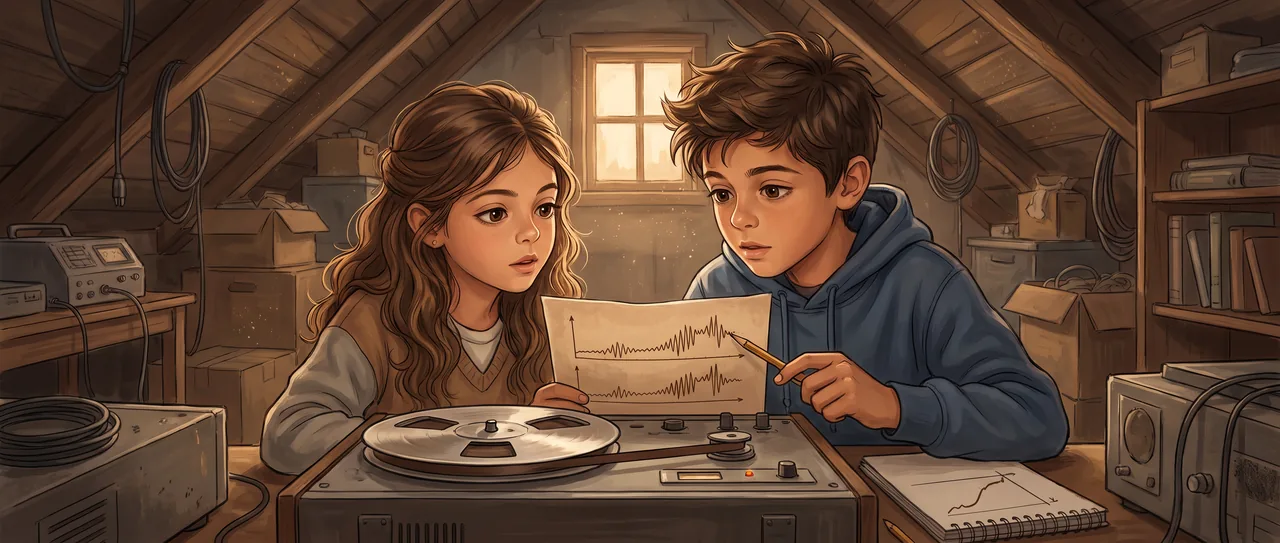
They were up in the attic of the little radio station because Maya's aunt ran the place and had said, if you two want to be useful, sort the old reels. Most of them were church bells and interviews with people about tomatoes. This one was thin and gray and someone had cared enough to write on it.
Soren threaded it. The speaker gave them a soft hiss, the sound a room makes when it is trying to be quiet.
"That's it?" he said.
"Wait."
And inside the hiss, near the end, there was a chirp. Up. A little sweep upward, faster and faster, and then it stopped. Less than a second. Like a bird that started a word and thought better of it.
"Play it again," said Maya.
He did. Same chirp. Rising, quickening, gone.
"That's not a bird," Soren said. "Birds don't speed up like that. That gets faster right at the end. Like something running out."
"Or falling in," said Maya. She wasn't sure why she said it. Soren pulled his notebook out and wrote the shape of it, a line curving up and steepening. "Whoever recorded this labeled it nothing on purpose. You don't write nothing about a bird."
"You write nothing," said Maya slowly, "when the whole point is that there shouldn't be anything."
They found a paper sleeve wedged behind the reel. Inside was a printout, a photocopy of a photocopy, the ink gone brown. A graph. The same rising wiggle Soren had drawn, except there were two of them, one over the other, almost the same but not quite.
"Two," said Soren. "Two copies of the same tiny sound."
"Two microphones?"
"Then why keep both if they match?"
Maya put her finger on the two lines. "They don't match. Look. This one starts a hair before that one."
Soren leaned in. She was right. The top wiggle happened, and then a whisker of a moment later, the bottom wiggle did the same thing.
"Two ears," he said. "Something arrived at one ear before the other."
"So it came from a direction."
"So it came from somewhere."
They sat with that. The hiss played on, the room being quiet again.
At the bottom of the printout there was typing, faint. Maya read it out loud. "Strain. Times ten to the minus twenty-one."
"What's strain?"
"Stretch," said Maya. "When you pull something and it gets longer. Strain is how much longer, compared to how long it was."
Soren wrote the number down and counted the zeros and then stopped counting. "Maya. Ten to the minus twenty-one. That's a decimal point and then twenty zeros and then a one."
"Stretch of what, though? What got stretched that little?"
He looked at the word again. Strain. Then he looked around the attic, the beams, the floor, his own two hands. "It doesn't say a rod. Or a wire. It's just strain." He tapped the floorboard. "What if it isn't the machine that stretched."
"Say it."
"What if the machine held still and the space stretched. The distance itself. Like the room got very slightly longer and then very slightly shorter, and the machine just noticed."
Maya went quiet, and then she wasn't quiet. "That chirp. The rising. Two things going around each other, faster and faster, closer and closer, until." She stopped. "Until they finished. And the finishing made the room breathe."
"How big were they, to breathe a room from far away?"
"Far how far?"
Soren turned the printout over. On the back, in the same brown ink, one line. He read it twice before he said it, because he wanted to be sure his mouth would work.
"One point three billion light years."
The hiss kept going. Outside the little attic window a pigeon actually did chirp, a fat ordinary sound, and it was almost rude how solid it was.
"Say that in a way I can hold," said Maya.
"I can't," said Soren, and he sounded happy about it. "A light year is how far light goes in a year. Light goes around the whole Earth seven times in one second. And this took one point three billion years to get here. It left before there were animals. It left before there were plants on land. It's been crossing empty space this whole time, this one little push, getting quieter and quieter, and it went through the Earth."
"Through it. Not around."
"There's nothing that stops it. It stretched the whole planet. By less than the width of a proton. Less than a thousandth of the width of a proton." He put his pencil flat on the floor. "We're smaller than that stretch by so much we don't even have a word."
Maya was looking at the reel going around and around. "And somebody built an ear patient enough to feel it."
"Somebody who nobody believed, probably," said Soren. "You'd have to be the kind of person who keeps measuring after everyone tells you there's nothing there."
Maya smiled at that, but she wasn't really listening to him now, she was listening to the tape.
"Play the chirp once more," she said.
He rewound. The hiss. Then the small rising sweep, faster, faster, gone.
"That's the last thing they ever did," Maya said. "Those two. Whatever they were. That sound is the last second of them touching, and it's the only thing left, and it came all this way, and it went through us, and it kept going."
"It's still going," said Soren. "Right now it's already way past us. It's out past the far stars. It never stops. It just gets fainter."
"So somewhere ahead of it, someday, something else is going to feel our floorboards stretch." Maya pressed the button and the chirp rose one more time. "Except they'll call it nothing too."
Soren didn't write anything for a moment. He held the pencil over the page and listened to the room being quiet, and thought about how the quiet had never once been empty, not for one point three billion years.
Then he wrote, small, at the bottom, under the rising line: it went through us and we felt it.
Maya rewound the tape to the start, so the chirp was waiting, and let it play again.
Read the interactive version, listen to the narration, and earn a gold star →
A science-verified short story for curious kids · Curiosity Land