The Shortest Way to Say It
The library closed at eight, but the coding club got the back room until nine, and by eight forty the only people left were Soren and a volunteer named Petra who kept looking at the clock.
"You can leave the cards out," Petra said. "Somebody will deal with them tomorrow."
But Soren was already sorting them. They were memory cards, the flip-and-match kind, and someone had spilled a whole stack of number cards among them. Long numbers, printed one per card. He was putting them in order because unordered things bothered him the way a crooked picture bothers some people.
"Here's a game," Petra said, trying to speed him up. "I read you a number, you memorize it. Winner remembers the longest one."
Soren looked up. "That's not fair. Some numbers are easy."
"A number's a number."
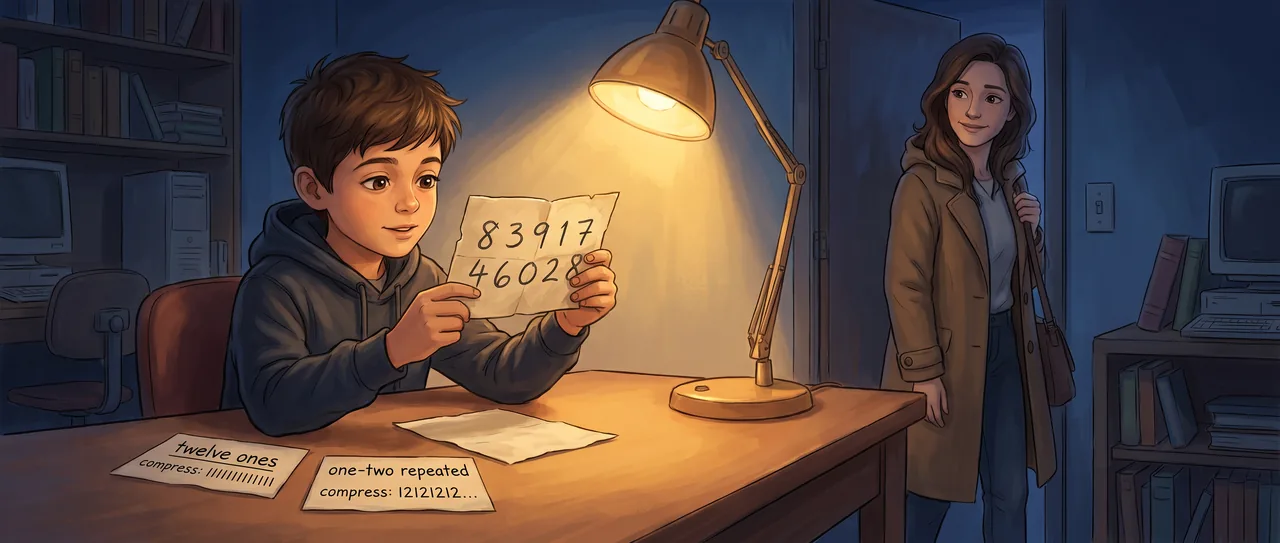
He held up a card. It read one one one one one one one one, twelve ones in a row. "This one I already know. Twelve ones. I don't have to remember twelve things. I have to remember two things. One, and twelve."
Petra shrugged, unimpressed, and reached for her coat.
He held up another card. This one said one two one two one two one two. "Same. One-two, six times. Two ideas." He put it down and picked up a third. "But this one."
The third card was long. Eight three nine one seven four six oh two eight. He stared at it. There was no trick in it. No repeat, no count-up, no pattern he could grab. To keep it he would have to keep all of it.
"So memorize it," said Petra.
"That's what I mean." He set the three cards in a row on the table. "These two are long but they're small. This one is short but it's big."
Petra stopped with one arm in her coat. "Say that again."
He did not say it again. He was looking at the cards. The first two, he could describe in a sentence and someone across the room could rebuild them perfectly. Print one twelve times. Print one-two six times. The instructions were shorter than the number. But the third card, the messy one, there was no sentence shorter than the number itself. To tell someone the number he would just have to read them the number. The shortest way to say it was to say all of it.
He pulled the club laptop over and opened the little coding window they used for exercises. He typed a program that printed the first card. It was tiny. He typed one that printed the second card. Also tiny. Then he tried to write one that printed the third card in fewer characters than the card itself.
He couldn't. Every version just printed the digits out one by one. The program was as long as the number, plus the word print.
"Petra. Come look."
She came. "The size of a number isn't how many digits it has," he said. "It's how short you can make the instructions. The first two are big on the outside and small on the inside. This one's the same size on the outside and inside. You can't squeeze it. There's nothing to squeeze."
"So it's just random," Petra said.
"That's what random means." He said it slowly, like he was hearing the definition for the first time from his own mouth. "Random means there's no shorter way to say it. That's the whole thing. Random isn't messy. Random is a number that already is its own shortest description."
Petra sat back down. Her coat was still half on. "Okay," she said. "That's actually a little bit interesting."
Soren reached for his notebook and drew three cards on the page, and under two of them he wrote a short instruction, and under the third he wrote nothing, because there was nothing shorter to write.
Then he stopped, because a thought had arrived that made the back room feel bigger than it was.
He fanned out the whole spilled stack. Forty, maybe fifty number cards. Some had patterns. Most did not. He tried to picture writing the shortest program for each one. For the patterned ones, a snippet. For the rest, the whole number copied out, no savings, no shortcut.
"Most numbers are like the third card," he said. "Aren't they. Most numbers you can't shrink at all."
"I don't know," Petra said. "Are they?"
He thought about it. There were only so many short programs. A short program is itself just a short string of characters, and there are only so many short strings. But there is no limit to how many long numbers exist. So the short descriptions run out. There are way more numbers than there are short ways to describe them. Which meant that almost every number in the world was like the messy card. Uncompressible. Its own shortest self.
"The patterns are the rare ones," he said. "The ones we can write short programs for. Twelve ones. Count-up-by-twos. Those are the special ones. They just look ordinary to us because those are the only ones we ever bother to talk about."
Petra looked at the stack of cards a long time. "So the numbers we have names for," she said, "and the numbers in our textbooks. Those are all the squeezable ones."
"They have to be. You can only put a number in a book if there's a short way to say it. A book isn't big enough to hold the other kind." He looked at the third card again, the eight three nine one, the one that could only be itself. "Almost every number that exists has never been written down anywhere and never will be. Because the only way to write one down is to write the whole thing out, and there are too many, and they're too long, and there was never a shorter way."
The clock said eight fifty-eight. Neither of them moved to leave.
Soren picked up the messy card and held it under the desk lamp, turning it, as if somewhere on it there might be a seam where it could be folded smaller.
There wasn't. He set it down on top of the stack, the one number in the room that was exactly as large as itself, and slid the whole pile toward the middle of the table where tomorrow someone would find it.
Read the interactive version, listen to the narration, and earn a gold star →
A science-verified short story for curious kids · Curiosity Land