The Sea That Left
The tide gauge on the pier had a needle that scratched a slow line onto a paper drum, and Maya liked to watch it because it was the only thing on the whole waterfront moving as slowly as she wanted to.
Her aunt was two hundred meters back, stacking crates of ice onto a truck, calling numbers to a man with a clipboard. The pier smelled of salt and diesel and the sweetish rot of seaweed drying on the pilings. Maya sat with her feet hanging over the water and waited for the boredom to become something else, because it usually did.
The needle jumped.
Not a wiggle. A climb. The line that had been crawling flat for an hour tipped up the drum, then dove down, then climbed again, drawing a shape like a long slow breath. Maya put her thumbnail on the paper and followed it.
Then the sea did the thing.
It left.
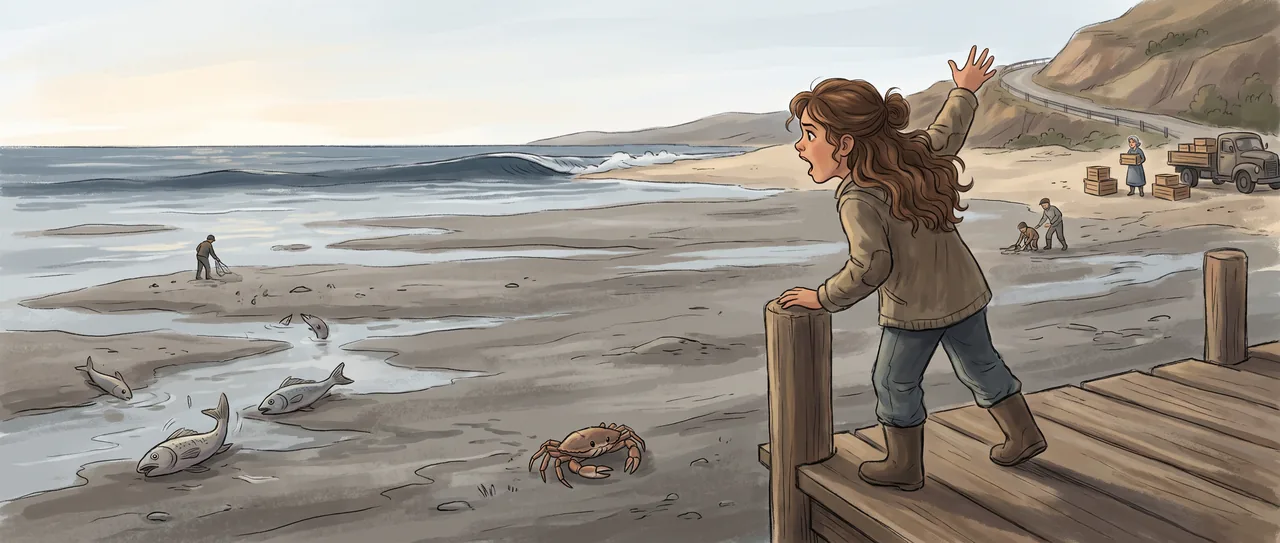
The water under her feet pulled back the way bathwater pulls when you open the drain, except it did not swirl, it just went, sliding out past the pilings, past the mussel line, past the green slick, down and down until the mud showed. Fish flapped in puddles. A crab walked sideways across sand that had been three meters underwater a minute ago. The smell changed, colder, older, the smell of the deep part that the sun never touched.
Down the beach, kids were laughing. Someone shouted about free fish. People walked out onto the wet mud, bending to grab flopping snappers, pointing their phones at the crab.
Maya did not go down to the fish.
Something about it sat wrong, the way a word sits wrong when it is spelled almost right. The sea does not leave. Tides leave, but tides leave slowly, over hours, she had watched the needle draw them, they were the slowest thing here. This had happened in the time it took her aunt to stack four crates.
She looked at the paper drum. The needle had drawn one long dip, a valley, and now it was starting to climb the other side.
A valley. A trough.
Maya knew about waves because she had spent a whole summer in the bathtub with her mother sighing outside the door. A wave was not water moving forward. She had proved it with a cork. The cork bobbed up and down and stayed put while the wave went through it. The water did not travel. The shape traveled. The energy traveled.
And a wave had two parts. A crest, which was the water piled high. And a trough, which was the water pulled low. Sometimes the trough came first.
If the trough had already passed her, if the sea had left because the low part of a wave had arrived, then the wave was not gone.
The wave was still coming. The high part had not gotten here yet.
She stood up. Her legs felt strange, too light. Out past the exposed mud, past where the water used to end, the horizon had a line on it. Not a wall. Not yet. Just a line, darker than the sea around it, and wide, wider than any boat, wide as the whole bay, and it was not where the water met the sky, it was closer than that, and it was moving.
Here was the thing that made her stomach drop before her brain caught up: it did not look tall. It looked almost flat. A ship out there would not even feel it. And it was coming very, very fast, faster than anything on the water should move, faster than her aunt's truck, and the far parts of the bay where the water was deep it stayed low and quick, but where it reached the shallow shelf near the beach the front of it began to stand up, to fold upward, because the bottom of the wave was dragging on the sea floor and the top was still racing and had nowhere to go but up.
Low and fast in the deep. Tall and slow in the shallow. Same water. Same energy. Just squeezed.
The kids on the mud were still laughing.
Maya did not scream a fact. There was no time to explain a cork or a trough or a shelf. She ran back up the pier, and she used the one word that was already true, the word the whole shape of the ocean was spelling out.
"UP!" she yelled. "Get up, get high, RUN UP!"
Her aunt turned with a crate still in her arms. Maya did not stop. She grabbed the sleeve of the man with the clipboard and pointed at the horizon line, and she saw the exact moment he saw it too, saw his face change from a person humoring a child to a person doing arithmetic he did not want the answer to.
Then everyone was moving. The man dropped the clipboard and it fanned open on the deck. Her aunt let the crate fall, ice skidding everywhere, and grabbed Maya's hand, and they were running for the hill road, and behind them the whole waterfront was running, the fish-catchers scrambling off the mud, someone carrying a toddler, someone shouting the same word Maya had shouted, up, up, up, until it stopped being one voice and became all of them.
They reached the switchback above the church and stopped because they could not run anymore, and Maya turned around.
The bay was filling. Not crashing, not yet, just rising, the sea coming back all at once and higher than it had ever been, swallowing the mud and the pilings and the pier where the tide gauge stood, lifting the empty truck sideways like it weighed nothing, pushing brown water up the streets where crates bobbed and turned.
Below her, the tide gauge went under. She thought about the paper drum still turning inside it in the dark, the needle drawing the last of the shape she had read, one long low valley and then the mountain, the whole thing spelled out in a line before any of it arrived.
Maya's aunt was holding her so tightly it hurt, and saying her name over and over, and asking how, how did you know, how.
Maya watched the water find its level in the ruined street. Out past the drowned pier, the horizon had gone flat and blue and ordinary again, and somewhere under it, invisible and enormous and quiet, the next low part was already on its way.
Read the interactive version, listen to the narration, and earn a gold star →
A science-verified short story for curious kids · Curiosity Land