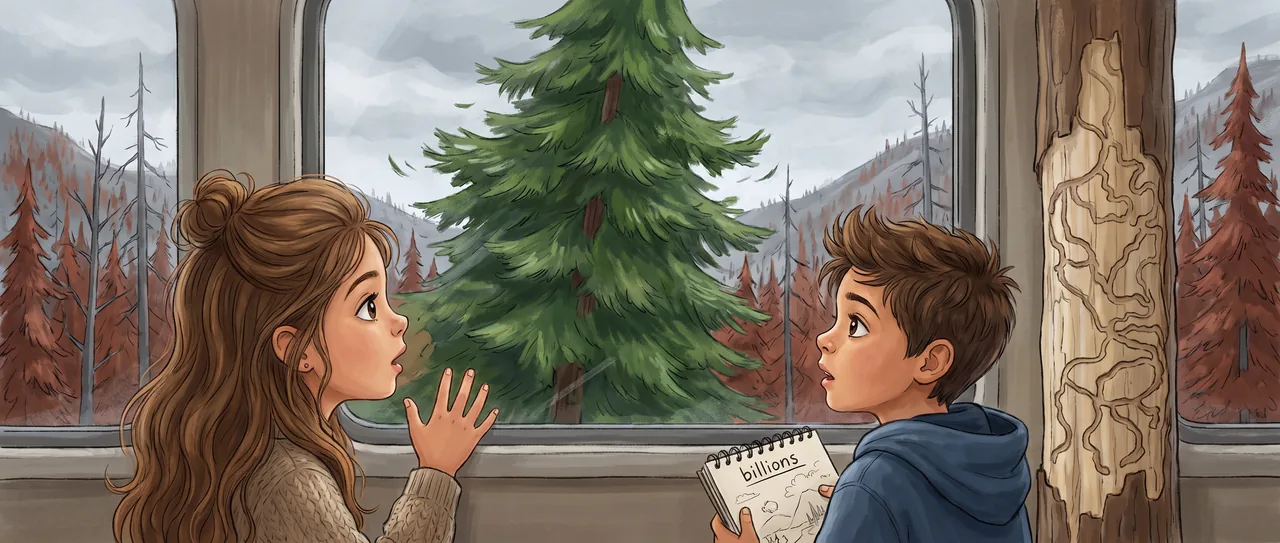
The Red Forest
The forest had turned the wrong color, and no one on the train seemed to care.
Maya had her forehead against the glass. Outside, the mountains rolled past covered in trees, except the trees were the color of an old penny. Not autumn red. Autumn came and went in a week. This red had been sitting here for years, mile after mile, whole slopes of it, so much red that the green trees looked like the strange ones.
"It's not fall," she said. "Those are pine trees. Pines don't do that."
Soren looked up from his notebook. He had been drawing the shape of the valley. He looked at the red and then at the green and then at the red again.
"They're dead," he said. "That whole side is dead."
An old man across the aisle heard them. He had a thermos of coffee and the look of someone who had ridden this train many times.
"Beetles," he said. "Little things. Smaller than a grain of rice. Been at it for twenty years." He said it the way you'd talk about weather. Then he went back to his window and did not explain, because to him there was nothing left to explain. It was just what the mountains looked like now.
Maya turned back to the glass. Smaller than a grain of rice. She tried to fit that against what she was seeing, which was a dead forest bigger than some countries, and the two things would not fit.
"That doesn't work," she said quietly.
"Which part."
"A bug that small. There aren't enough of them. You'd need billions."
Soren wrote billions and put a question mark after it. "Then there are billions," he said. "Something let there be billions."
The train slowed for a curve. Up close now, Maya could see the dead trees had no needles left, just gray branches with red bark, and under the bark, where a strip had peeled loose on one trunk near the tracks, there were lines. Winding tunnels carved into the wood like a map of rivers seen from space.
"Look at the peeled one," she said. "The wood. It's written on."
Soren looked. The tunnels forked and forked again. Each fork was a place a beetle had turned.
"That's every tunnel from every beetle in one tree," he said. "In one tree."
They were both quiet, doing the arithmetic they couldn't finish. One tree, that many tunnels. This many trees, all the way to where the mountains met the sky.
"Why now, though," Maya said. "Beetles were always here. The trees were always here. Why did it break now."
The old man had been listening again. "Cold used to kill them," he said. "Forty below, a good hard winter, kills the young ones in the bark. We don't get those winters much anymore." He shrugged, one shoulder. "Warm winter, they all live. Then there's more of them. Then more trees, then more of them." He tipped his thermos toward the window. "That's twenty warm winters right there."
He said it and let it go. But Maya caught it and would not let it go, because it had a shape she recognized, the worst and best shape, the shape of something feeding itself.
"More beetles kill more trees, and more dead trees means more beetles," she said. "It goes up. It keeps going up on its own."
"Until it runs out of trees," Soren said. He wrote it down. Then he stopped writing and looked at the red slopes with a different face. "Maya. The trees."
"What about them."
"A tree that's alive pulls carbon out of the air. That's the whole thing trees do. That's why people plant them." He tapped the window against the red. "These aren't pulling anything out. They're dead. They rot, and the beetles chew them, and all the carbon that whole forest spent a hundred years breathing in." He didn't finish it out loud.
"It goes back out," Maya said.
Soren nodded slowly. "The forest was on the good side. It was taking carbon out of the sky for us. And it flipped. This whole thing is breathing the wrong way now."
Maya put her hand flat on the cold glass without meaning to. A forest she could not see the end of, that used to help, that used to hold its breath for a hundred years so the air stayed livable, and it had turned around. Because of a bug the size of a rice grain. Because of a few degrees in January. Because winter got tired.
"That's the part," she said. "That's the part that doesn't fit and it's true anyway." Her voice went small. "Something that small. Something that little as a temperature. And you get this."
The old man was watching them now, both of them, with something that wasn't quite a smile.
"Most people just see the pretty red," he said. "You two are the first ones on this whole train to ask what it means."
Maya barely heard him. She was looking at the green trees scattered through the red, the ones still alive, still breathing in, still on the good side, standing there in ones and twos like the last people awake in a sleeping house.
"Some are still green," she said. "Why those."
"Nobody's sure," the old man said, and for the first time he sounded interested instead of tired. "Some of them the beetles skip. Some fight back with sap. Some folks think a few just have something in them the others don't. Scientists are still crawling around out there trying to figure out which green ones are the tough ones." He looked out the window with her. "If you could find that out. Which ones. Why." He didn't finish either.
Maya kept her eyes on one green tree standing alone in a sea of red, getting closer, filling the window, and she thought about somebody someday learning to read the difference, tree by tree, and planting whole mountains of only the green kind that winter couldn't warm out of.
Soren had stopped writing. He was watching the same tree.
The train pulled level with it. For one second the green tree filled the whole window, close enough to see its needles moving, and then the red closed over it again, and it was gone behind them.
Read the interactive version, listen to the narration, and earn a gold star →
A science-verified short story for curious kids · Curiosity Land