The Oysters That Wouldn't Close
The tank of larvae was supposed to hum with life. Instead it sat quiet under the blue lights, and Maya's aunt kept checking the same numbers on the same screen like they might change if she looked hard enough.
"Fourth batch this month," Aunt Reyes said. "They hatch fine. Then day two, day three, they just stop building."
"Building what?" Soren asked.
"Shells. A baby oyster spends its first days making a shell out of the water around it. Pulls the ingredients right out of the sea. If it can't build fast enough, it can't feed, and it starves inside two days."
She went to answer a phone that had been ringing for a while. Maya put her face close to the glass.
The larvae were there. She could see them, tiny pale specks drifting. But they drifted wrong. They were not the busy dots she had watched last summer, spinning and swimming. These barely moved.
"They look tired," she said.
"They're microscopic," Soren said. "They can't look tired."
"They look tired."
Soren pulled his notebook from his jacket and copied down the numbers from the screen while they were still up. Water temperature. Salinity. Something called pH, which sat at seven point six. He didn't know what it should be. He wrote it anyway.
They found the hatchery's old logbooks in a cabinet, years of them, handwritten before the screens. Soren ran his finger down the pH column, page after page, back and back.
"It used to be higher," he said. "Eight point one. Eight point two. Every year a little lower." He flipped forward again. "It goes down when the wind comes from the sea for a few days. Aunt Reyes wrote it here. Upwelling."
"What's upwelling?"
"Deep water coming up to the top. She underlined it. The bad batches all line up with it."
Maya thought about the specks that drifted wrong. Deep water. Old water. Water that had been down in the dark a long time before the wind pulled it up to where the babies were trying to build.
"What's in deep water that isn't in the top?" she asked.
Soren didn't know. So they did the thing Aunt Reyes had shown them the first day, when she was teaching them to test the tanks. They took a sample of the hatchery water, the water the larvae were dying in, and Maya breathed into it through a straw. Long slow breaths, the way you fog a window.
The indicator drops went from blue toward green toward a tired yellow-green. The number on the meter slid down. Seven point six. Seven point four.
"That's just my breath," Maya said.
"That's carbon dioxide," Soren said. He was looking at the meter and not at her. "Your breath is full of it. It goes into the water and the water gets more acid. Same direction as the logbook."
Maya sat back. Her breath. Just carbon dioxide, the plain gas that came out of everyone, all day, without thinking. It had turned the water sour enough to move the needle.
"Then the deep water," she said slowly. "It's full of it too. Because everything down there has been breathing and rotting and sinking for years with no way to let the gas back out."
"And the sky's putting more in from the top," Soren said. He had found it in one of Aunt Reyes's newer notes, a printed sheet tucked in the logbook. He read it out. "The ocean takes in about a quarter of the carbon dioxide people put in the air. It's been doing it for two hundred years."
Maya looked at the quiet tank. Two hundred years of extra breath, sinking in.
"So the babies aren't tired," she said. "The water's fighting them."
Soren wanted the mechanism. He always wanted the mechanism. He read further down the sheet, and then he read it again to be sure, and then he said it out loud carefully.
"The shell is calcium carbonate. To build it the larva needs carbonate out of the water, little pieces of it floating around. But when carbon dioxide dissolves in, it grabs those pieces and changes them into something else. It doesn't make the water dangerous to touch. It just eats the building blocks. So the babies reach out for the pieces to make their shells, and the pieces aren't there anymore."
Maya pressed her lips together. "They're trying to build. And the bricks keep dissolving before they can lay them."
"On day two," Soren said. "Right when they need them most."
They sat with that. Outside, the wind was coming off the sea again, the wind Aunt Reyes had underlined.
Here was the part Maya couldn't put down. The logbook only went back forty years, but the printed sheet went back much further, into rock and ice, into the record scientists read like tree rings. And it said this: the water had gone sour before, over ages, over slow deep time. But never this fast. What was happening in the tank right now was happening ten times faster than any of it. Faster than the record had ever seen. So fast that nothing in the sea had lived through a change like it before, and no one could turn the page ahead to see how the story went, because the page had not been written by anything, ever.
"Nobody knows what happens next," she said. "Not even the rocks know."
Aunt Reyes came back in, phone finally quiet. She saw the logbook open, the straw, the meter reading seven point four, Soren's notebook covered in the dates that matched.
"You found the upwelling," she said softly. It was not a question.
"We found what's in it," Maya said.
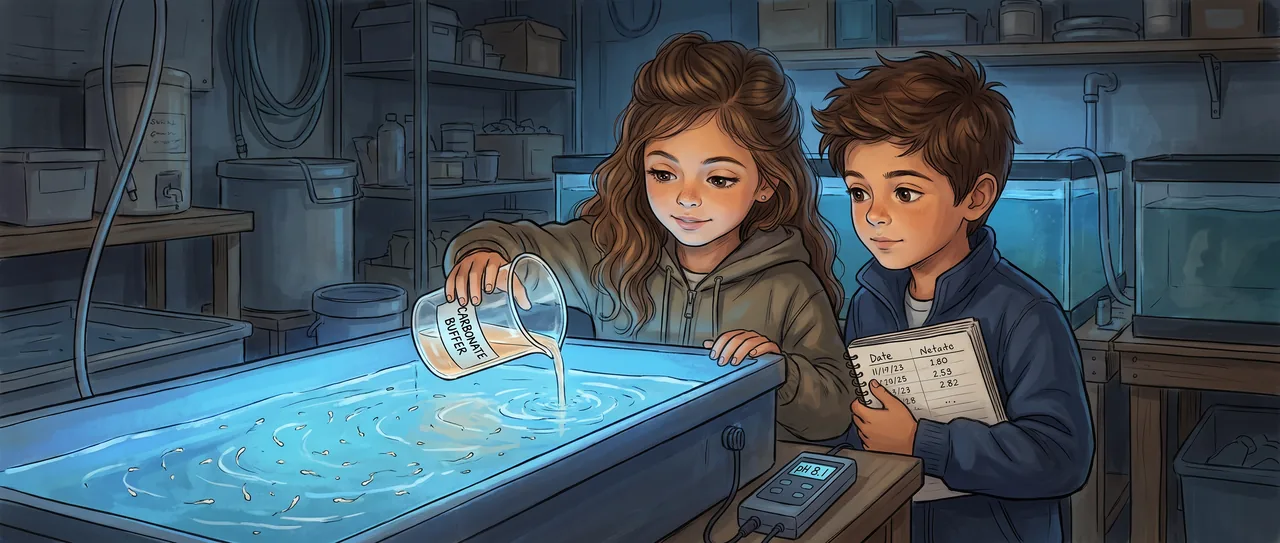
Aunt Reyes looked at the tank for a long moment. "There are hatcheries up the coast that buffer their water now. Add carbonate back. Give the babies their bricks." Maya was already at the sink, filling a clean beaker, reaching for the carbonate tin on the shelf. She measured a small spoonful into the water and stirred, and the meter needle lifted, seven point six, seven point eight, climbing back up toward the number the babies had been born expecting.
She carried the beaker to the tank and held it above the quiet drifting specks, and the specks began to spin.
Read the interactive version, listen to the narration, and earn a gold star →
A science-verified short story for curious kids · Curiosity Land