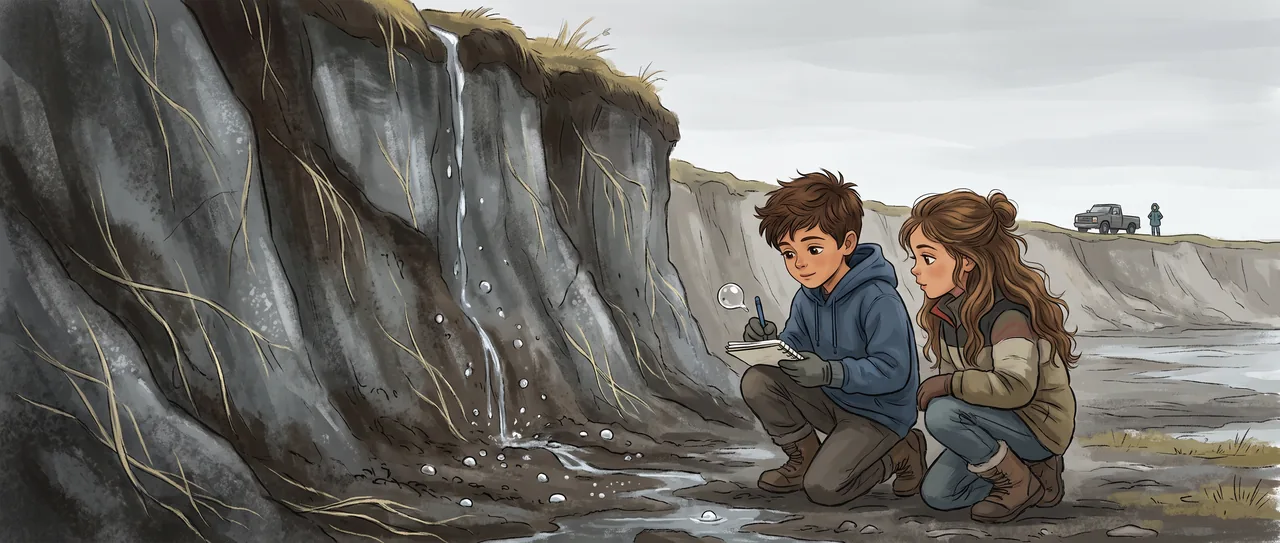
The Ground That Remembers
The mud smelled like a freezer that had been unplugged for a week.
"That is not a normal smell," Soren said. He was holding the plastic tube while Maya's aunt worked the corer down into the bank.
"That," said Aunt Del, not looking up, "is thirty thousand years old. Older than that." She grunted the corer free and slid out a cylinder of dark, sludgy soil laced with pale threads. "Grass. Real grass. From when this whole place was a plain full of mammoths."
Maya crouched at the cutbank. Where the river had chewed the tundra away, the ground showed its layers like a cake left too long in a cold room. Green and brown on top. Then gray. Then, low down, a wall of dirty ice you could knock on.
"It's ice," she said. "But it's not just ice. There's stuff in it."
"Yedoma," Del said. "Frozen ground with a lot of old plant in it. Been locked up since the mammoths. My job is to measure how fast it's unlocking." She checked her watch. "And my job, in about four minutes, is a phone call. Log the core. Don't fall in the river."
She walked off toward the truck with the satellite phone.
Soren set the core down and looked at the smelling mud. "Okay. Grass that's thirty thousand years old. Why does thirty-thousand-year-old grass still smell?"
"Because it never rotted," Maya said.
"Right. Frozen. So it just paused."
"It didn't finish," Maya said. She was staring at the wall of icy dirt. "When grass rots it turns into gas, mostly. That's what rotting is. But this grass got frozen before it could."
Soren opened his notebook and drew the layers, top to bottom, the pen catching on the cold paper. "So all of this is grass and moss and animals that started to rot and then just, what, held their breath. For thirty thousand years."
"Half-rotted," Maya said. "For thirty thousand years."
They looked at the cutbank. It went on down the river for what looked like a mile. The same layers. The same wall of ice with old life stuck in it.
Soren did something with his mouth that meant he was multiplying. "Del said the ground here holds more carbon than the sky does."
"Twice as much," Maya said. "She said twice as much as the whole atmosphere is down in the frozen ground."
"That can't be right."
"She said it twice."
Soren looked at the little core in his hand, then at the cutbank, then up at the sky, which was doing nothing, being just sky. "The sky looks like the big thing," he said slowly. "You look up and the sky is the big thing."
"But it isn't," Maya said. "The ground is the big thing. The ground is holding more than the sky."
Something shifted under Soren's boot. A trickle of meltwater ran down the face of the ice wall, and where it ran, the mud went soft and let out a small, wet burp.
They both went quiet and watched the bubble.
"That's the gas," Maya said. "That's the finishing. It waited thirty thousand years and now it's finishing."
"Because it thawed." Soren pressed his palm near the melting spot, then pulled it back and wiped it on his jeans. "It's warmer, so it thaws, so the grass finishes rotting, so it lets out the gas."
"And the gas is the warm kind," Maya said. "Methane. Carbon dioxide. The gases that hold in heat."
Soren stopped drawing.
He looked at the pen. He looked at the burping mud. And Maya watched him get to the bottom of it, because she had gotten there half a second before and she wanted to see his face do it too.
"Wait," he said.
"Yeah."
"The thawing lets out the warm gas."
"Yeah."
"And the warm gas makes it warmer."
"Yeah."
"And warmer makes it thaw more." He put the pen flat down on the notebook like he didn't trust his hand. "It's a circle. The ground is thawing itself."
"It's feeding itself," Maya said. "Every burp makes the next burp easier."
The river kept working at the bank. Another trickle. Another soft, wet sound farther down, and then one they couldn't see at all, just heard, somewhere in the long wall of old ground.
Soren looked down the cutbank, the whole mile of it, all those layers letting go one bubble at a time, and Maya saw him try to count it and give up, because you couldn't count it, it was too big and it was already happening.
"Everybody worries about the sky," he said quietly. "Cars and smoke and planes. Stuff you can see going up."
"I know."
"Nobody's looking down." He crouched at the ice wall the way Maya had, right at the level of the oldest layer. "The big thing is under our feet and it's the quietest thing here."
Maya crouched next to him. Up close, she could see them now that she knew to look, tiny beads clinging to the melting face, swelling, releasing. Not fast. Not loud. Just steady, one after another after another, thirty thousand years old and brand new.
"Del's measuring how fast it unlocks," Maya said. "That's her whole job. Just measuring the speed."
"Somebody has to know the speed," Soren said. "You can't slow a thing down if you don't know how fast it's going." He picked his pen back up. His hand was steadier now. "That's a real job. Standing in the cold, counting bubbles nobody else thinks to watch."
"You'd be good at it," Maya said, and she meant it, and he knew she meant it.
Across the mud, Del was walking back, phone still to her ear, saying numbers into it.
Soren didn't look up at her. He leaned close to the ice, to one particular bead of gas near the pale thread of ancient grass, and he waited, pen ready, to see exactly when it would let go.
It let go.
Read the interactive version, listen to the narration, and earn a gold star →
A science-verified short story for curious kids · Curiosity Land