Neither One Thing
The field trip was to a place that smelled like coffee but sold no coffee. Soren stood at the back of the group while a woman in a blue coat named Priya explained that they took the caffeine out of the beans here, and everyone else looked at their phones.
"Water?" a boy asked.
"Used to be, at some plants," Priya said. "Water, or chemical solvents. We use carbon dioxide."
Soren wrote down the words carbon dioxide. That was the gas that came out of soda. That was the gas he breathed out. He could not picture how a gas pulled anything out of anything.
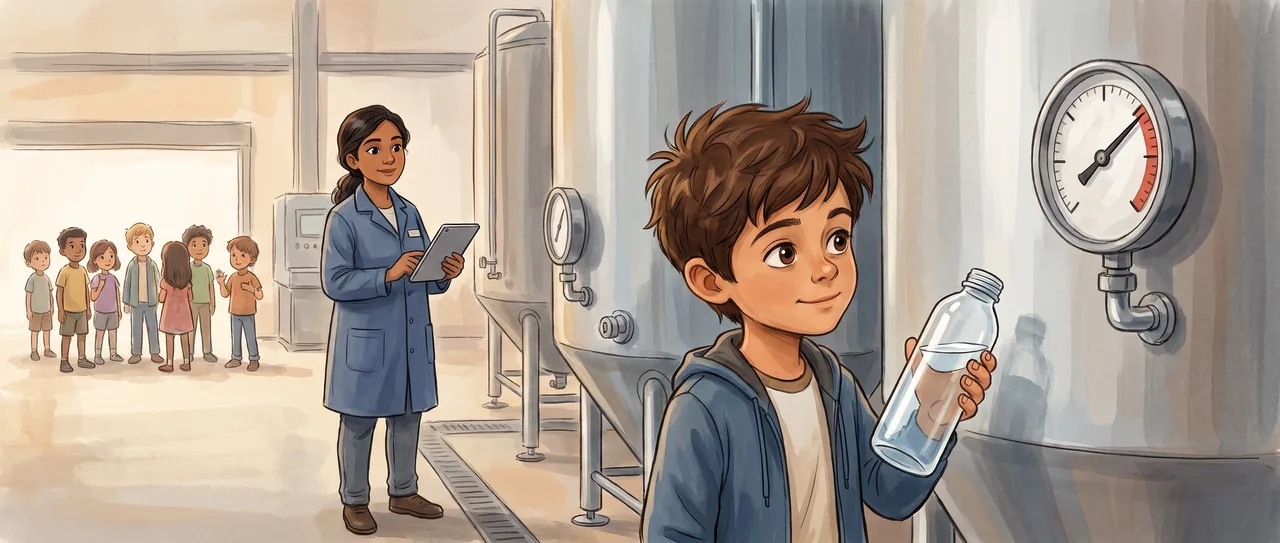
The machine was a tall steel tank, taller than the tallest kid, with pipes running off it and a gauge whose needle sat very far to the right. Priya patted it the way you pat a horse.
"In here we push the CO2 up to about seventy-four times the pressure of the air in this room," she said. "And we warm it a little past body temperature. And it changes."
"Into a liquid," Soren said. He had not meant to say it out loud.
Priya looked at him. "That's the good guess," she said. "It's the wrong guess. Come here."
The rest of the group drifted toward a sample table with beans in bowls. Priya stayed by the tank. She was clearly busy. She kept glancing at the gauge and at a tablet in her hand, and Soren understood that he had about two minutes before she remembered she had a whole class to manage.
"When you squeeze a gas hard enough and warm it at the same time," she said, "you reach a point where it stops being able to decide."
"Decide what?"
"Whether to be a gas or a liquid." She tapped the gauge. "Below this point, CO2 knows what it is. Cold and squeezed, it's liquid. Warm and loose, it's gas. There's a line between them. A surface. You can see it, like the top of water in a glass."
"And past the point?"
"The line disappears." She said it plainly, like it was ordinary. "The surface between liquid and gas just goes away. There is no top of the water anymore, because there's no difference between the water and the air above it. It's one thing. We call it supercritical."
Soren looked at the tank. He tried to picture a glass of water where the line at the top simply stopped existing. Where you could not say where the liquid ended and the air began, because the question no longer had an answer.
"So what is it, then," he said. "If it's not a gas and it's not a liquid."
"It's both. It's neither." Priya almost smiled. "It flows through the beans like a gas, gets into every crack, because it has no surface tension holding it back. But it dissolves things like a liquid. So it flows into the bean like breath and washes out the caffeine like water. And when we let the pressure go, it turns back into ordinary gas and just floats away. Leaves the caffeine behind. Leaves the flavor behind. Takes only what we wanted it to take."
Soren wrote: flows in like a gas, washes out like a liquid, leaves the flavor.
"How does it know to leave the flavor?" he asked.
"It doesn't know anything." She checked her tablet. "We tune it. A little more pressure, it grabs different molecules. A little less, it's picky. Caffeine is easy to grab at the setting we use. That's the whole trick. We don't chase the caffeine. We build a thing that only caffeine fits into."
Someone from the class called Priya's name. She held up one finger to them without looking away from the gauge.
Soren was still stuck on the disappearing line. "You said there's a point," he said. "An exact point where the line goes away. Is it the same for everything?"
"Every substance has its own," Priya said. "Its own temperature, its own pressure, where it stops being able to decide. Water has one. It's just very high, very hot, hard to reach. CO2's is gentle. That's why we use it."
"Everything has one," Soren repeated.
"Everything."
He stood there with that. Every substance in the world, the water in his bottle, the air in the room, the metal of the tank, all of it had a hidden point, a doorway, where the thing it obviously was and the thing it obviously wasn't stopped being two different things.
Priya was already walking toward the class. Soren followed a few steps behind, not writing, just holding the tank in the corner of his eye.
At the sample table the other kids were smelling beans and saying they smelled like coffee, which they did. Priya poured out a little of the decaffeinated grounds and passed the bowl around. When it reached Soren he smelled it. It smelled exactly like coffee. Nothing had been added. Something invisible had walked into every one of these beans, without a face, without being liquid or gas, taken one specific thing, and walked back out.
"Priya," he said. "Can I see the gauge again."
She was tired, he could tell, and she had said everything she planned to say. But she walked him back over.
The needle sat far to the right, holding steady. Behind the steel there was a fluid with no top and no bottom and no surface, filling every space exactly the way both a gas and a liquid would, being a thing that Soren's own eyes had never been allowed to see and never would, because it only existed under a pressure that would break any window you tried to watch it through.
"Is it doing it right now?" he asked. "In there. Right now."
"Right now," Priya said. "There's a batch running. That needle not moving is the whole point. It means the line is gone and staying gone."
Soren watched the needle not move.
He thought about the water in his bottle. Somewhere far above any pressure he could imagine, it had its own point, its own doorway where it would stop knowing whether to be sea or sky. He unscrewed the cap and looked at the little flat surface of the water inside, the clean line where it ended and the air began.
He tipped the bottle, and watched the line tilt and hold, and hold, and hold.
Read the interactive version, listen to the narration, and earn a gold star →
A science-verified short story for curious kids · Curiosity Land