The Wrong Week
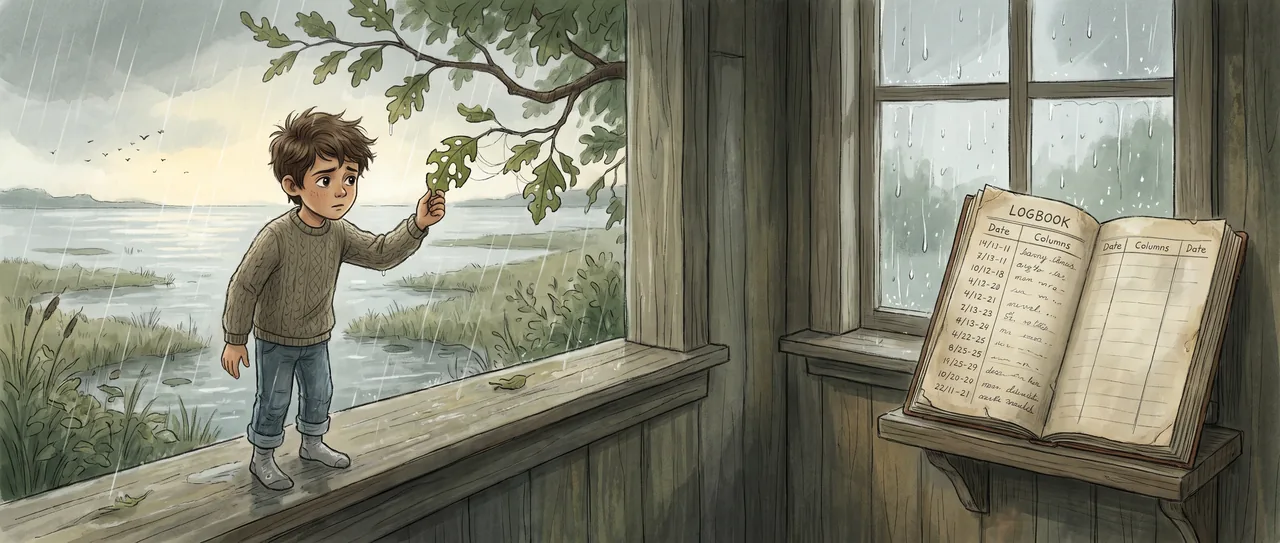
The logbook smelled like the cabin, which smelled like woodsmoke and old paper and the marsh coming in under the door. Soren found it on the shelf under a dead flashlight. On the cover his great-aunt had written one word in pencil. Arrivals.
She had died before he was born. His mother said she used to sit at this window every spring with a cup of tea and wait for the birds to come back, and write down the day each kind arrived. Nobody had opened the book in years.
The pages went back sixty springs. Every line was a date and a name. April nineteen, pied flycatcher. April twenty-two, first willow warbler. The handwriting got shakier the further along he read, then stopped.
Outside it was raining. There was nothing else to do, so Soren started copying the flycatcher dates onto a sheet of paper, oldest first, one under the other.
He expected them to be a mess. People remembered spring however they wanted. But his great-aunt had been careful. The numbers did something.
The old dates were late April. The middle dates were still late April. Then, near the end, they crept. April eighteen. April sixteen. April fifteen. The flycatchers were coming back earlier than they used to. Not by a lot. About a week, across a lifetime.
Soren wrote a week under the column and looked at it. A week seemed like nothing. Birds could not read calendars. Why would they care about one week.
He kept turning pages, and that was when he found the other numbers.
In the back of the book, upside down, his great-aunt had started a second list from the other end. She had written it small. Oaks in leaf. Then dates. Then, beside some of them, a word he had to sound out. Caterpillars. And after that, most years, three letters. Pk. He decided pk meant peak. The week the little green caterpillars were thickest on the new oak leaves, fat and everywhere, the week you could shake a branch and they would rain down.
He made a second column next to the first. Flycatcher arrival on the left. Caterpillar peak on the right.
At the top of the book, sixty springs ago, the two columns nearly matched. The birds arrived, and a few days later the caterpillars peaked. He could see how that would work. You fly a thousand miles, you are starving, you build a nest, and right then the trees fill up with soft green food exactly when there are open mouths in the nest.
Then he ran his finger down both columns at once, and his stomach did something cold.
They were not moving together.
The caterpillar peak was sliding earlier fast. The oak leaves came out sooner every warm spring, and the caterpillars hatched to meet the leaves, and the peak jumped up the calendar. Early April now. But the flycatchers, who spent their winters far away in Africa, only moved a little. They still left Africa on almost the old schedule. They still arrived in the third week of April, give or take.
Sixty springs ago the two numbers were four days apart.
At the bottom of the list they were nearly three weeks apart.
Soren sat very still Maybe she measured the caterpillars differently later. Maybe her eyes got worse. He checked the handwriting. It was careful all the way down. Maybe three weeks did not matter. He tried to make it not matter.
He could not make it not matter. He knew what a hungry chick was. Chicks did not wait. A chick needed food the day it needed food. If the caterpillars had already come and gone, turned into moths and flown off, before the eggs even hatched, then the parents could hunt all day over an empty forest. Both of them there, birds in the trees, leaves on the trees, everything present, and nothing to eat at the one hour it had to be eaten.
He understood then why the flycatcher line in the front of the book had a gap near the end. Some springs, no arrival written. Not because his great-aunt stopped watching. Because fewer came back. And fewer of those had chicks that lived to fly to Africa and fly home again and land on this marsh next April.
He went to the window. The rain had thinned. The oaks along the water were already in full leaf, a green so new it was almost yellow. It was only the middle of April.
He walked out to the nearest oak in his socks and pulled a low branch down and looked.
Bare. Chewed leaves, little holes everywhere, but the caterpillars themselves were gone. Already gone. He turned leaf after leaf. Silk threads, empty. The feast had happened. He had missed it, and so had the birds still somewhere over the sea, flapping north on last century's clock, toward a table already cleared.
And it was not one wrong spring. He had sixty of them in his hands, in pencil, and they told you which way it was going and how fast.
Soren went back in and did not sit down. He copied both columns onto a fresh sheet, clean, so anyone could see the two lines walking apart. Under his great-aunt's last shaky entry he wrote this year's date and this morning's empty branch. The book that had stopped started again in his handwriting.
He kept looking at the gap between the two columns and thinking about the birds crossing the sea right now, thousands of them, wings going, not knowing. They could not know. Only someone standing in two springs at once could know. Someone with the old book open and the new branch in their hand.
He carried the logbook to the window and propped it open on the sill facing out, both lists showing, and pulled a chair up the way she must have, and watched the empty oaks for the first flycatcher to drop out of the sky into the wrong week.
Read the interactive version, listen to the narration, and earn a gold star →
A science-verified short story for curious kids · Curiosity Land