The Wrong Number of Spirals
"They're not going to fit," Soren said. "I counted the holes wrong."
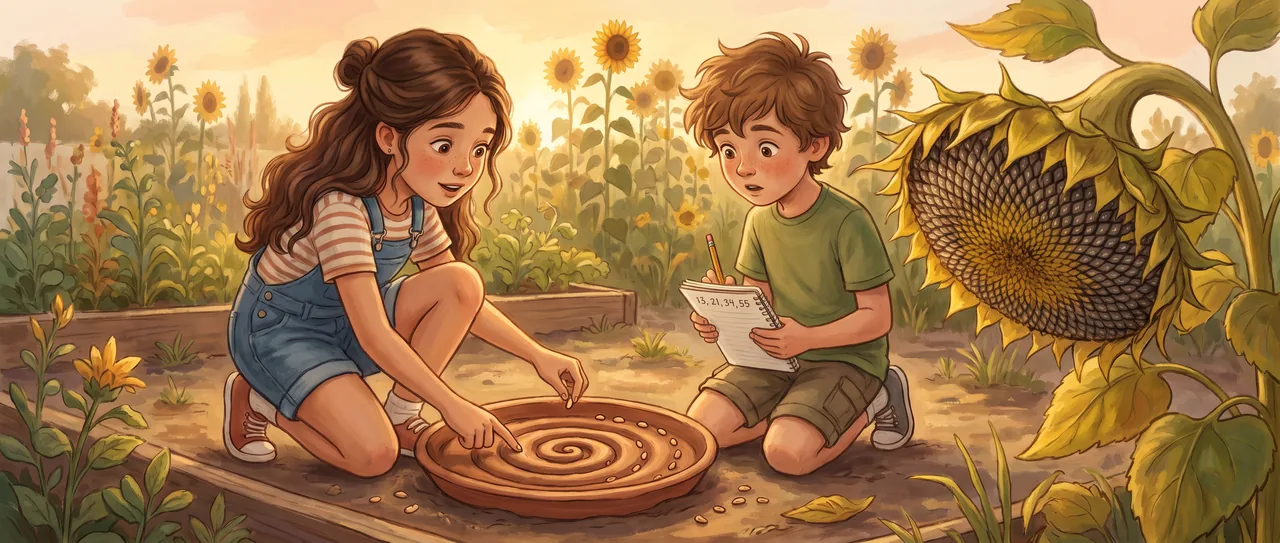
He had built the planter himself, a flat spiral of clay winding out from the center like a snail that had decided to lie down. He had wanted the bean seeds to go in one to a hole, evenly, all the way out. Instead the holes near the middle were crammed and the holes near the edge had big empty gaps between them.
"You spaced them wrong," Maya said.
"I spaced them the same," Soren said. "That's the problem. Same angle every time. Look."
Maya looked. He was right. He had turned the planter a little, poked a hole, turned it the same little, poked another. A steady march around and around. And the result was ugly. Lines of holes lined up like spokes, with fat wedges of nothing in between.
"Nature doesn't do it like that," Maya said.
"Nature doesn't have to build planters," said Soren.
"No. But it packs seeds." She was already up, walking to the sunflowers at the end of the row, the enormous drooping ones with heads bigger than her face. She tipped one down and stared into it. "Come look."
Soren came. The center of the sunflower was packed with seeds, hundreds of them, thousands maybe, and there were no gaps. No wedges of nothing. No spokes. Just seeds, all the way out, tight as cobblestones.
"There's spirals in it," Soren said slowly. "Going two ways."
"Count them."
He traced one set with his finger, the ones curving to the right. It took a while. "Thirty four," he said. Then the ones curving left. "Fifty five."
Maya said the numbers back like she was tasting them. "Thirty four. Fifty five."
"So?"
"So thirty four plus twenty one is fifty five," she said. "And twenty one plus thirteen is thirty four. Those keep showing up. My grandmother has them in her quilt pattern."
Soren pulled his notebook out of his back pocket and wrote in the margin: 13, 21, 34, 55. Each one the two before it added together. His pencil stopped.
"That can't be why it packs," he said. "A flower doesn't add."
"No," Maya agreed. "So it's not adding. It's doing something else that comes out to that."
They stood there over the enormous nodding head. A bee walked across it, unbothered, stepping seed to seed.
"You turned the same angle every time," Maya said. "And you got spokes. So the flower turns a different angle every time."
"It can't turn a different angle every time. Then it wouldn't be regular. It'd be a mess."
"It's the most not-a-mess thing I've ever seen, Soren."
He looked at his planter, then at the flower, then back. "Same angle," he said. "Every seed. It has to be the same angle. But not a whole fraction of the circle. If it were a half, you'd get two spokes. A third, three spokes. A quarter, four. Any nice fraction lines back up on itself and leaves gaps."
"So it uses a bad fraction," Maya said, and started grinning. "The worst one. One that never lines back up."
"There's no such thing as the worst fraction."
"There is if you want to never repeat." She crouched by the planter and put her finger on the center hole. "Give me the protractor."
Soren dug it out. "What angle?"
"I don't know yet. Something ugly. Something that won't divide into the circle evenly no matter how many times you go around."
They tried it. Maya turned the planter a large clumsy amount, more than a third of the way, and poked. Turned the same clumsy amount, poked. The holes did not line up into spokes. Each new hole dropped into a gap left by the ones before, filling in the empty spaces instead of stacking on top of them.
"It's tucking in," Soren whispered. "Every new one tucks into the biggest hole left."
"Because it never repeats." Maya kept turning, kept poking, faster now. "If it never lines up with itself, there's never a spoke, so there's never a gap for the spoke to leave."
Soren counted the spirals forming in their own clay planter as the holes multiplied. One way, then the other. "Five," he said. "And eight."
Maya stopped turning. "Say that again."
"Five one way. Eight the other."
Five. Eight. Thirteen. Twenty one. Thirty four. Fifty five. The same ladder, climbing out of nothing, just because they had picked the angle that refused to ever agree with itself.
"We didn't put those numbers in," Maya said. "We put in one angle. The numbers fell out."
Soren sat back on his heels. "The sunflower doesn't know the numbers either," he said. "It just grows each seed at the angle that won't crowd the last one. And the numbers fall out of it. Every time. For every sunflower that ever grew."
"Not just sunflowers," Maya said. She was somewhere else now, running down her list. "Pinecones do it. Pineapples. My grandma said nautilus shells. Those curl the same way."
"A shell isn't packing seeds."
"It's packing itself. Growing without ever bumping into where it already was." She looked up. "Same problem. Fit the new part next to the old part with no waste. Same answer."
Soren opened his mouth and shut it. Then he said, very quietly, "Hurricanes."
"What?"
"The arms of a hurricane. In the pictures. They spiral out the same way. And I saw a photo of a galaxy in a library book. A whole galaxy, Maya. The arms." His voice had gone thin. "That's stars. That's a hundred billion stars, and they're doing the same thing your grandmother's quilt is doing, and it's the same thing that just happened in our planter because I counted the holes wrong."
"Nobody told the galaxy the numbers," Maya said.
"Nobody told any of it." Soren looked at the sunflower, its huge patient face packed to the brim. "It's not a plan. It's just what you get. It's just what fitting looks like when nothing wants to waste room."
Maya picked one bean seed off the ground and set it into the last empty gap in the spiral. It dropped in perfectly, tucked between two others, and there was no space left over anywhere.
Above them the sunflower turned its heavy head a fraction toward the sun, the seeds inside it wound tight in thirty four and fifty five, the way they had been since long before anyone was there to count.
Read the interactive version, listen to the narration, and earn a gold star →
A science-verified short story for curious kids · Curiosity Land