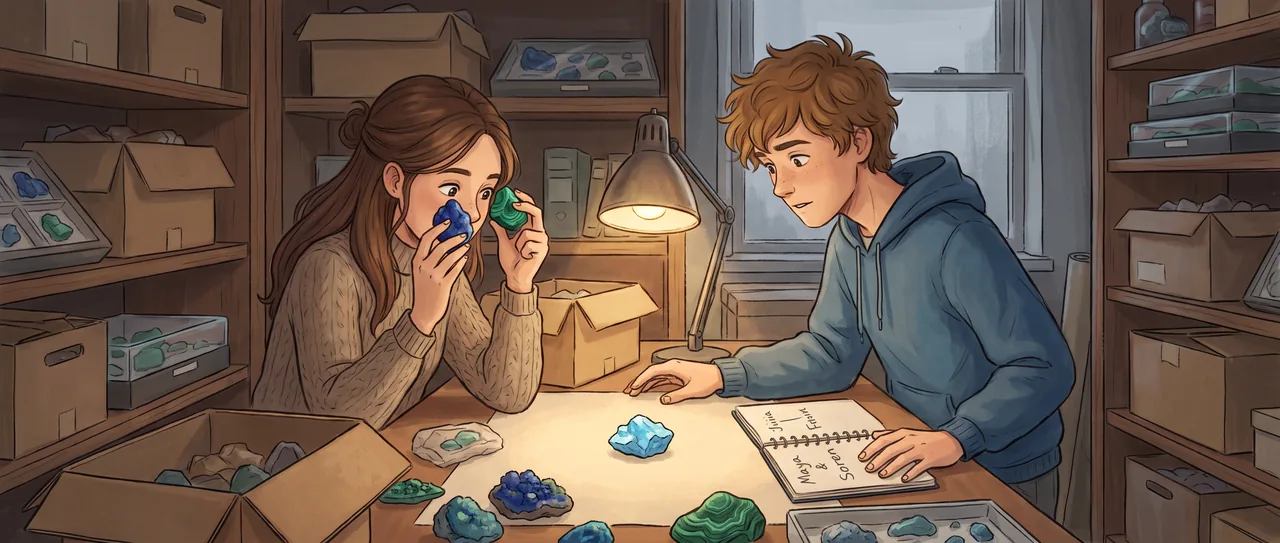
The Two Colors of Copper
The label said one word. Copper. It was taped between two stones, and the two stones were not the same color at all.
"That's wrong," Maya said. She held them up, one in each hand. "Somebody mixed up the labels."
The blue one was deep, like the middle of the ocean where you can't see the bottom. The green one was the green of a pond in summer. She was sure they had fallen off the wrong shelf.
Soren took the green one and turned it under the desk lamp. "This is malachite. It says so on the tray underneath. And that blue one is azurite."
"Right. So one of them isn't copper."
"They're both copper." He tilted the tray so she could read the faded card. Somebody had written it in tiny careful letters a long time ago. Both minerals: copper carbonate. Same metal.
Maya frowned. She set the two stones side by side on the desk, blue next to green, and looked at them the way she looked at a puzzle that had cheated.
"No," she said. "Color comes from the stuff inside. Different color, different stuff. That's just how it works."
"That's what I would have said too," Soren said.
The curator had left them alone twenty minutes ago. He had waved a hand at forty boxes and said, sort by mineral type, please, I'll be in the archive, and then he had walked off talking to himself about a missing invoice. He was not coming back soon. That was fine. Maya worked better without someone hovering.
She picked up the blue stone again. "Then why are they different?"
"The card says the copper's the same. So it's something else that's different."
"Something else." She said it slowly, testing it. "The copper's the same but the rock around it isn't."
Soren pulled his notebook out of his bag and set it on the desk. He wrote both names down and drew a line between them. "Malachite and azurite are almost the same recipe. Copper, carbon, oxygen, water. Almost. The amounts are a little different."
"A little different makes ocean and pond?" Maya shook her head. "That's too much difference for a little."
"I know. That's the part that's weird."
They both looked at the two stones. Maya turned off the desk lamp and looked at them in the gray window light, then turned it back on. The colors held. Ocean. Pond. The same metal at the center of both, wearing two coats.
"Okay," Maya said. "So the copper's not doing the color by itself. The copper needs help. Whatever's packed around it changes what color it is."
Soren stopped writing. "Say that again."
"The copper is the same. But how tightly the other stuff is squeezed around it isn't. And that changes the color."
"How would squeezing change a color?"
Maya didn't answer right away. She was chasing it. "Color's light," she said. "When something looks blue, it's eating the other light and giving back blue. Right? A red shirt eats everything but red."
"Yes."
"So the blue rock eats a different light than the green rock. Even though the copper's the same." She pressed her hands flat on the desk. "So the copper eats different light depending on what's packed around it."
Soren wrote eats different light and underlined light twice. "The copper's the same. The neighbors are different. The neighbors change what light it eats."
"And what it eats is what we don't see," Maya said. "And what's left over is what we do."
For a second neither of them said anything. Outside the storage room they could hear the curator, far off, still hunting his invoice.
"That means the color isn't in the copper," Soren said carefully. "It's in the copper and the space around it, together. Neither one alone."
Maya picked up both stones and held them close to her face, one eye on each. "So you could take one copper atom," she said, "and give it different neighbors, and it would be a different color every time."
"How many colors?"
"I don't know." She was almost whispering now. "That's the thing. I don't know how many."
Soren felt the room get bigger around him. He had walked past a hundred display cases full of colored stones in his life. Rose quartz, amethyst, that yellow one, the blue one. He had thought of the colors as belonging to the stones, the way a name belongs to a person. Fixed. His.
But the color didn't belong to the copper. The copper was just sitting there, the same in both hands. The color belonged to a conversation between the copper and everything crowded around it. Change the crowd, change the color. The metal never even had to change.
"There are cases and cases of these out front," he said. "All those colors."
"Yeah."
"Some of them are probably the same metal. Just with different neighbors."
Maya turned toward the door to the front room where the good displays were. "The rusty red one and the green one on the copper roof of the town hall," she said. "That's the same metal too. Iron's red when it rusts, copper's green when it does. Every metal that makes color, it's not really the metal picking the color."
"It's the metal and its neighbors," Soren said.
"Together." Maya put the two stones down, blue beside green, exactly touching. "So there's a color for every way you can crowd it. And nobody's tried all of them."
Soren looked down at his notebook, at the two names with the line between them, and it looked suddenly small, like a doorway drawn on a wall the size of the whole building.
"We were going to sort these by mineral type," he said.
"We still can." Maya was already lifting the lid off the next box. "But now I want to sort them a different way too."
"By what?"
"By what metal's hiding inside. And then see how many colors the same metal made." She pulled out a stone the color of a summer sky and set it apart from the others, on its own, in the middle of the empty desk. "Start with copper."
Soren reached into the box and set the next blue stone beside it. Then a green one. Then one so pale it was almost white, and they both leaned in to look at it, wondering what the copper had been crowded with to come out that quiet.
Read the interactive version, listen to the narration, and earn a gold star →
A science-verified short story for curious kids · Curiosity Land