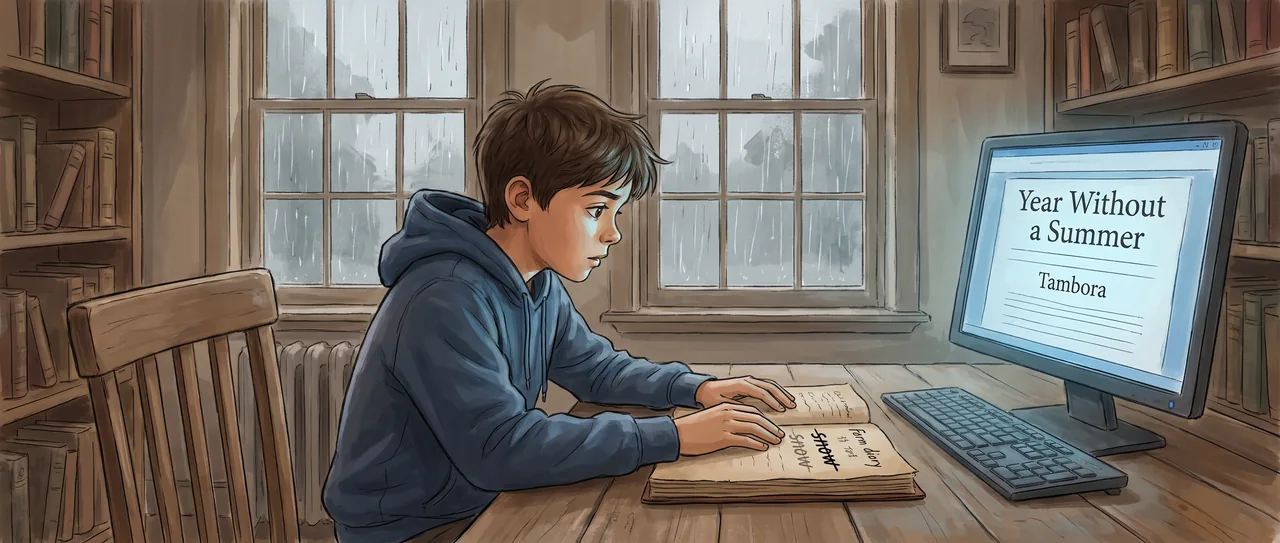
The Summer That Didn't Come
The diary was behind glass, but the librarian let Soren hold it because nobody else had asked in years.
It belonged to a farmer named Josiah Pratt, who had lived four miles from where Soren was sitting. The pages were brown and soft, and the ink had faded to the color of weak tea. Soren turned them carefully, one at a time.
Most of it was boring. Weather, cows, the price of nails. Then he reached June.
June 6th, 1816. Snow. A foot of it on the north field. Killed the corn.
Soren read it twice. Then he read the date again, because dates were the sort of thing you could misread.
June. Snow in June. In a state where June meant sweating through your shirt and swatting bugs off your neck. He kept turning pages. July had frost. August had ice on the water buckets in the morning. Josiah Pratt had planted his corn three times and lost it three times, and by September he was writing about which neighbors had bread and which did not.
Soren took out his notebook. He copied the June entry word for word, the way Josiah had spelled it, snow crossed out once and written again like the man hadn't believed his own hand.
The librarian came by with a cart of returns. She was young and looked tired and had a coffee going cold beside the returns desk.
"Find something?" she asked.
"Was there a war?" Soren said. "In 1816. Something that would freeze the crops."
"Wars don't freeze crops," she said. "Cold freezes crops."
"But why was it cold?" Soren said. "In summer. Everywhere?"
She shrugged, not unkindly, the shrug of a person with a cart to empty. "People wrote it down and moved on, I guess. Folks were tougher then."
That wasn't an answer. Toughness didn't lower the temperature. Soren looked back at the page. Josiah Pratt had not been tough about it. Josiah Pratt had been terrified, in his small careful handwriting, of a cold that came from nowhere he could see.
From nowhere he could see.
Soren sat with that. A farmer standing in his field in June, snow falling on his corn, and no cloud of war on the horizon, no fire, no reason on the ground anywhere he looked. Whatever did this had to be too big to fit in a field. Too big, maybe, to fit in the whole country. Something that could reach a farm in America and touch every farm at once had to be standing somewhere very far away, and it had to be enormous.
He went to the computer at the end of the room. He typed: cold summer 1816.
The screen filled up. Year Without a Summer. He read fast, then slow. Frost in July. Failed harvests in France and Germany and Switzerland. Bread riots. And under it, a word he had to say out loud to himself. Tambora.
A volcano. Not in America. Not in Europe. In Indonesia, on the other side of the planet, so far that a person could not walk there in a lifetime. It had erupted in April of 1815, more than a year before Josiah Pratt's snow, and it was the biggest eruption anyone had ever written down. Tens of thousands of people had died where it stood.
Soren stopped there for a second. He didn't rush past that part. He let the number be a number of people.
Then he read the part that made his hands go cold. The mountain had thrown so much ash and gas so high that it went above the weather. Above the rain that would have washed it down. It spread into a thin veil all the way around the Earth, a veil you could barely see, and it turned away just enough sunlight to cool the whole planet. Not by much. By a little. A little, spread across every field in the world, was snow on Josiah Pratt's corn in June.
Soren looked at the diary, still open on the table across the room. A man in this town had written about that veil without knowing it was there. He had felt a mountain he would never hear the name of. The cold that came from nowhere he could see had come from a specific place with a specific name, and it had taken a year and the whole sky to arrive.
He kept scrolling, because the screen wasn't finished with him.
That same summer, the cold and the endless gray had trapped a group of friends indoors by a lake in Switzerland. Rain every day. No sun. To pass the time they told each other ghost stories, and one of them, a girl of eighteen named Mary Shelley, wrote a story about a scientist who builds a creature and brings it to life. She wrote Frankenstein in the dark, wet gloom of the year the mountain made. A volcano in Indonesia had killed Josiah Pratt's corn and written the first monster novel, and it had done both with the same thin gray veil, and almost nobody who lived through it knew the two things were the same thing.
He thought about all the diaries in this room. The whole shelf of them, farmers and shopkeepers and a woman who taught school, all writing down their small true weather. Snow. Frost. No bread. None of them able to see the mountain. All of them feeling it anyway. The world had reached into their fields from six thousand miles away, and they had recorded it faithfully without ever knowing what they were recording.
He carried the diary back to the desk.
"You were right," he told the librarian. "They wrote it down and moved on. But they didn't know what they were writing down."
"And you do?" she said, not mean, just surprised.
"A mountain," Soren said. "On the other side of the world. They wrote down a mountain and thought it was snow."
She looked at him for a moment, then set down her coffee and came around the desk. "Show me," she said.
Soren opened the diary to June again. He turned it so she could read it right side up. Outside, the rain kept coming down against the tall windows, steady and gray, and the librarian bent over the brown page and read the word snow, crossed out once, written again.
Read the interactive version, listen to the narration, and earn a gold star →
A science-verified short story for curious kids · Curiosity Land