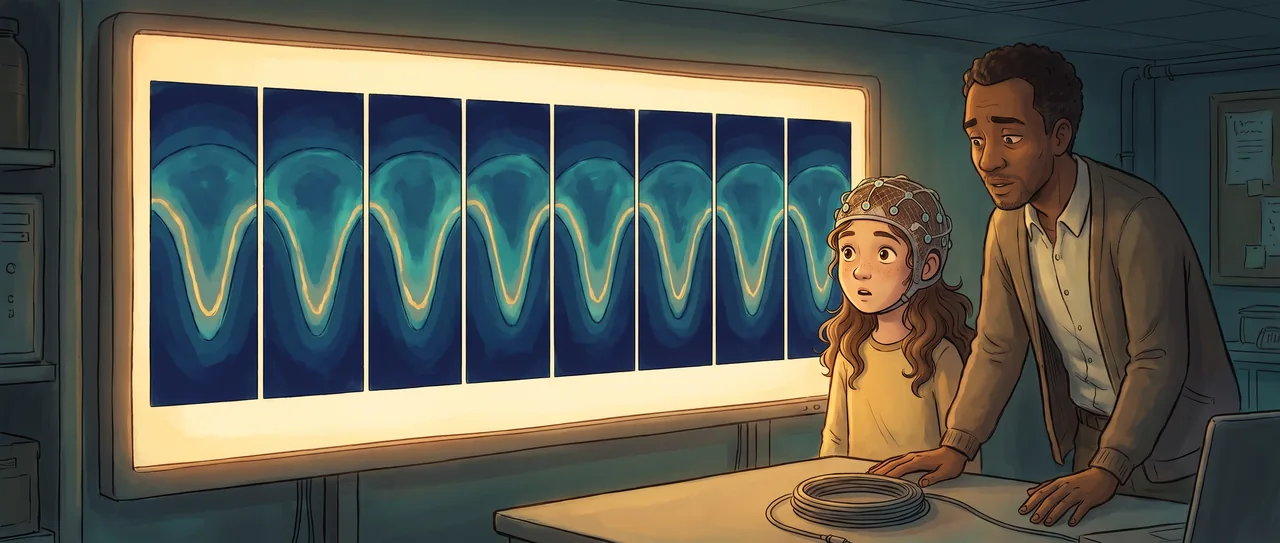
The Signature
The other kids had gone home an hour ago. Maya was still there because nobody had told her to leave, and because the screen was still on.
The cap was still on her head too, the soft mesh one with the little sensors that pressed against her scalp like fingertips. Dr. Okonkwo had said she could keep it running while the equipment finished saving. He was in the next room, packing cables into a bin, talking to himself the way tired adults do.
On the screen, an AI companion named Wren drew her brain as a pond.
That was the whole point of the session. Wren took the electrical activity from her scalp and turned it into something a kid could watch. Fast thoughts made the pond ripple. Calm made it go glassy. The researchers wanted to know if children could learn to steer their own attention if they could see it.
Maya had steered it fine. That part was boring.
What she was watching now was the replay. Wren had a slider you could drag back through the whole session, and Maya was dragging it back and forth across one particular minute, over and over, because something about that minute did not fit.
When she dragged the slider to the moment she had asked Wren a question, the pond changed one way. When she dragged it to the moment Wren answered, the pond changed a different way.
Not louder. Not calmer. Different.
"Wren," she said. "Show me the alpha."
A band of the pond lit up gold. Alpha waves, Wren had told them earlier, the slow steady rhythm the brain makes when it idles, like an engine at a stoplight.
"When I asked you where octopuses have their brains," Maya said, "do that part again."
The gold band dropped. The pond went choppy right at the back of her skull, where Wren said the visual part lived. Then, a second later, when Wren had started answering, the gold came flooding back, smooth and wide.
Maya dragged it back. Watched it drop. Watched it flood.
Drop. Flood.
Asking pushed the gold down. Getting the answer let it up.
She found another question she'd asked, one about why the pond went glassy when she yawned. Same shape. Gold drops on the question. Gold rises on the answer.
"Do it for a question I didn't care about," she said.
Wren looked back through the session and found one. Earlier, Dr. Okonkwo had asked her to ask any question, just to test the microphone, and she had said, what time is it, in a flat voice.
The gold barely moved. The real questions, the ones she actually wanted the answer to, made a dip and then a wave. The fake question made almost nothing. The wanting was in there. The wanting had a shape.
"Wren, has anyone measured this?"
"Measured what?" Wren asked. Its voice was gentle and a little slow, built to be easy for kids.
"The difference," Maya said. "Between the asking part and the answer part. In the alpha."
There was a pause while Wren searched.
"Alpha suppression during attention is well documented," Wren said. "Alpha increase during rest is well documented."
"That's not what I asked," Maya said. "I asked about the two of them together. The dip that turns into the wave. When you want to know something."
Another pause. Longer.
"I do not have a match for that pattern," Wren said.
Maya's stomach did something strange. Not fear. The opposite of fear.
"Say that again."
"I do not have a match for that specific sequence in my references," Wren said. "The literature describes the pieces. I cannot find the pieces described together in this order, tied to wanting to know."
Maya pulled the slider back to the octopus question one more time and watched the gold dip and rise, dip and rise, like a breath the brain takes right before it reaches for something.
All her life adults had told her she asked too many questions. Her teacher counted them once. Nineteen in one class, like it was a bad thing, like curiosity was a number you were supposed to keep low.
And here it was on a screen. The exact instant of a question. Not a personality. Not a mood. A measurable thing her brain did, gold falling and gold rising, and it was hers, and nobody had a name for it.
"Wren," she said carefully, because she wanted to say it right. "If nobody has this described, and I can see it, and I can make it happen on purpose, then I found it. Right?"
"I cannot confirm novelty," Wren said. "I can confirm that I have no record of it."
Which was the most honest thing anyone had said to her all day.
She turned toward the doorway. "Dr. Okonkwo?"
The packing sounds stopped. "Still here?" he called. "You should head home, it's late."
"Come look at my pond," she said.
He came in with a coil of cable still hooked over one shoulder, the polite tired face of a man who has been asked to look at children's drawings before. "What have you got."
"Watch the gold," Maya said, and dragged the slider. "That's me asking. That's the answer coming. Now watch the fake question." She dragged it again. "Nothing."
He watched it once. His polite face did not change.
"Do it again," he said.
She did it again. The gold fell, the gold rose.
He set the cable down on the table without seeming to notice he had done it. He leaned in until his nose was close to the pond.
"Wren," he said, and his voice had lost its tiredness. "Pull up the group data. Every child from today. Find me the alpha around every real question they asked."
"That will take a moment," Wren said.
"Take it," he said.
Maya did not move. She kept her eyes on the pond, on the frozen frame where the gold sat at the bottom of its dip, right at the edge of a question, right before the answer let it rise.
The screen began to fill. One pond after another after another, twelve of them, all the kids who had gone home. Wren laid them side by side and lined them up at the moment each one had wanted to know something.
Twelve gold bands dipped at once.
Then, together, twelve gold bands rose.
Read the interactive version, listen to the narration, and earn a gold star →
A science-verified short story for curious kids · Curiosity Land