The One That Knocks Back
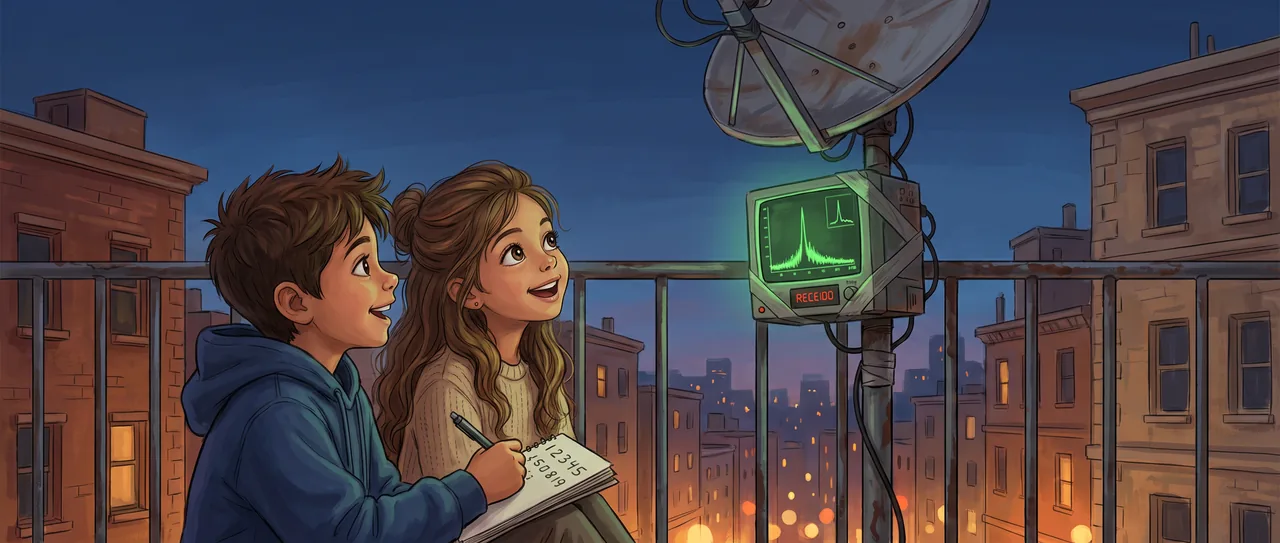
The dish had come from a scrapyard, and it still had a bird's nest wedged in the bracket when they hauled it up the fire escape. Soren wired it to the receiver. Maya taped the cheap AI stick to the railing so it could see the readout and listen along.
"Okay," said Maya. "Tell it to flag anything weird."
"That's not a setting," said Soren. "Weird isn't a number."
"Then tell it to flag anything that doesn't match the catalog."
He typed it in. The little AI blinked green and started scrolling. Fast radio bursts, it announced in its flat voice. Estimated seven thousand crossing the sky per day. Most too faint for this dish.
"Seven thousand," Maya said. "A day."
"From all over the universe," said Soren. "Each one lasts about a millisecond. A flash of radio, then gone."
"And nobody knows what makes them?"
"Some. Magnetars, maybe. Dead stars with insane magnetic fields. But not all of them. Not for sure."
Maya leaned back against the warm brick and watched the graph twitch. "So we're sitting on a roof listening to seven thousand mysteries and we can hear maybe none of them."
"Probably none," Soren agreed. He sounded happy about it.
They listened for an hour. The AI flagged a microwave two floors down. It flagged a passing plane. It flagged Maya's phone when she got a text.
"This is garbage," Maya said, but she didn't move.
Then the AI said: Anomaly. Not in catalog.
Both of them sat up.
"Show me," said Soren.
A spike, sharp and clean, a hair wide on the graph. Gone before the AI finished naming it.
"Could be a car," said Maya. "A garage door. A satellite."
"Could be," said Soren. He was already writing the time down. His pen moved across the page and stopped at the second.
"But?"
"But the AI says the frequency smears. Lower frequencies came in a tiny bit later than higher ones. Cars don't do that. Garage doors don't do that."
"What does that?"
"Distance does that," said Soren. "When radio crosses space, it drags through all the thin gas between the stars. The low notes get held back a little. The more gas it crossed, the bigger the smear."
Maya stared at him. "So the smear tells you how far it came."
"Roughly. And this one's smear is big."
"How big is big?"
Soren looked at the number the AI had thrown up. "Big as in, not from this galaxy."
The microwave downstairs beeped. Somewhere a bus sighed at a stop. Maya didn't hear any of it.
"Okay," she said. "One flash. From far. That's an FRB. That's the thing. But you said seven thousand a day. Why would this one matter?"
"It wouldn't," said Soren. "One flash is one flash. You can't do anything with one. You can't even point at it and say come back."
Maya nodded slowly. And then she went quiet, and then she said, "So we wait."
"For what?"
"For it to do it again."
Soren put his pen down. "Maya. Almost none of them repeat. Almost all of them flash once and you never hear from them again. The odds that this exact one—"
"I know the odds are bad," she said. "But if it flashes twice, then it's not just a flash. Then it's a thing that keeps happening. And a thing that keeps happening you can find. You can turn a real telescope on it. You can watch it. You can ask it why."
Soren looked at her. "You want to sit here and see if a spot in another galaxy blinks twice."
"I want to see if it knocks back," said Maya.
So they set the AI to watch the exact patch of sky the smear had pointed to, and they waited. The city cooled. The dish ticked as the metal shrank. Soren guessed out loud that nothing would happen, because that was the honest guess, and he committed to it.
Forty minutes later the AI said: Anomaly. Not in catalog. Same source.
The same clean spike. The same smear, the exact same size, because it had crossed the exact same ocean of gas to get here.
"That's twice," Maya whispered.
"That's twice," said Soren, and his voice cracked on the second word.
"Search it," said Maya. "Is it in any list. Is it named. Has anybody ever—"
The AI searched every public catalog it could reach. No match, it said. No recorded repeating source at these coordinates.
Nobody had this one. Out of the whole sky, out of all seven thousand a day, out of every dish and every scientist and every survey scanning in real time, this particular corner had blinked twice for two kids on a roof and no one else had written it down.
"It's ours," Maya said. "For like a minute, before we tell somebody, it's completely ours."
"We have to tell somebody," said Soren. "Someone with a real telescope has to catch the next one. We can't do the why. The dish can't do the why."
"I know." Maya was grinning so hard it looked like it hurt. "But we found the twice. We found the thing that means you're allowed to ask."
Soren was already writing the coordinates in careful block numbers, pressing hard, as if a spike that had traveled across the universe might slip off the page if he wrote it lightly. He copied them again underneath, in case.
"What do you think it is," Maya asked. "Really."
"A magnetar," said Soren. "Probably. Some dead star flexing."
"But you don't know."
"No," he said. "Nobody knows why the repeaters repeat. That's the actual open question. Some of them go quiet for years and then start again. Nobody knows the pattern."
Maya looked up at the patch of dark the smear had come from, the patch that looked like every other patch, empty and ordinary.
"So somewhere up there," she said, "something is knocking. On a schedule nobody's figured out. Thousands of times a day. And we just heard one of them do it twice."
The AI blinked green and kept scrolling, and out on the far edge of the graph, faint as a held breath, a third spike began to rise.
Read the interactive version, listen to the narration, and earn a gold star →
A science-verified short story for curious kids · Curiosity Land