The Metal That Held a Grudge
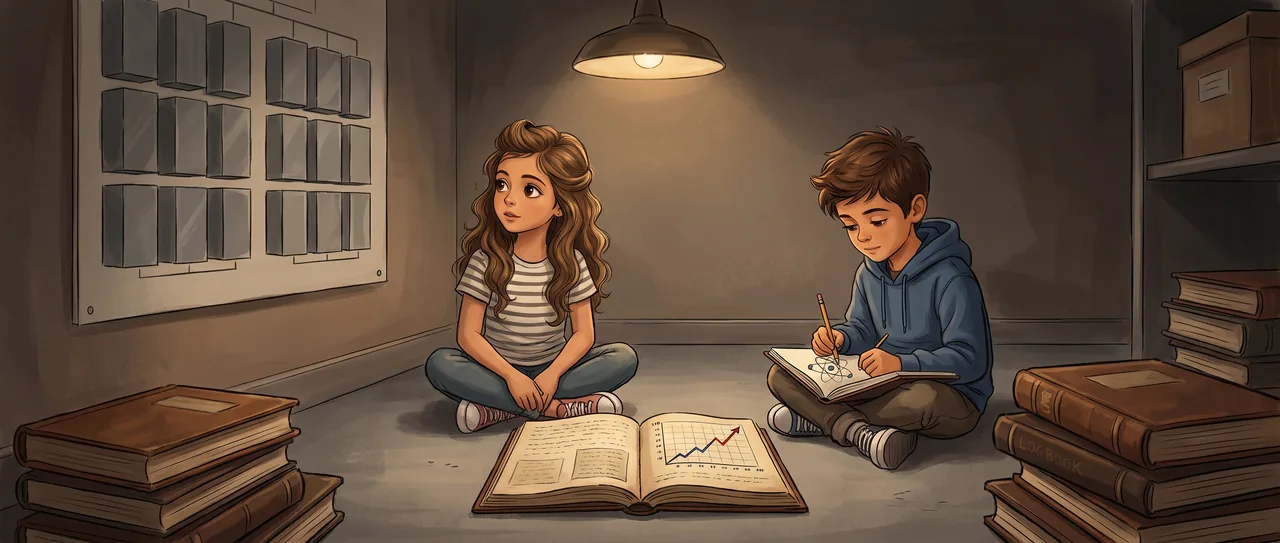
The volunteer had left them with three boxes and one instruction, which was do not spill anything, and then she had gone to find the missing tour group. So Maya and Soren were alone in the archive room with a stack of operator logbooks that smelled like old basements.
"Listen to this," Soren said. He had a logbook open on his knees. "Nine of October. Anneal begun, block temperature holding. Then further down, same day, block temperature not holding. Underlined twice."
"What's an anneal?" Maya said.
"No idea. But whoever wrote this was scared. You can tell by the handwriting."
Maya took the book. She read the underlined part, then flipped back three pages, then forward again. "They kept heating the reactor on purpose. Look. Every few months. On purpose, when it wasn't running."
"That's backwards," Soren said. "You heat things to make them do stuff. You don't heat a switched-off reactor."
"Unless the off part was the problem." She tapped the page. "They were feeding it heat like you feed a baby. Little bit, little bit. And this one time it wouldn't take the bottle."
Soren pulled out his notebook and copied the two lines, the calm one and the scared one, one above the other.
On the wall behind them was a museum panel, the kind with a diagram and too many words. Maya walked over to it while Soren read.
"Graphite," she said. "The gray blocks. That's what the reactor was mostly made of. Big pile of pencil lead, basically."
"Pencils don't catch fire on their own."
"This kind might have." She was reading fast now, finger under the lines. "The graphite slows down the little pieces flying off the atoms. Neutrons. It's like a net. It catches them so the reaction keeps going nice and steady instead of all at once."
"Okay," Soren said. "So the graphite is doing a job. It's a goalie."
"Right. But every time it catches one, the neutron knocks an atom sideways. Out of its spot in the row. And the atom just, stays there. Off in the wrong place."
Soren stopped writing. "It doesn't go back?"
"No. It gets stuck standing crooked. And there's a bump of energy in there now, in the crookedness. Like when you push a door open a little and it stays open. The push is still in the hinge."
"One atom," Soren said slowly, "is nothing."
"One atom is nothing. But it's not one." Maya turned around. "It's every atom the goalie ever caught. For years. All of them shoved a tiny bit sideways and none of them going home. The whole gray pile is holding still and it's full of pushes."
Soren looked at the calm line in his notebook. Anneal begun. Then the scared one. Block temperature not holding.
"Say that again," he said. "The stuck atoms hold energy."
"Yeah."
"So if you gave them a way to unstick. If you warmed it up just enough that they could all slide back into their rows at once."
Maya's eyes went wide. "They'd let go of the push. All of them. At the same time."
"And letting go of a push," Soren said, "is heat coming out."
They both looked at the panel. Then at the logbook on the floor between them.
"That's the anneal," Maya said quietly. "They weren't heating a switched-off reactor to make it hot. They were heating it a little so it would give back the energy in small change. On purpose. Before it decided to give it all back on its own."
Soren flipped to a page near the back where a graph was pasted in, a temperature line climbing, then a sharp spike where it climbed by itself.
"Block temperature not holding," he read. "That's this spike. The graphite started unsticking its own atoms. And each atom coming home made a little heat, and the little heat helped the next atom come home, and that made more heat."
"It fed itself," Maya said. "The pile was warming itself up out of stuff that happened years before. Neutrons from a Tuesday nobody remembers."
Soren put his hand flat on the cold floor without thinking about it, the way you touch something to check it isn't hot.
"That's the part that gets me," he said. "It's not radioactive doing it. It's not the reaction. The reactor's off. It's just, the shape of the graphite. The material remembers every hit and keeps score, and one day the score comes due."
"Materials remember," Maya repeated. She said it like she was trying it on. "I always thought a thing was just a thing. A block is a block. But the block went through something and it kept it. It kept it in where the atoms stand."
"There's a name in here for the stored part," Soren said, running down the page. "Wigner energy. Named after the man who figured out it had to be there before anyone measured it. He knew the atoms had to be holding something."
"He knew before he could see it," Maya said.
"Yeah."
She sat down next to him on the floor. "So somebody looked at a gray brick that looked completely fine and asleep, and thought, no, you're not asleep, you're holding your breath."
"And he was right."
Maya picked up the logbook and held it in both hands, careful, the way you hold something that turned out to be alive. "All those operators coming in every few months to warm the pile up gently. Letting it exhale a little at a time so it never had to do it all at once."
"Like walking a dog so it doesn't chew the house."
"Like that." She almost laughed, then didn't. "They were babysitting the memory of a machine."
The door banged. The volunteer leaned in, out of breath, tour group behind her.
"You two survived," she said. "Sorry. Bring the boxes down when you can."
Neither of them moved to the boxes. Maya was looking at the museum panel again, at the row of gray blocks in the diagram, drawn neat and quiet and identical.
"Every one of those," she said. "Standing there looking normal. Full up with pushes."
Soren opened his notebook and drew a single atom, and beside it drew it again, nudged one step sideways, and left it there, crooked, holding the door of the page a little bit open.
Read the interactive version, listen to the narration, and earn a gold star →
A science-verified short story for curious kids · Curiosity Land