The Compost Engine
Soren had built the compost tumbler wrong, and he knew it before his uncle told him.
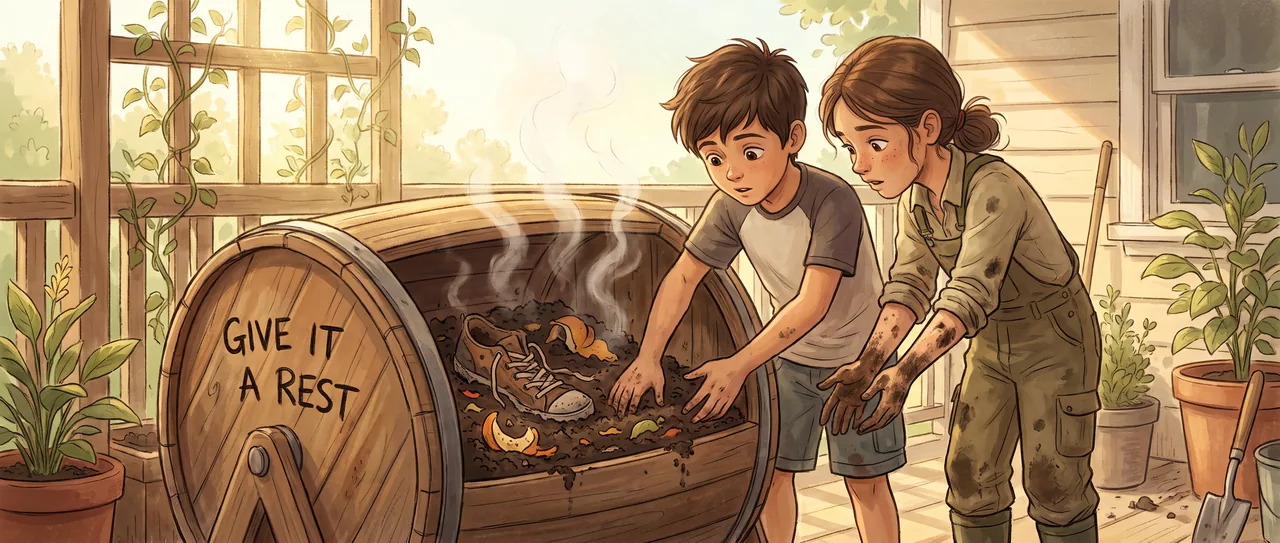
The barrel spun fine on its axle. That was not the problem. The problem was that after three weeks of turning it every morning, the inside still looked like a garbage can. Banana peels, coffee grounds, a shoe someone had thrown in as a joke. Nothing had become soil. Nothing had become anything.
"You keep feeding it," his uncle said, half looking, mostly reading his phone on the porch step. "That's your trouble. You add scraps every single day. Give it a rest."
"Rest doesn't do anything. Rest is when things sit there."
"Suit yourself," his uncle said, and went inside for more coffee.
Soren wrote the words give it a rest on the corner of the barrel in marker, mostly so he could disagree with them where he could see them.
The next day Maya came over with her hands already dirty from her own garden, and she looked into the barrel and made a face.
"It smells like a stomach," she said.
"It smells like failure."
"No, a stomach. Sour. Like when you're hungry." She poked the shoe with a stick. "You're giving it too much. It never gets a chance to eat what's already in there."
Soren stopped. "That's what my uncle said."
"Your uncle's right, then. Don't make that face."
So they tried it her way, which was also his uncle's way, which annoyed him. For one week, no scraps. No banana peels, no coffee grounds. Just turning the barrel, every morning, feeding it nothing.
By the third day the smell changed. Less sour. Warmer, almost like bread.
By the fifth day Soren put his hand deep into the barrel and pulled it back fast. It was hot. Not from the sun. Hot from the inside.
"Feel this," he said.
Maya put her whole arm in. "It's cooking itself."
"There's no fire. There's no food going in. Where's the heat coming from?"
Maya pulled her arm out and looked at the mess on it, which had stopped being a mess. The shoe was going soft at the edges. The peels were gone. In their place was something dark and crumbly that had not been there when they fed it.
"It's eating itself," she said. "When you stopped feeding it, it started eating itself."
Soren did not say anything for a moment. He was thinking about a documentary his mother had fallen asleep to, something about a Japanese scientist and a word that sounded like a spell. Autophagy. Self-eating. The man had watched cells do it under a microscope, watched a starving cell turn on its own broken parts and take them apart and use them again.
"That's a real thing," Soren said slowly. "In us. Cells do this. When you don't eat for a while, your cells start cleaning house. They break down the old broken stuff inside them, the machinery that's worn out, and they build new stuff from the pieces."
"Bodies do this?" Maya was leaning over the barrel like it might answer.
"When they're a little hungry. When you exercise. The cell runs low on new supplies, so it goes hunting through itself for junk to recycle. A guy got the Nobel Prize for figuring out how it works. Two thousand sixteen."
Maya was quiet, and then she laughed, but not at him.
"So when your uncle said give it a rest, he was actually right about your whole body."
"He didn't know that."
"He didn't know that," she agreed. "But the barrel knew."
Soren looked at the dark warm crumble in his hand. He had thought soil was made by adding things. Adding scraps, adding time, adding water. He had built a machine for adding. And the soil had only started when he stopped.
"It's not building up," he said. "It's the opposite. It's taking apart. That's what making soil is. Taking the old broken things apart so carefully that the pieces are worth something again."
"And that's happening in me right now?" Maya pressed her hand flat against her own stomach. "Some cell in here is pulling apart a broken piece of itself because I skipped breakfast?"
"Maybe. If you skipped it long enough." Soren felt the strange thing arrive, the thing that always arrived when the world got bigger than he'd left it that morning. "There are trillions of them. And every one of them can do this. Every one of them has a way to reach inside itself and clean out what's broken and keep the good parts. Nobody had to teach them. They were doing it before anybody had a microscope."
"They were doing it before there were people to have microscopes."
"They were doing it before there was a word for it."
Maya sat down on the porch step, the one where his uncle had been sitting, and looked at her dirty hand like it belonged to someone she'd just met.
"So the reason it feels bad to be hungry," she said, "the sour empty feeling, might be the exact same time your cells are doing their best work."
"Cleaning up. Yeah."
"The worst feeling is the good part." She said it like she was checking whether it could possibly be true. "That doesn't seem like how it should work."
"A lot of it doesn't seem like how it should work," Soren said. "When they mess it up, when the cell stops cleaning house, that's part of what goes wrong in old age. In some diseases. In the brain. The junk piles up because nothing's taking it apart anymore."
"So the rot is the healthy thing." Maya turned the word over. "The taking-apart is the healthy thing. And the piling-up is the sick thing."
"I built it exactly backwards," Soren said. "I thought I was supposed to keep filling it."
His uncle came back out with his coffee and looked into the barrel and grunted, pleased, like the compost had done it on its own.
"Told you," he said. "Give it a rest."
Soren did not correct him. He turned the barrel one slow full turn and heard the soft heavy tumble inside, the sound of a thing coming apart into something better, and under his palm on the warm metal he could feel it, faintly, still cooking.
Read the interactive version, listen to the narration, and earn a gold star →
A science-verified short story for curious kids · Curiosity Land