The Chess Set Nobody Kept
The box smelled like other people's houses. Maya pulled out a chess set with three pawns missing, then a stack of gray notebooks tied with a shoelace.
"Somebody's homework," said Soren.
"It's dated," Maya said. "Nineteen ninety-one. Look, there's a name. Dr. E. Okafor." She flipped a page. "It's about brains."
Soren leaned in. The handwriting was small and slanted, and it went in columns, like whoever wrote it was counting things.
"She's counting synapses," he said. "Or somebody's synapses. Look, per cubic millimeter. Age two. Age five. Age eleven."
"Eleven is us," said Maya.
"Age two has way more than age eleven," said Soren. He ran his finger down the numbers. "That's backwards. You'd think you get more as you get older. You learn more."
Maya went quiet. Then she said, "What if you don't build a brain. What if you carve one."
"What do you mean, carve."
"A two-year-old's brain has too many connections," she said, tapping the number. "Then it loses them on purpose. That's what these columns are. They're a brain throwing stuff away."
Soren frowned. "Nobody throws away brain on purpose."
"Then read the next page."
He turned it. There was a diagram, a smudged drawing of something like a tree with far too many branches, and next to it the same tree with most of the branches gone. Under the first one she'd written born knowing everything possible. Under the second one she'd written now knowing this.
"Okay," Soren said slowly. "So the branches are connections. And the second tree kept the ones that got used and dropped the ones that didn't."
"Which ones got used?" Maya asked.
"The ones the kid actually did stuff with. Sounds, faces, whatever was around them." He stopped. "So the tree is shaped by what happened to you."
"By what you paid attention to," Maya said.
A woman running the sale drifted over. "Two dollars for the notebooks if you want them. My aunt was a professor. Never married, worked all the time. We don't know what half of it means."
"Was she Dr. Okafor?" Soren asked.
"Emily, yes. She studied babies for forty years. Then she got old and, well." The woman touched her own temple, a little sad. "At the end she couldn't keep our names straight. But she could still play piano. Every note."
She went back to the cash box.
Maya and Soren looked at each other.
"Piano stayed," Maya said. "Names went."
"Because she played piano a million times," Soren said. "That branch got used so much it was practically a trunk." He picked up the notebook again, careful now, like it had gotten heavier. "Wait. If it's use it or lose it. Then all this stuff we're doing right now."
"Is carving," said Maya.
Neither of them said anything for a second. The basement had that hum old basements have.
"That's a lot of pressure," Soren said finally, and he laughed, but not really.
"No," Maya said. "It's the opposite." She was flipping fast now, looking for something she couldn't name yet. "Think about it. She wasn't sad about the branches she lost. She wrote now knowing this. Like the ones you keep are the point."
Soren found it before she did. Near the back, a loose page, different ink, written much later, the handwriting shakier.
He read it out loud. "The wasteful brain is the wrong idea. We do not lose the connections we should have kept. We keep the connections that a specific life required. No two prunings are the same. There has never been and will never be a brain shaped like this one."
"Read the last line," Maya said. She'd seen there was one.
Soren read it. "Every child is the only expert on their own experience. The brain believes them."
Maya sat back on her heels on the concrete floor.
"That's why grown-ups can't do it for us," she said. "They keep saying pay attention like we're supposed to pay attention to their stuff. But it's ours. Whatever I keep looking at, that's what my brain keeps. It literally builds around what I notice."
"And drops what you ignore," said Soren. "So if you're a kid who notices weird stuff nobody else notices."
"Then you're growing a brain nobody else has," Maya said. "On purpose. Right now. Just by being interested."
Soren looked at the columns again, at age eleven sitting in the middle of the drop, halfway between the flood of two and the settled shape of twenty.
"We're in the middle of it," he said quietly. "Like, today. The pruning's happening while we're sitting here."
"Every second we spend on this," Maya said, "is a branch we're voting to keep."
Soren got out his own notebook. He didn't say anything about it. His hand moved down the page copying Dr. Okafor's numbers, age two, age five, age eleven, and then he added one she hadn't lived to write, a blank line, and next to it he wrote us, right now.
"She spent forty years figuring out that the thing that scares people about their brain is actually the best part," Maya said. "You don't fill up. You get carved into somebody. And you're holding the knife."
"She forgot our names," Soren said. "I mean, she forgot everybody's names, at the end."
"But she didn't forget piano," Maya said. "She kept the thing she loved the most. Right down to the last branch."
The woman at the cash box called over. "Two dollars, if you're taking them."
Maya dug in her pocket. She had a dollar and some quarters. Soren had the rest.
"We'll take all of them," Maya said.
They carried the box up the basement stairs together, and it was heavier than it should have been, three missing pawns and forty years of a woman's counting, and when they got outside the light was so bright after the basement that they both stopped on the steps and squinted at the same time, and Maya said, "I want to go home and do something hard," and Soren said, "Which thing," and Maya said, "Doesn't matter. Something I'll keep."
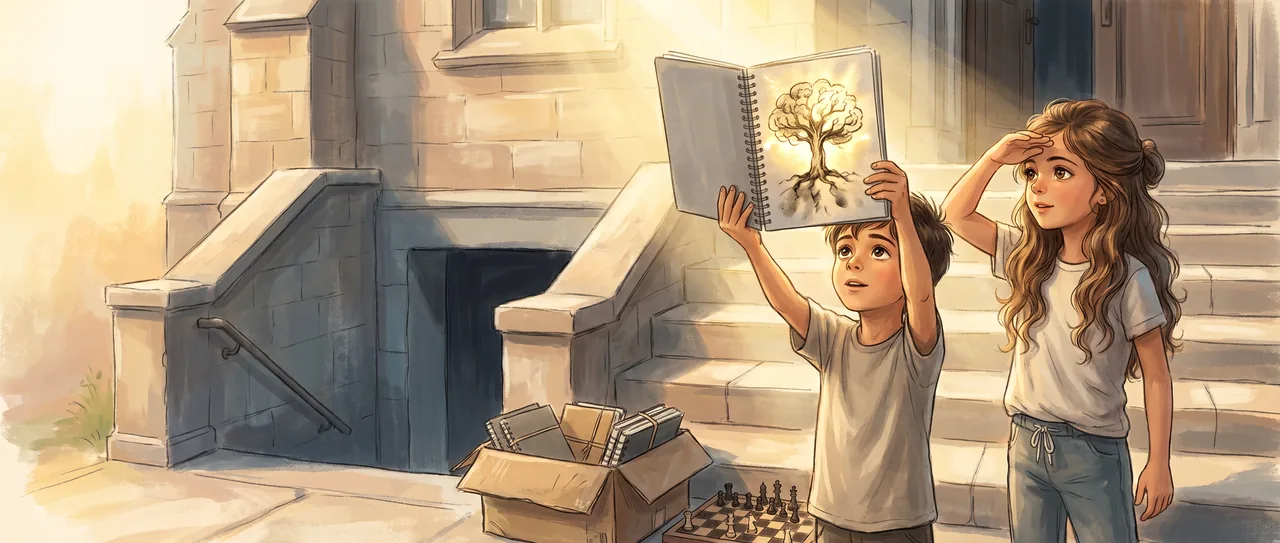
On the sidewalk, Soren opened the top notebook to the tree with all its branches and held it up so the sun came through the thin paper, and every line of the smudged drawing lit up at once.
Read the interactive version, listen to the narration, and earn a gold star →
A science-verified short story for curious kids · Curiosity Land