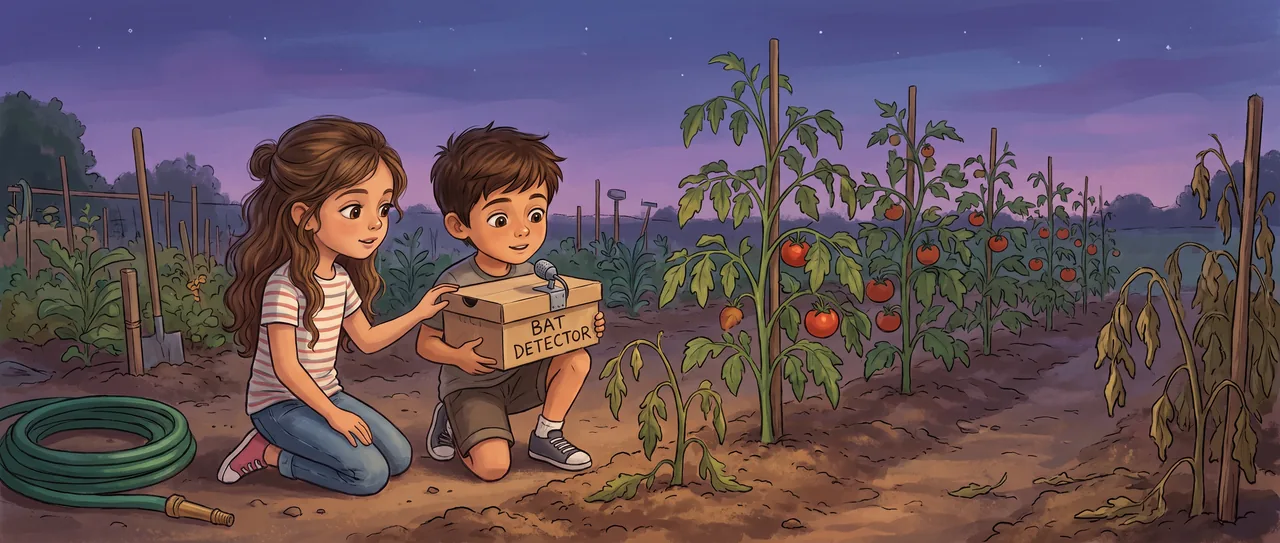
The Bat Detector and the Thirsty Tomatoes
The bat detector was a shoebox with a knob on it, and it hissed.
Soren held it up toward the darkening sky, tilting it the way you tilt a cup to catch the last of something. The device took the sounds too high for human ears and dragged them down low enough to hear, so bat squeaks came out as fat wet clicks. They had come to the garden for bats. There were supposed to be bats.
"Nothing," Maya said. She was lying flat on the path between the tomato beds, arms out, feeling the day's heat leak up out of the dirt into her back. The soil was warm and dry and a little crumbly, like the crust of something baked too long.
"Give them time," Soren said. "Bats come out when it's properly dark."
He swung the box slowly. Hiss. Hiss. The knob was warm under his thumb. Then, close, a click.
He froze. "Bat."
But there was no bat. He would have felt one, that little flick of air, that sense of something crossing overhead. The sky was empty and going purple.
The click came again. And again. Not the rhythm of a flying thing, sweeping past and gone. This stayed. This sat right in front of him at knee height.
"Point it down," Maya said, sitting up. She had heard it too.
He pointed the box at the ground. The clicks got louder in the speaker, a scatter of them, dry little pops like knuckles cracking very far away, or bubble wrap trodden in the next room.
"That's the dirt?" Soren said.
"No." Maya was already up on her knees, hands moving along the nearest tomato plant, feeling the leaves. They were soft in the wrong way. Not crisp. Drooping, curling at the edges, the whole plant sagging like a person who has been standing too long. "It's this one."
Soren brought the box close to the stem, four inches away, no more. The pops crowded together, overlapping, a small frantic popcorn sound coming out of a plant that was making no sound at all. He could see it in the dusk, dark and still, not one leaf moving. His ears told him it was silent. The box told him it was loud.
"It's talking," he said, and then felt stupid, because plants don't.
Maya moved down the row on her knees, and Soren followed with the box. The next plant over stood up straighter, leaves flatter, cooler under her palm. He held the detector to it.
Hiss. A pop. Another, ages later. Almost nothing.
"This one's quiet," he said.
Back to the droopy one. Loud again. A whole crackling storm of it.
"The dry ones are loud," Maya said. Her voice had gone fast and low "The thirsty ones. That one nobody watered." She looked down the row toward the far end where a hose lay coiled and forgotten. The plants nearest the hose were the standing-up ones. The plants at the dry end were the sagging ones.
Soren swept the box along the whole bed, slow, from wet end to dry end. In the speaker the clicks built like walking from a quiet room into a room full of small fires. Wet, quiet. Halfway, a few. Dry end, a downpour of popping.
"Why would a plant make a noise," he said. He crouched with the box against the stem, listening to the pops come one on top of another. "It's not lungs. It doesn't breathe like that."
Maya pressed her thumb along the stem of the loudest plant. She thought about the dry soil against her back, the crumbly crust of it, the water that wasn't there. "When it's thirsty," she said slowly, "it's pulling. Pulling water up. All the way up, through little tubes." She traced her thumb upward. "And if there's no water down there to pull, and it keeps pulling anyway."
Soren felt it click into place, the way a bone settles. "Then it pulls on nothing. And something snaps." He thought of sucking a straw at the very bottom of a glass, that rude gurgle, the air breaking through where the drink should be. A bubble, forming, bursting, inside a tube thinner than a hair. Thousands of them. Each one a pop.
"It's not trying to say anything," Maya said. "It's just so thirsty it's snapping."
But Soren was looking at the shoebox in his hands, and then out at the whole garden, all the beds, the beans, the peppers, the herbs, the neighbor's plot beyond the fence. Every one of them full of tubes. Every one of them pulling water up all day in the heat. He turned the knob and swept the box in a slow circle over the dark garden.
Pops. Everywhere. Faint from the watered beds. Loud from the dry ones. From every direction, low and high, near and far, a whole field of small dry voices that had been going the entire time, the entire summer, his entire life, in a language of bursting bubbles pitched too high for any person to catch.
"We come out here all the time," he said. "It was never quiet. Not once."
Maya lay back down in the warm dirt, but this time she turned her head sideways, cheek to the soil, ear pressed against the ground she had thought was empty. She couldn't hear it. Her ears were the wrong ears. They always had been.
"Somebody built this to hear bats," she said, meaning the box, meaning whoever had first dragged those high sounds down low enough. "Nobody built one to hear this yet."
"We could," Soren said.
A real bat crossed overhead at last, and the box gave its fat wet click, and neither of them looked up.
Soren carried the shoebox down the row, holding it four inches from each stem, and the garden crackled and hissed and popped around him in the dark, plant after plant after plant, all of them saying the one thing they had always been saying, which he could finally almost hear.
Read the interactive version, listen to the narration, and earn a gold star →
A science-verified short story for curious kids · Curiosity Land