One Letter
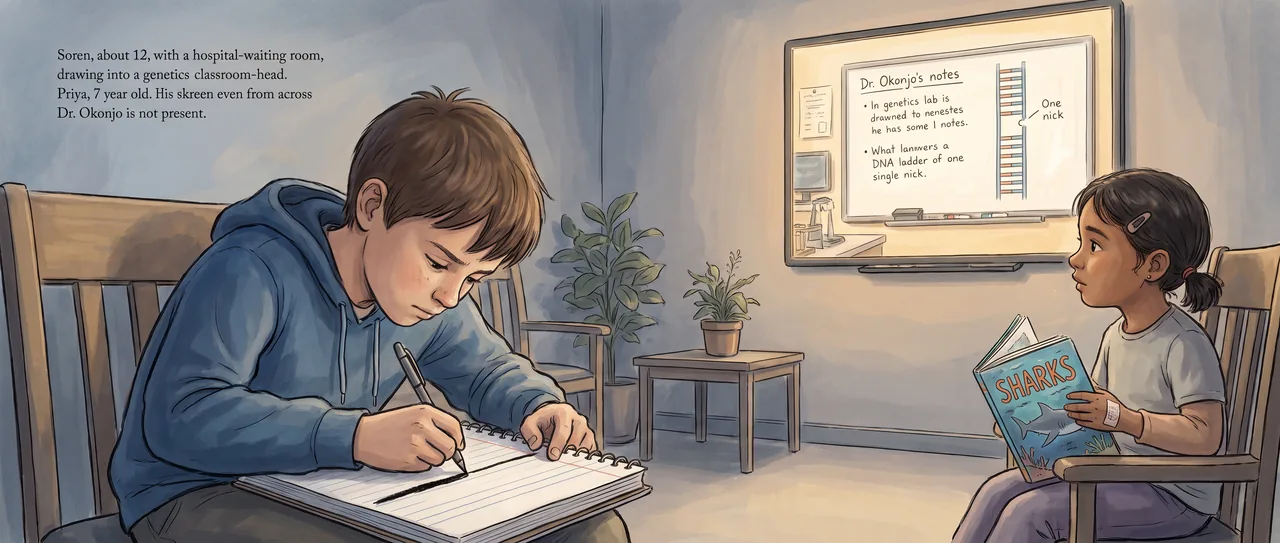
The screen on the wall showed a woman named Dr. Okonjo standing in front of a whiteboard that had a very long word written on it. The word was hemoglobin. Soren was sitting in a plastic chair next to his cousin Priya, who was seven and had a bandage on the back of her hand and a book about sharks open on her lap.
Soren had not wanted to talk today. He had brought his notebook but he had not opened it. He was watching. On the whiteboard, Dr. Okonjo drew a ladder. A twisted ladder, the kind everyone had seen a hundred times.
"This is the instruction book inside Priya's cells," she said, waving at the kids in the room through the camera. "Three billion letters long. And in the middle of all of them, in Priya's case, there is one wrong letter. One. It makes her blood cells fold into the wrong shape."
Priya looked up from her sharks. "One letter," she said, like she was checking the number.
"One," said Dr. Okonjo.
Soren leaned forward. He had read about this. He knew the word CRISPR, knew there were scissors that could go into a cell and cut. He waited for her to say scissors. He was ready to not quite believe it.
But she didn't draw scissors.
"Now," said Dr. Okonjo, "the older way to fix this was to cut the ladder. Both sides. Snip." She made a scissor motion with her fingers. "And then let the cell repair the break. But a break is a big thing. A break in three billion letters is a serious event. The cell panics a little. Sometimes it fixes it messily."
Soren nodded without meaning to. That was the part that had always bothered him about the scissors. You could not cut something that important and be sure of the edges.
"So some people asked a different question," said Dr. Okonjo. She capped her marker. "They asked: what if we don't cut at all? What if we don't break the ladder? What if we just walk up to the one wrong letter, and change it. Erase one letter and write the right one. Without ever snapping the rails."
Soren stopped watching the screen and started watching the idea.
He pictured the ladder. He pictured three billion rungs, each rung made of two letters holding hands across the middle. And somewhere in there, one rung where the wrong two letters were holding hands. The old way cut the whole rail to get at it. The new way did not cut the rail.
"How," Soren said, out loud, before he decided to.
A few kids turned. Dr. Okonjo tilted her head at the camera. "How?" she repeated. "Good. That's the right question."
"You can't just erase a letter," Soren said. "It's chemistry. The letters are molecules. You'd have to change the molecule itself. Turn one kind of letter into another kind. Without breaking anything around it."
The room was quiet. Priya had put a finger in her shark book to hold the page.
"Yes," said Dr. Okonjo, and she said it slowly, the way you say something to a person who just walked ahead of you on the path. "That is exactly what it does. We send in a tool that finds the one spot. It nicks only one side of the ladder, gently, just to mark the place. And then a little chemical machine sits on the wrong letter and changes it. Rearranges its atoms. A C becomes a T. And the rung is right. And the ladder was never broken."
Soren sat back.
He was not thinking about Priya's blood yet. That would come later, in the car, and it would make his throat tight. Right now he was thinking about the size of it. Three billion letters. And somebody had built a thing small enough and careful enough to walk to letter number one-point-something-billion, out of three billion, and change one atom's worth of one letter, and leave everything on either side of it exactly as it was.
"That's," he said, and then he didn't have the next word.
"I know," said Dr. Okonjo.
Soren finally opened his notebook. He wrote three billion, and then he drew a very long line, and somewhere in the middle of the line he made one tiny mark, and he pressed the pen down harder on that one mark than on anything else on the page.
"Is that what's in my hand," Priya said. "The changing thing."
"Something like it," said Dr. Okonjo, and her voice was careful now, because she would not promise a seven-year-old anything the science had not promised her. "We're still learning. It doesn't always land in the right spot. We check, and check, and check. It is very new. You are helping us learn."
Soren looked at his cousin's hand. The bandage. The small, ordinary hand holding a book about sharks. And underneath the skin, in cells too small to see, in a book of letters longer than every book in every library, a machine the size of nearly nothing was reading, looking for one letter among three billion, the way you might look for one wrong comma in every book ever written.
"How does it know where to stop," Soren said. He wasn't asking the screen anymore. He was mostly asking the air.
"That," said Dr. Okonjo, "is the part we're still making better. It reads the letters on either side. Like a bookmark that knows the sentence. But three billion is a lot of sentences. Sometimes there are two that look almost the same."
"So you have to be sure," said Soren.
"So we have to be sure," she agreed.
Soren closed the notebook but kept his thumb inside it, on the page with the one hard mark.
Priya went back to her sharks. She turned a page. On the wall, Dr. Okonjo picked up her marker again and started a new drawing for the other kids, but Soren wasn't watching the screen.
He was watching his cousin's hand turn the page, and thinking about the letter under her skin that might, right now, be quietly becoming the right one.
Read the interactive version, listen to the narration, and earn a gold star →
A science-verified short story for curious kids · Curiosity Land