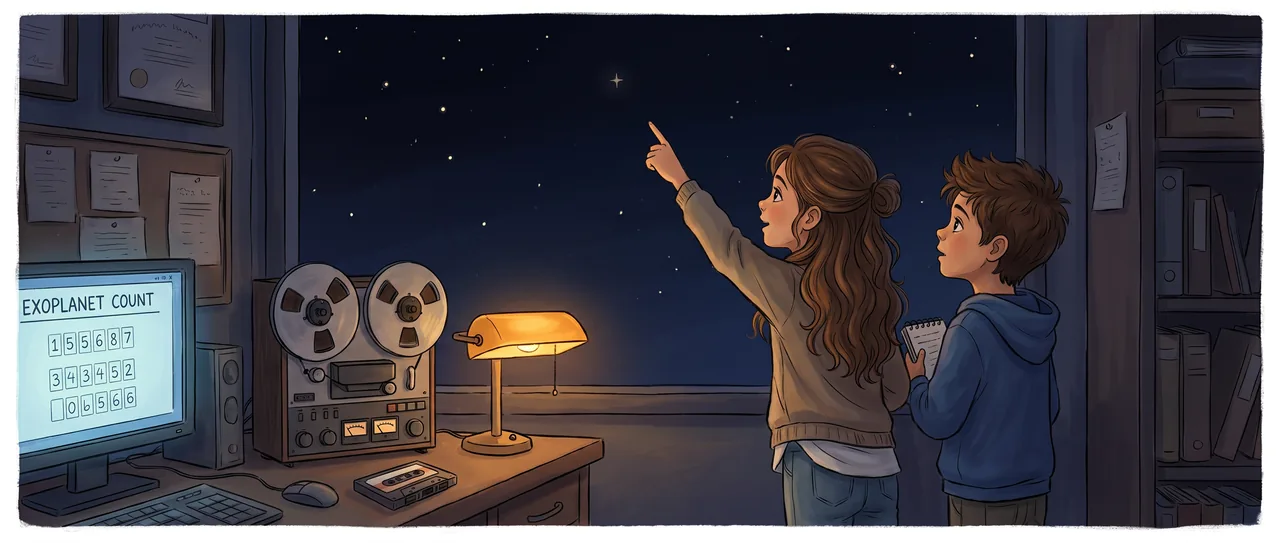
The Wobble in the Old Recording
The night host, a man named Devi who mostly wanted to eat his sandwich in peace, handed them a box of cassette tapes and said, "Label these by year. Don't erase anything. I'll be in the booth."
Then he was gone, and it was just Maya and Soren and a box that smelled like a garage.
"Nineteen ninety-five," Soren read off a cracked plastic case. "Science Hour. Somebody wrote a star on it in pen."
"Play it," said Maya.
The tape hissed. A woman's voice came up out of the hiss, thin and far away, interviewing a scientist who kept laughing like he couldn't believe his own luck.
"So let me make sure I understand," the interviewer said. "You didn't see the planet."
"No, no," the scientist said. "You can't see it. The star is too bright. The planet is a whisper next to a shout."
"Then how do you know it's there?"
Maya leaned toward the speaker. Soren opened his notebook and clicked his pen.
"The star wobbles," the scientist said. "A tiny wobble. The planet is small, but it pulls on the star, and the star swings a little toward us, then a little away. When it swings toward us the light bunches up. When it swings away the light stretches out. We measure the color of the light changing. Back and forth. Every four days."
"Four days," Maya said out loud. "That's a whole year for that planet. Four days."
"That's fast," Soren said. "It's really close to its star, then. It's roasting."
"Shh, I want to hear."
"For thousands of years," the scientist was saying, "people asked whether there were other worlds around other suns. It was a question you could only argue about. You could not answer it. And now." He stopped. The tape hissed. "Now we have one. Fifty-one Pegasi. There is a planet there. The question is answered."
The interviewer laughed. "Just one, though."
"Just one," the scientist agreed. "But you understand. Before today the number was zero. Now the number is one. That is the hardest step. From zero to one."
The tape clicked off on its own. The reel had run out. Then she said, "He sounds like it's the biggest thing that ever happened."
"To him it probably was," Soren said. He was still writing. "One planet. He said it like it was a mountain."
"So how many are there now?"
Soren stopped writing.
"I don't know," he said. "That tape is from before we were born. Before our parents were, basically."
Maya was already up, walking to the old computer on the corner desk, the one Devi used for the logs. "Look it up. He said the number went from zero to one. I want to know what it is now."
Soren came and stood behind the chair. She typed with two fingers, fast and wrong, backspacing.
The page loaded. He read it before she did, because she was still fixing a typo.
"Maya."
"What."
"Five thousand five hundred."
She stopped typing.
"Confirmed," Soren said. "That means they're sure. Five thousand five hundred that they're actually sure about. Since him. Since that tape."
Maya looked at the little speaker across the room where the scientist's voice had been. "He was so happy about one."
"Keep reading," Soren said, because there was more, and his finger had found it on the screen, and he needed her to see it at the same time he did.
She read it aloud, slowly.
"They think the galaxy has more planets than stars."
Then neither of them said anything.
Soren read it again to himself to make sure it said what he thought it said. It did.
"That can't be a mistake in the sentence," Maya said. "More planets than stars. Not the other way."
"More planets than stars," Soren repeated.
"How many stars are there?"
Soren had this one. He didn't even have to look. "In our galaxy? A couple hundred billion. Like, two hundred, three hundred billion."
"And there's more planets than that."
"At least one each, on average. Probably more."
Maya pushed the chair back from the desk and stood up and walked to the window. The station was on the edge of town and the window faced away from the streetlights, toward the dark part of the sky.
"Come here," she said.
Soren came.
She pointed at one star. Just picked one. "That one."
"Okay."
"Probably has a planet." She moved her finger. "That one too. That one. That one. All of them. Every single one I point at."
"You can't know it's every single one," Soren said, because he had to, because that was his job. Then, quieter, "But the odds. On average. Yeah. Pretty much every one you point at."
"On the tape it took him his whole life to prove one existed," Maya said. "And now we're standing here and I literally can't point at a star that probably doesn't have one."
Soren opened his mouth to add something careful about how some of those points of light were whole other galaxies, farther than she thought, with their own hundreds of billions of stars, their own uncountable planets. He decided it could wait. It made the window feel like it was getting bigger and he wanted to just feel that for a second.
"He said the hard part was zero to one," Maya said. "But that's not even the amazing part. The amazing part is that once you can find one, it turns out they're everywhere. They were always everywhere. He just couldn't hear them yet."
"Whispers next to shouts," Soren said. "He couldn't hear them because they were quiet, not because they weren't there."
Maya turned around. "There are people right now whose whole job is listening for the quiet ones."
"Yeah."
"I could do that."
"Yeah," Soren said. "You could."
In the booth, Devi's microphone light glowed red. His voice came soft through the wall, reading the weather to whoever was still awake.
Maya turned back to the glass. Outside, the dark part of the sky was full of small unblinking lights, and she started pointing at them again, one after another after another, not counting, just naming each one that had a world.
Behind her, the reel-to-reel began to squeal as Soren carefully wound the old tape back to the beginning.
Read the interactive version, listen to the narration, and earn a gold star →
A science-verified short story for curious kids · Curiosity Land