The Second Brain in the Jar
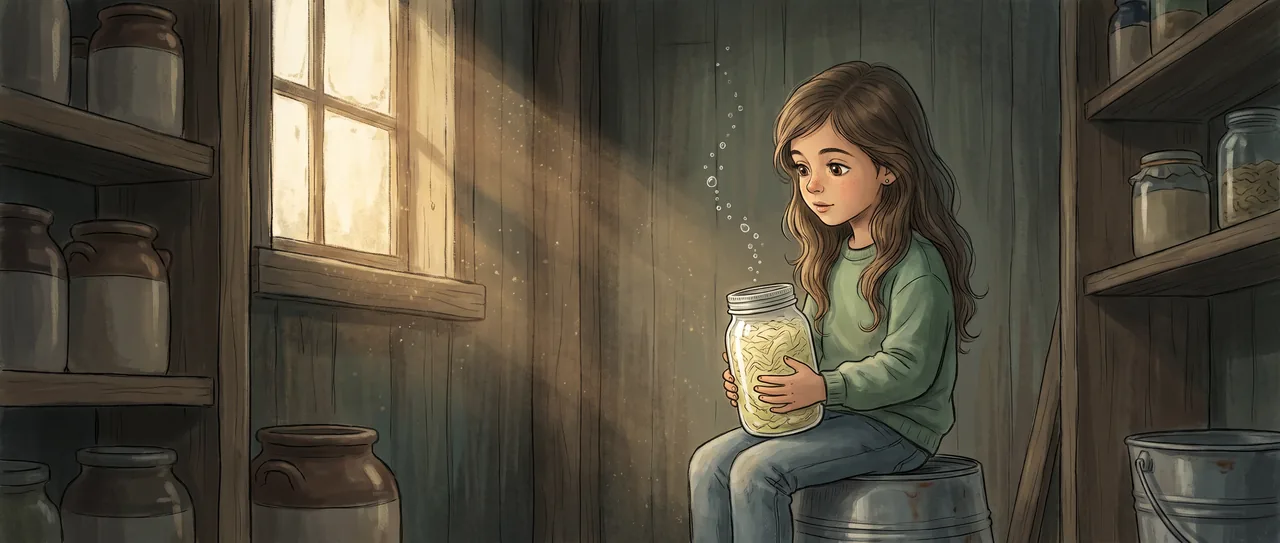
The shed smelled like salt and sour apples and something underneath that Maya didn't have a word for. Old. Busy. Like a room full of people whispering, if the people were too small to see.
She was supposed to be checking the jars. Mrs. Okafor had gone to move her car and said, back in ten, don't shake anything. So Maya was not shaking anything. She was holding a jar of cabbage up to the one dusty window and watching bubbles climb.
The bubbles came in little runs. A pause, then three, then a long climb of them, then nothing. Not steady. Not like soda, which fizzed all at once and gave up. This was more like breathing. She put her palm flat against the glass and felt the tiniest tap through it, a bubble hitting the side.
There was nobody in the jar. That was the thing she kept coming back to. Salt and cabbage and water, no yeast added, no packet, nothing. But it was fizzing. Something was eating in there. Something was making gas, and heat, she could feel the faint warmth against her cheek when she leaned close.
The cabbage had come with its own passengers. That was what Mrs. Okafor said last week, laughing. Every leaf a city. You don't add the bugs. They're already living on the plant. You just make them comfortable and get out of the way.
Maya set the jar down and looked at the label. Batch nine. Day four.
She thought about the pamphlet on the workbench, the one from the food-science group that ran the swap. She'd read it twice while waiting. It said fermenting microbes did more than sour things. They made vitamins. They made acids. And there was one line she'd read three times because it kept sliding off her brain: many of these bacteria produce the same signaling molecules your nervous system uses. Including serotonin.
Serotonin. She knew that word. It was a brain word. A mood word. The thing people meant when they said their brain chemistry.
But the jar didn't have a brain.
She picked it up again. The bubbles ran, paused, ran. Chemistry a brain used, being made by a smear of cabbage bugs in salt water, with no brain anywhere near them. Made before there were brains at all, probably. Made by things that were making it long before anybody had a head to keep it in.
Her own head felt strange suddenly. Light. She sat down on the overturned bucket.
Because here was the part that wouldn't hold still. If bacteria made serotonin, and bacteria lived on cabbage, and bacteria also lived in her, in her gut, billions of them, the pamphlet had said that too, then. Then.
Then most of the serotonin in her body wasn't being made in her brain at all.
She checked the pamphlet again, fast, thumbing to the paragraph. There it was. About ninety percent of the body's serotonin is produced in the gut, much of it influenced by the microbes living there.
Ninety percent. Not in the skull. In the belly. In the dark warm wet crowd of bugs that came in on her food and stayed and set up cities exactly like the ones fizzing in the jar in her hands.
Maya looked down at her own stomach. Then at the jar. Then at her stomach.
The same thing was happening in both places.
She didn't feel like herself for a second. She felt like a jar. A warm jar with a lid, full of a fizzing invisible crowd that was, right now, without asking her, making some of the chemistry that decided how she felt. Not a passenger she carried. A partner she'd never met. Making things. Sending things up. A pause, then three, then a long climb.
She pressed her hand against her own middle and felt nothing, no tap, no bubble, but she knew it was there. All of it. Trillions of them. Older than her by a billion years and living inside her by lunchtime.
Mrs. Okafor's steps crunched outside. The door opened and let in a slab of real light.
You look like you saw a ghost, Mrs. Okafor said.
Maya didn't look up from the jar. This is making serotonin, she said. Right now. In the salt.
Mrs. Okafor set down her keys. Some of it, probably, she said. She sounded pleased and a little wary, the way adults did when a kid went past where they'd meant to take them. The lactobacillus and their neighbors, yes. They make all sorts of things we're only just naming.
And the same kind of bugs are in me, Maya said. Making most of mine. Not my brain. Them.
Mrs. Okafor picked up a rag and didn't answer right away, which was how Maya knew the answer was yes and that the woman didn't have the bottom of it either.
We used to think the brain ran the show, Mrs. Okafor said finally. Now people study the gut and the brain like they're two ends of one long conversation. Signals going up the nerve, both directions. Nobody's sure yet who starts the sentence.
Maya turned the jar slowly. Nobody's sure who starts the sentence.
So when I feel okay, she said. On a good day. When I feel like things are fine.
She stopped. She was watching a single bubble come loose from a shred of cabbage at the bottom, wobble, and begin to climb, gathering others as it rose, a little silver run of them tapping up the inside of the glass toward the surface where the light was.
Some of that might be starting down here, she said. In something like this.
Mrs. Okafor smiled and started wiping the bench. Maya, that's the whole mystery. That's what everybody's chasing.
Maya didn't put the jar down. She held it against her stomach, glass to shirt, the warm one against the warm one, and watched the next run of bubbles start.
A pause. Then three. Then a long climb.
Read the interactive version, listen to the narration, and earn a gold star →
A science-verified short story for curious kids · Curiosity Land