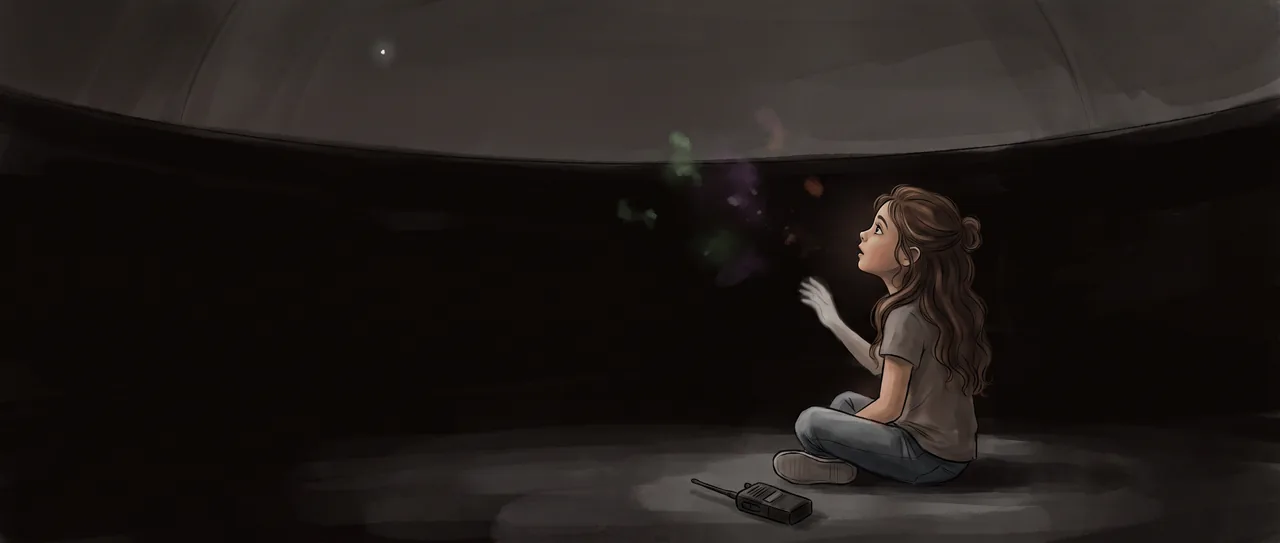
The Room With No Light
The door of the old star chamber shut with a sound like a book closing, and then there was nothing.
Not dark the way a bedroom is dark, where the window leaks and the hallway glows under the door. This was the other kind. Maya's aunt Reba had called it a blackout room, built so the old planetarium could show stars against a sky with no cheating light in it. Reba was somewhere down the hall now, muttering at a junction box, and she had left Maya inside with a walkie-talkie and a warning.
"Give it twenty minutes," Reba had said. "Your eyes do a thing. Just wait."
Maya sat on the cold floor and waited.
At first the dark pressed on her like a hand. She waved her fingers in front of her face and saw nothing, not even a shape, not even the memory of a shape. She had never in her life seen nothing. There had always been something. Streetlight. Phone. The green dot on the microwave. Here there was only the sound of her own blood, a soft rushing behind her ears, and the cold of the floor coming up through her jeans.
She counted her breaths. She made a list in her head of things that did not make sense yet. Why twenty minutes. Why not ten. What was her eye doing in there, in the wet dark of itself, that took so long.
Then the walls began to arrive.
Not suddenly. It was more like the way a name comes back to you, sideways, when you stop reaching for it. A faint grayness that might have been the far wall. A darker mass that was probably the doorframe. Nothing had changed in the room. She knew that. The room was exactly as black as before. Something in her had changed instead.
She held her hand up again. This time she saw it. Not the color of it, not the lines of her palm, just a paleness moving where she moved. Her own hand, made of almost no light at all.
"Reba," she said into the walkie. "I can see my hand."
"Told you," came the crackle back. "Rod cells. They pile up the light. Give it more time, it gets stranger."
Maya lowered her hand and went very still, listening to the room with her eyes.
And it did get stranger. The longer she sat, the more the dark stopped being empty. It began to swim. Little grains of dim color drifted across it, green and violet and a soft rusty red, blooming and fading, never in the same place twice. She knew, in some careful part of herself, that this was her own eye talking to her, the cells firing on their own the way a quiet radio hisses. But she watched anyway, because it was beautiful, and because it was the first thing she had ever seen that was made entirely of the inside of her.
Then she saw the point.
One point. High and to the left, near where the ceiling should curve down to the wall. A single speck, so faint it was less a light than a rumor of one. She turned her head. It stayed. She looked away from it, off to the side, the way Reba had taught her once to look at faint stars, and there it was, steadier when she did not stare straight at it.
"Reba," she whispered. "There's a light in here."
"Can't be. It's sealed."
"There's a light."
A long pause of static. Then Reba's voice, slower. "Where."
"Top left. Tiny. Like the smallest star."
Another pause. "That old dome has a pinhole. Been meaning to patch it. There's a service lamp out in the corridor, way down. If you're seeing that, kiddo, you're seeing about as little light as a person can see."
Maya kept her eyes on the speck. One pinhole. One far-off lamp. The light coming through it had crossed the whole dark corridor and the whole dark room to arrive at the back of her eye in the smallest possible amount, in ones, in single grains, and something in her had caught them. Not a machine. Not a sensor plugged into a wall. Her. The wet dark ball of her own eye, sitting patient in her skull, reaching out and closing around light one piece at a time.
She thought of every night she had ever spent under an ordinary ceiling, blind to this, her eyes flooded and lazy with lamplight, never once given the chance to go this quiet and this deep.
And then she thought about the colors. The drifting grains of green and violet and rust that had been swimming in front of her for twenty minutes. She had no name for a single one of them. Not one. She knew red and green and blue and the box of crayon words, and none of those words fit what she was seeing now. These were colors from further in, colors her eye could make and hold and tell apart from each other, millions of them, more than any language on earth had ever bothered to name.
She sat in the pit of the dark, at the bottom of her own seeing, and she felt how much larger she was on the inside than any word had ever let on.
"Maya?" Reba's voice. "Still with me?"
"Yeah," Maya said. Her own voice sounded far away. "Don't patch the pinhole yet."
"Why not?"
"Because I want to keep watching it."
The speck held its place, high and to the left, faint as a held breath. Maya did not look straight at it. She let it sit in the corner of her eye where it lived best, and she watched the single point of light stay lit, grain after grain after grain, at the far edge of the dark she had thought was empty.
Down the hall a door opened. A thin line of yellow appeared under the chamber door, ordinary and enormous, and the drifting colors vanished all at once, drowned, and Maya closed her eyes to keep them a second longer.
Read the interactive version, listen to the narration, and earn a gold star →
A science-verified short story for curious kids · Curiosity Land