The One That Came Up
The dock smelled of salt and diesel and the particular cold of things brought up from very far down. Soren stood beside his aunt's sorting table with his sleeves pushed up, tossing hake into one bin and skates into another, when the shouting started at the far end of the pier.
A man named Petar had something in a plastic tub, and the tub was too small for it. People gathered. Soren went too, because gathering meant something was wrong, and wrong was the thing he could never walk past.
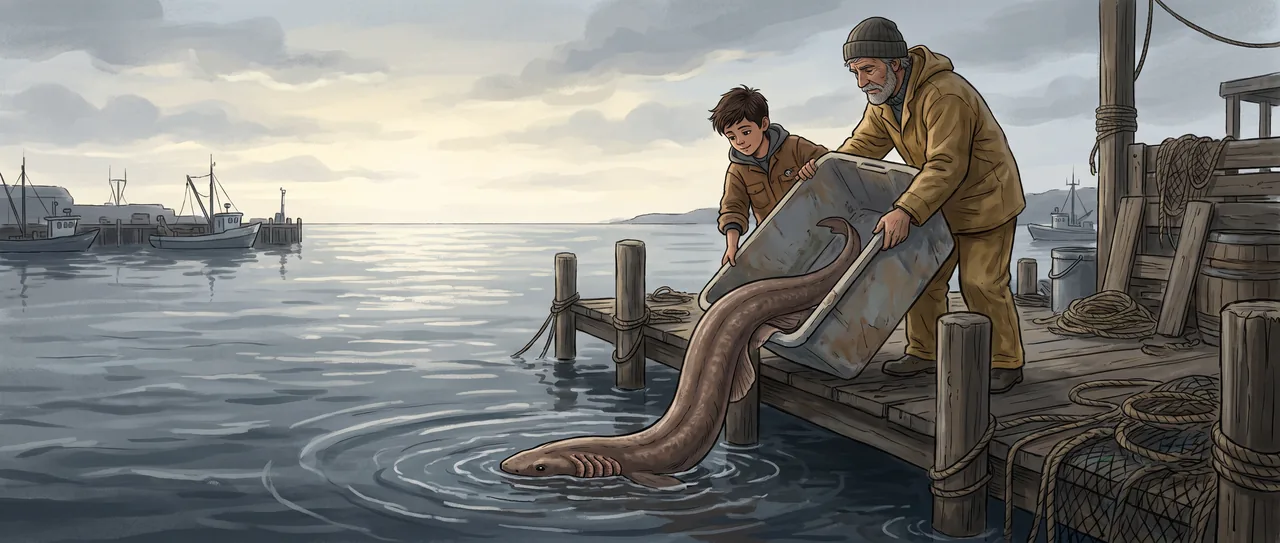
It was an animal about as long as his arm and his aunt's arm together. Brown, eel-shaped, wrong. Its body rippled where a fish should have been solid. Where a normal shark had a clean line of gill slits, this one had six frilly folds on each side, ruffled like the collar of an old shirt, gathered under its throat almost meeting in the middle.
"Snake," someone said. "It's a snake eel."
"It's a shark," said Petar. "It came up in the deep net. Six hundred meters, maybe more. It was already swimming funny when it hit the light."
Soren crouched to be level with it. The mouth was what stopped him. It opened at the very front of the head, not underneath, and inside were rows of teeth, and each tooth had three sharp points curving back, hundreds of them, arranged like something built to hold and never let go.
He had seen those teeth before. Not on an animal. In a book.
His aunt kept a battered field guide under the sorting table for arguments exactly like this one. Soren went and got it and turned pages with hands that were not quite steady. Not because he was afraid. Because the animal in the tub kept not fitting, and the not-fitting was climbing up his arms.
He found it. A grainy photograph, a paragraph, a name. Frilled shark. And beside the photograph, a smaller picture that made him stop breathing for a second: a fossil, an impression in stone, teeth pressed into rock. Three points. Curving back. The same.
"It looks like the fossil," Soren said out loud, to no one.
"Everything old looks like a fossil," said his aunt, not unkindly, sorting.
"No." He held the book so she could see. "Not looks like an old thing. Looks like the fossil. The same teeth. The stone one is eighty million years old."
That number did not want to sit in his head. He tried to make it sit. Eighty million years. He knew dinosaurs were old. He tried to line it up. The stone version of these teeth had been pressed into that rock before there were flowers. Before grass. There had been forests with no blossom in them anywhere, oceans with this animal already swimming in them, already frilled, already wearing that same collar of gills.
And it had kept it. Through the whole long dying of the dinosaurs, through ice, through the arrival of every flower and bird and person, the frilled shark had gone on being exactly this. It had found the deep dark cold and stayed there and stopped changing, because down there nothing asked it to.
Soren looked from the book to the tub and back. He was holding a photograph of a fossil and looking at the animal that made it, and they were the same animal, and one of them was eighty million years old and one of them was in a plastic tub in front of him, breathing.
Except it was barely breathing.
He saw it then, the thing that had bothered him from the first second without a name. The frills were not moving right. The whole body had a slackness, a giving-up in it. The animal was not resting in the tub. It was failing in the tub.
"It's dying," Soren said.
"They mostly are, by the time we see them," Petar said. "They don't belong up here. Something about the pressure, the warm. They only come up when they're already going."
Soren looked at the water past the end of the pier, flat and gray and shallow, and understood something that made the whole morning tilt. Nobody had ever really seen this animal alive. Not properly. Every photograph, every fisher's story, every specimen in every jar in every museum was of a frilled shark at the surface, in the light, dying. The healthy ones, the living ones, the millions of years of them, were all down there in the dark where no eye had ever watched them hunt. What came up was only ever the ones that were leaving.
So the picture in the book was true and also almost a lie. It showed the animal, but only the shape of it collapsing. The real frilled shark, the one that had held its exact self steady across eighty million years, had never once been seen doing the thing it was built to do.
"Can we put it back," Soren said. It was not really a question. "Can we put it down deep."
"It won't make it," his aunt said. "Once they're up, they're up."
"I know." He did know. He had watched enough things stop on this dock to know. "But it shouldn't be in a tub. It should be in the water. It's the wrong water but it should be water."
Petar looked at him for a moment, then nodded and lifted the tub. They carried it to the edge together, the boy and the man, and tipped it, and the frilled shark slid out into the gray shallow sea.
For one moment it swam. The long body flexed, the frilled gills lifted and settled, and it moved the way the fossil could never show anyone, curving, deliberate, ancient. For that one moment Soren was watching the oldest thing he had ever seen do the thing it had always done.
Then it sank, still moving, down past where the light reached, down toward the dark it had come from and could not get back to, and the gray water closed flat over the place where it had been.
Soren stayed at the edge of the pier. Below him the water dropped away and kept dropping, six hundred meters, more, into a cold he would never touch, where the animals that never came up were still down there, being eighty million years old, and nobody was watching them at all.
Read the interactive version, listen to the narration, and earn a gold star →
A science-verified short story for curious kids · Curiosity Land