The Number That Won't Sit Still
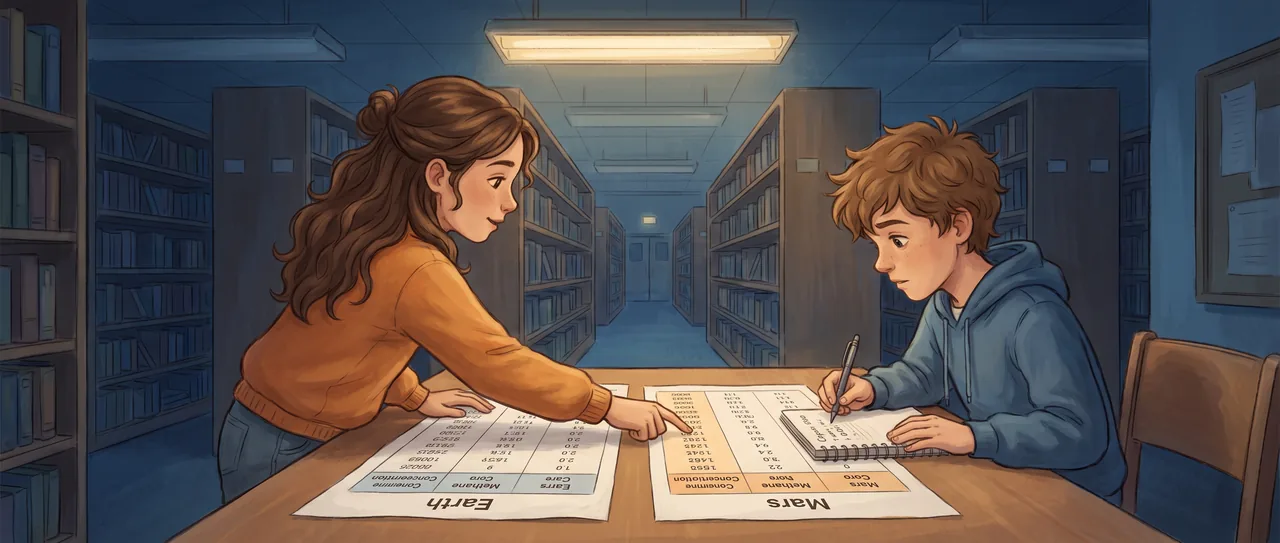
The librarian had already turned off half the lights when Maya slid the printout across the table and said, "This one's wrong."
"They don't print wrong numbers in a science journal," said Soren, without looking up. He was double-checking their citations, because their science club talk was tomorrow and he did not want to stand in front of everyone and say a thing that wasn't true.
"I didn't say they printed it wrong. I said it's wrong." She tapped the column. "Look. Methane. Summer. Then it drops. Then it comes back. Summer, drops, comes back."
Soren leaned over. The table listed methane measured in the air at Gale Crater on Mars, month after Martian month. She was right about the shape. The number went up in the warm season and down in the cold one, and it did it again the next year.
"So it's seasonal," he said. "Lots of things are seasonal."
"On Earth things are seasonal because stuff is alive," Maya said. "Leaves. Bugs. The whole ground breathing."
"You don't know that's why."
"I know that's why on Earth." She pulled the second printout toward her, the one about home. "Read me the Earth one."
Soren read it. "Almost all the methane in Earth's atmosphere is made by living things. Bacteria in swamps. Cows. Rice fields. Termites." He stopped. "Termites, apparently."
"Termites," Maya agreed, delighted for one second before her face closed back into the problem. "So on Earth, that number moving up and down. That's the planet being alive. Right? That's the actual signature of alive."
"On Earth."
"Say the Mars part again."
Soren found the line and read it slowly, the way he read things he didn't fully believe yet. "On Mars the amount of methane rises and falls with the seasons. There is no accepted explanation."
The library clock made its small tick. Somewhere a cart rolled.
"No accepted explanation," Maya repeated. "That means nobody knows."
"It means nobody's agreed," said Soren. "Those are different. People have guesses."
"Then guess."
He put his pen down, which for him was a real commitment. "Okay. Guess one. Rocks. There are rocks that can burp out methane when water gets into them. No life needed. That could do it."
"Do rocks care what season it is?"
"...Not really. That's the problem with guess one." He wrote guess one anyway, and a small dent next to it. "Guess two. The methane is old. It got trapped underground a long time ago, frozen into the soil, and when Mars warms up in summer it leaks out, and when it freezes it stops. That's seasons without anything being alive."
Maya was quiet. Then, "That one's good."
"I know it's good."
"I don't like that it's good." She frowned at the table like it had let her down. "Because trapped-and-leaking would explain the up and down. But it doesn't explain the other weird thing."
"What other weird thing?"
She ran her finger down the column again, slower. "It doesn't just go up and down. It goes away too fast. Look. It spikes, and then a few numbers later it's basically gone. Something's eating it."
Soren checked. She was right again. The methane didn't just fade the way a leak would taper off. It vanished. On Earth methane hangs in the air for years. Here it appeared and then something scrubbed it out of the Martian sky in a season.
"That's not in our notes," he said quietly.
"I know. I'm looking at the number, not the notes." She sat back. "Soren. Something makes it, on a schedule. And something destroys it, on a schedule. On the planet next door."
He didn't answer right away. He was doing the thing he did, walking each step to make sure the floor was there before he put his weight on it. "If it made it and just sat, that's chemistry," he said. "But made and destroyed, fast, timed to the warm season. That's the shape of. " He stopped.
"Say it."
"That's the shape of Earth," he said. "That's the shape our planet makes because it's covered in things that are alive."
"So is Mars alive?"
"No," he said. "I mean, I don't know. That's the whole thing. Nobody gets to say no yet. And nobody gets to say yes."
And there it was. Not an answer. The other thing. A real live drawer in the universe that nobody on Earth had been able to open, and it was just sitting there in a printout in a closing library, waiting.
"People with telescopes," Maya said. "People with rovers. People who've looked at this their whole lives."
"Yeah."
"And the honest thing they wrote down was we don't know."
"Yeah."
Maya had spent a lot of her life being the kid who wouldn't stop asking, who kept a running list in her head of things that didn't add up, who got told that everything had already been figured out by someone smarter and older and somewhere else. She looked at the words no accepted explanation and understood that this was not true. That the smartest people alive had a list too, and this was on it, and they had not crossed it off.
"They put it in a book," she said. "The not-knowing. They just. Printed it."
"That's how you do it," Soren said. "You write down the number that won't sit still, and you leave it out where somebody can find it."
Maya pulled the Mars printout close and looked at the summer column, the little rise, the number climbing off a planet where the sky is the color of butterscotch and nobody has ever proven a single living thing.
"Change the talk," she said. "Tomorrow. We don't do the answer."
"We do the question."
"We do the question."
Soren opened his notebook and copied the summer numbers down by hand, one under the other, the rise and the fall and the too-fast vanishing, while the librarian killed the last of the lights over the far shelves.
Read the interactive version, listen to the narration, and earn a gold star →
A science-verified short story for curious kids · Curiosity Land