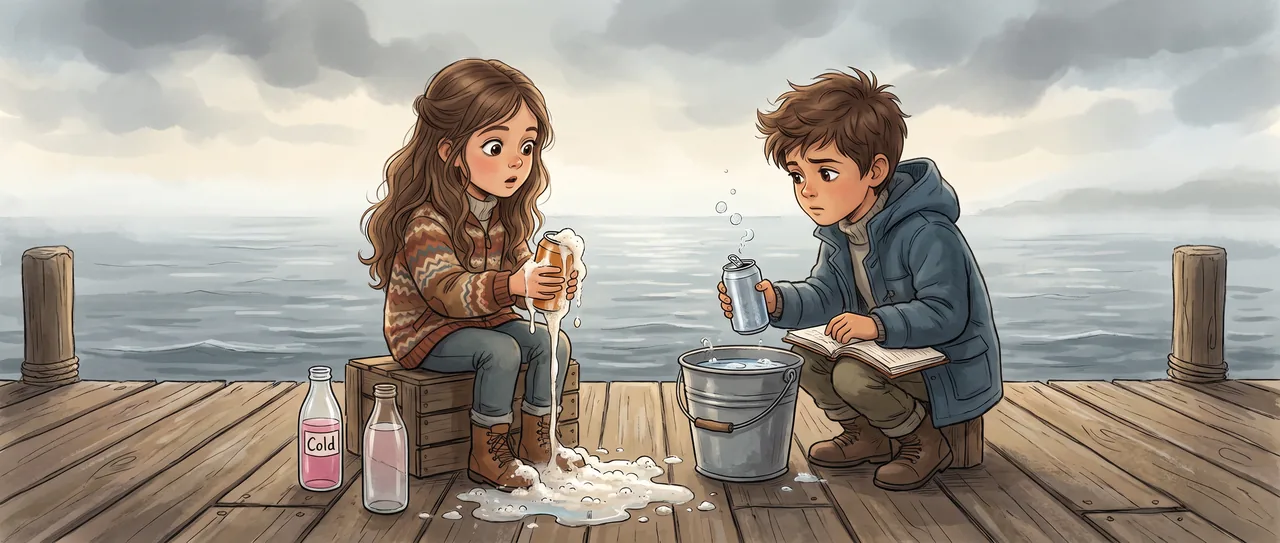
The Fizz Test
The two bottles had sat side by side on the dock all morning, and now they disagreed.
"Warm one is wrong," Maya said. She tapped the bottle they had kept in the sun. "It should match."
"It doesn't have to match," Soren said. "They started the same. Same seawater, same everything."
"Same everything except the sun bottle got warm." She held it against her cheek. "This one's warm. The cold one's cold. And the meters are different."
They had built the whole thing themselves. Two clear bottles of seawater scooped from the same bucket. Into each they had breathed through a straw, the same number of breaths, filling the space above the water with the carbon dioxide from their lungs. Then a strip of cabbage-water indicator taped to the side of each, the purple kind that turned pink when the water went sour with dissolved gas. One bottle in the shade. One in the sun.
Soren crouched and read them again, slow, the way he read everything twice.
"The cold one is pinker," he said.
"That's backwards," Maya said. "We put the same breaths in both. Same gas. The pink is supposed to tell us how much went into the water."
"So more went into the cold water."
"Why would the cold one drink more?" She was already pacing the dock boards. "It's the same air on top of both. Same amount waiting to go in."
Soren opened his notebook and wrote down the two colors, and the two temperatures beside them, and drew a small arrow between them that he did not yet know the meaning of.
"Try the fizz," he said.
That was Maya's word for it. She grabbed the two cans of plain soda water they had brought for lunch, both from the same fridge, both unopened. She handed one to Soren.
"Yours goes in the bucket of harbor water," she said. "Cold. Mine sits in the sun with me."
They waited. Gulls argued over something at the far end of the dock. When Maya's can had gone warm in her hands and Soren's had gone cold in the water, they opened them at the same time.
Maya's went off like a small animal. Foam climbed the sides and ran over her fingers and dripped off the dock.
Soren's opened with a quiet tick and a lazy curl of bubbles.
"Whoa," he said.
"Warm can lets go of the gas," Maya said. She was staring at the foam sliding down her wrist. "It can't hold it. The cold one holds it fine."
"So it's not about how much gas is waiting on top," Soren said. "It's about how much the water can keep." He looked back at the two bottles. "Warm water keeps less."
"That's why the sun bottle is wrong." Maya wasn't pacing now. "It's not wrong. It drank less because it's warm. The gas was there. The water just couldn't take it."
They looked at each other. Then they both looked, at the same moment, past the dock, at the actual ocean.
It was very big. It went out until it stopped being water and started being sky.
"Soren," Maya said carefully. "How much of it is there."
"Of the ocean?"
"Of the gas. In the ocean. Compared to the air."
Soren had read this, and he had to reach for it, and when he found it his voice went a little strange. "The ocean has about fifty times more carbon dioxide in it than all the air does."
Maya stopped. "Fifty."
"Fifty times. It's holding it the way the cold can holds it. Dissolved. Quiet." He looked at his soda, flat now. "And it keeps taking more. A big piece of everything the cars and the factories put up. Like a quarter of it. The ocean just drinks it down."
"That's good," Maya said. "That's the cold can. It's holding the fizz for us."
" "What."
He put his hand flat on the sun bottle. The pink one that wasn't pink enough.
"It's warming up," he said. "The whole thing. The whole ocean, a little. Every year a little."
Maya looked at the foam still drying on her fingers, and at the huge gray water going out to the sky, and she got there before he finished. He watched her get there.
"It's the warm can," she said. "If it gets warmer it holds less. So it takes less of ours. So more of ours stays up in the air."
"And more in the air makes it warmer," Soren said.
"Which makes it hold even less." Maya sat down hard on the dock boards. "Which leaves even more in the air. Soren. It feeds itself. It pushes its own handle."
Neither of them said anything for a second. A wave slapped the pilings under their feet, then another.
"That's the part nobody built," Soren said. "It's not a machine somebody made. It's just what cold water and warm water do. It's the same thing our two bottles are doing right here." He tapped the cold one, then the warm one. "The ocean is just the biggest can there is."
Maya was still looking at the water. "So the people figuring out the warm part," she said slowly. "The ones measuring how much it's still drinking. That's a real job. Right now. Someone's out there measuring the fizz."
"Ships do it," Soren said. "Buoys. They check what the water holds all over the world. That's a whole thing people do."
"Good," Maya said, and she meant it hard. "Because I want to know the number. I want to know if it's still drinking as much as last year. I'd check it every single day."
Soren wrote the two colors down again, and under them he wrote fifty, and he did not know how to write the size of the thing the number was attached to, so he left the rest of the page empty.
Maya stood up and lifted the warm bottle and the cold bottle, one in each hand, weighing them like she could feel the difference in what they were holding.
Then she reached down, cupped a handful of the real ocean off the top of a wave, and let it run out slow between her fingers, watching it go, trying to feel how much was hidden in the part she couldn't see.
Read the interactive version, listen to the narration, and earn a gold star →
A science-verified short story for curious kids · Curiosity Land