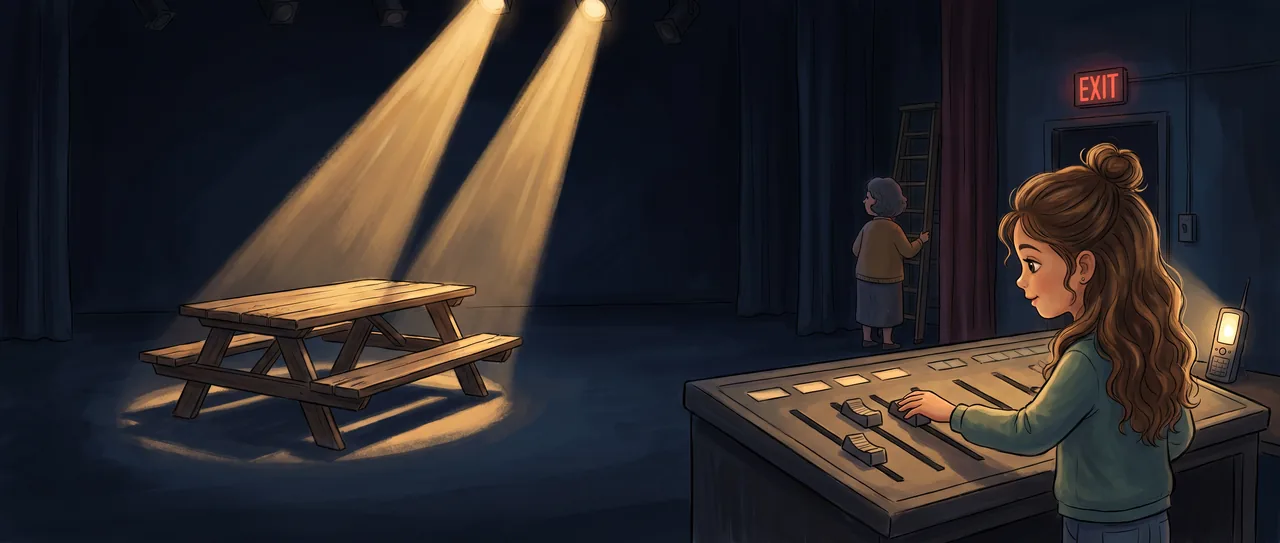
The Few Lights On
The theater was almost dark, which was the whole problem.
Maya's aunt Del was up a ladder unhooking lamps from the overhead grid, and she'd told Maya to sit tight, and sitting tight was a thing Maya did badly. So Maya found the dimmer board instead. Rows of little sliders, each one wired to one lamp in the grid above the empty stage.
She pushed every slider to full.
The whole stage went flat white. No shadows. No edges. A picnic table someone had left out there looked like a smear of nothing, like a thing photographed into a blank.
"Hey," Del called down. "That's a lot of power for a picnic table."
Maya pulled them all back down and looked at the stage in the dark and could see nothing at all. Everything on, she saw a smear. Everything off, she saw nothing. Somewhere between those was the table.
She brought up one slider. Just one. A single lamp threw a hard line down the near edge of the table, and suddenly the table had a corner, sharp as a fold in paper. Then she brought up a second lamp on the far side. Another edge. Two lamps, two edges, and now her brain built the whole table out of just those two lines, filled in the top and the legs it couldn't even see.
"Del," she said. "How many of these do I actually need?"
"To see the table? I dunno. Couple."
"Not a couple. The fewest."
Del came down the ladder because that was the voice Maya used when she wasn't going to let it go.
Maya was already testing. She turned everything off and then brought lamps up one at a time, and every time a new lamp caught an edge, the table jumped clearer. But lamps that landed in the flat middle of the tabletop did nothing. They just added glare. The middle was boring. The middle was predictable. The edges were where the information was.
"Three," Maya said finally. "Three lamps and I can see the whole table. The rest are wasted."
"Wasted is a strong word."
"They're on and they're not telling me anything." Maya turned to face Del in the dim. "Why would you ever turn all of them on? You'd burn all that power just to see less."
Del wiped her hands on her jeans. "That's actually the whole trick of lighting. You don't wash a scene. You pick the few lamps that carry the shape. A good designer lights the edges and lets your head do the rest."
Maya wasn't listening to the part about lighting. She'd caught on the other part. Lets your head do the rest.
She'd filled in the tabletop she couldn't see. From two edges. Her head had done that.
"So my eyes are doing the same thing the board does," she said slowly. "Only a few things turned on at once."
"Your eyes take a picture, kiddo. Every point."
"No." Maya shook her head, fast, chasing it. "No, if my eyes were like all the sliders full, I'd just see a smear. I don't see a smear. I see edges. Corners. The parts that change." She looked back at the stage. "Something in there is only turning on for the edges. Most of it stays off."
She didn't have the word for it. She had the shape of the word, the way you feel a stair in the dark with your foot before you see it.
Del plugged her phone into the board's little work light and the glow lit both their faces. "You're kind of describing my brain on a good tech rehearsal," she said. "I stop seeing everything and start seeing only the three things that matter."
"That's not just you," Maya said. "That's everybody's eyes. All the time. Right now."
She looked around the dark theater. The exit sign. The ladder. Del's face. And she understood that she was not seeing all of it. She was seeing a handful of edges and letting the rest be filled in, the same way she'd filled in the table. A whole seat of neurons somewhere behind her eyes, and almost all of them off. A few switched on for this line, a few for that corner, and out of that tiny scatter of on-lamps her head was building an entire room.
It should have felt like less. It felt like more.
"Del. If I built a fake eye. A computer one. And I told it it was only allowed to turn on a few things at a time. Just a few. What would it do?"
"Blow a fuse?"
"No. It'd have to figure out which few. It'd have to find the edges on its own. Because that's the cheapest way to still see everything." Maya's hands had come up off the board and she was holding them still in the air like she was cupping the idea. "It would end up doing what my eyes already do. Not because anybody told it about eyes. Just because that's what few-lamps-at-a-time makes you become."
Del looked at her for a second. "Is that true?"
"I don't know," Maya said, and she meant it completely, and it was the best thing she'd said all night. "But it feels like it has to be. If there's only one cheap way to do it, everything cheap ends up looking the same. My eyes. A computer. Anything that has to see with the fewest lights on."
She turned back to the board and pulled every slider down to black. Then, in the dark, she brought up one lamp.
One edge of the table. One clean fold of light in a room full of nothing.
"Watch," Maya whispered, though Del was already watching.
She brought up the second lamp. Then the third. And on the third the whole table snapped into being, top and legs and all, most of it invisible, all of it there.
"Three lamps," she said. "Out of forty. And I can see everything."
Behind them the exit sign hummed. On the stage the picnic table stood in its three lines of light, and everywhere the lamps weren't pointing stayed dark, and Maya kept every other slider down, and looked, and looked, and did not turn a single extra one on.
Read the interactive version, listen to the narration, and earn a gold star →
A science-verified short story for curious kids · Curiosity Land