The Color of Middle C
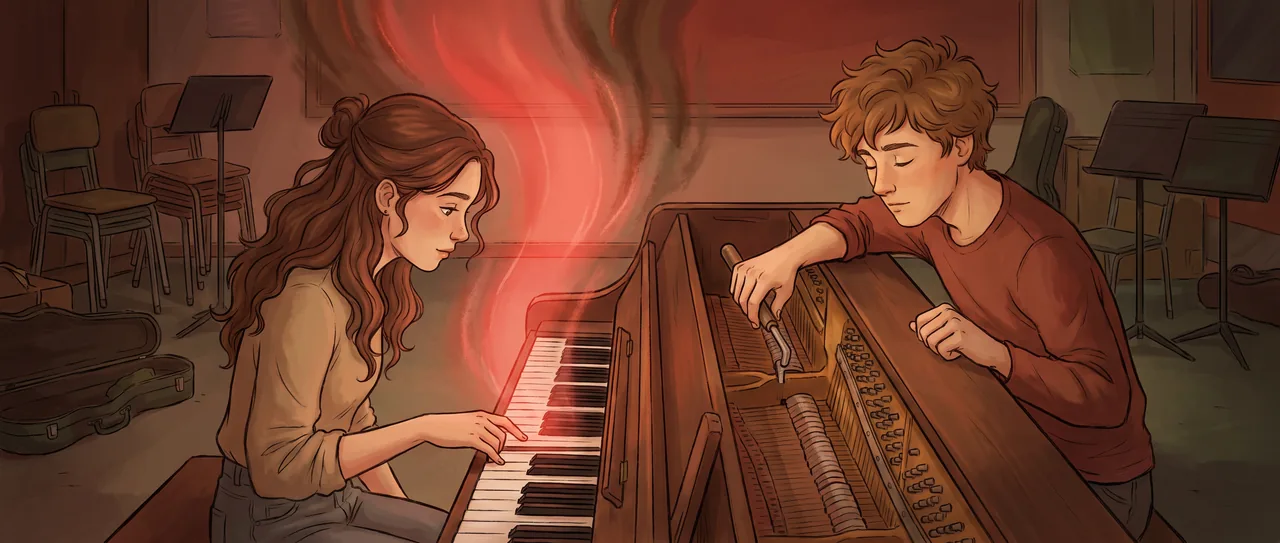
The concert was over and everyone had gone home except Maya and Soren, who were supposed to be stacking chairs and were instead standing at the old upright piano nobody wanted to play.
"It's flat," Maya said. She pressed one white key, then another. "This one especially. It went brown."
Soren was holding his phone. The tuning app had frozen on a spinning circle and would not unfreeze. He shook the phone, which did nothing, because shaking has never fixed software.
"App's dead," he said. "We'll have to do it by ear. Play the flat one again."
Maya played it. "Brown," she said again.
"What's brown?"
"The note. It's a muddy brown. The one next to it is more of a red." She played it to check. "Yeah. Red."
Soren looked up from the phone. "The note is red."
"The sound is red. Middle C is red." She said it the way you'd say the sky is up. "It always has been. Play the low one and you'll see, it's almost black."
Soren played the low one. It was a low sound. It was not black. It was not anything except low.
"I don't see black," he said carefully.
"Ha ha."
"No. Maya. I'm not joking. I hear a low note. There's no color."
Maya's hand stopped on the keys. "There's no color when I play this." She hit middle C, hard. "This one."
"There's a sound. A clear one. That's it."
She hit it three more times, watching his face the way you watch someone to see if they're teasing. His face stayed the same kind of confused.
"Okay," she said slowly. "Do the letters. When you write the letter A. What color is it."
"Letters aren't colors."
"A is red," Maya said. "B is orange, sort of a burnt orange. Five is yellow. Seven is green. Tuesday is a darker green than seven."
Soren put the phone down on the piano lid. He picked up his notebook instead and opened it flat and clicked his pen.
"Say that again. Slower."
"A is red. Two is white. Two is really white, like the whitest one." She was frowning now, not upset, just working. "You're telling me two isn't white."
"Two is a two. It's whatever color the pen is." He was writing fast. "You see them even when they're printed in black?"
"The black is on top. The real color is underneath." She looked at him. "Everybody has the underneath one. Don't they."
Soren stopped writing.
"I don't," he said.
The room was very quiet. "Play middle C one more time," he said.
She played it. Red, for her. A sound, for him. The same wire in the same piano hitting the same string the same number of times a second, and it walked into two different heads and became two different things.
"How do you tune it, then," Maya said suddenly. "If you can't see when it's off. I can see it. When it's in tune the red is clean. When it's flat the red goes brown and muddy on the edges."
Soren tilted his head. "When it's off, I hear a wobble. Two notes fighting. They beat against each other, wah, wah, wah, and it gets slower as they get closer, and when they stop fighting it's in tune."
"I don't hear a wobble."
"You don't hear the beats?"
"I see the mud clearing up."
They stared at each other over the top of the piano.
"We're doing the same job," Soren said slowly, "with two completely different tools, and we didn't know until the app broke."
"Play the tuning fork," Maya said.
Soren struck the fork against his knee and pressed the stem to the piano's wood. The true note came up through the whole body of the instrument.
"That's it," they both said, at the exact same time, and then looked at each other because they had not meant the same thing at all.
"That's clean red," said Maya.
"That's no wobble," said Soren.
He reached in with the tuning wrench, the one the music teacher had left on the lid, and turned the pin a hair. "Tell me when the red is clean. I'll tell you when the wobble stops. If we hit it at the same time, we know we're right."
Maya leaned in close to the keys. Soren closed his eyes.
He turned the pin. Slow.
"Muddy," said Maya.
"Wobble," said Soren.
He turned it more.
"Getting redder."
"Wobble's slowing. Wah. Wah. Wah."
A hair more.
"Almost. Almost. There's still a little brown right on the top of it."
"One more beat. Half a beat." His hand moved like he was cracking a safe. "Almost."
He turned the pin the smallest amount a hand can turn a thing.
"Clean," said Maya.
"Stopped," said Soren.
Together. Actually together this time, the word landing on top of the word.
They didn't move. The note hung in the air, one single true note, and it was red and it was silent-of-wobble and it was both of those and neither of those, depending on which skull it was standing in.
"There are people," Soren said quietly, "who taste words. It's a real thing. It's called synesthesia. I read about a man who said the name Kevin tasted like toast."
"So I'm not broken."
"No. You've got the wires most people don't. About four out of a hundred, the article said. It runs in families." He wrote the number down. "My grandmother said thunder was purple. Everybody thought she was being poetic."
Maya put her finger back on middle C but didn't press it. "Wait. So every person in this school heard tonight's concert." She was going fast now. "And not one of them heard the same concert. Some of them saw it. Some of them tasted it, maybe. And nobody in that whole room knew, because everyone thought their own underneath was everybody's underneath."
"Play it," Soren said.
Maya pressed middle C, and let it ring out into the empty room, into both of them, where it split cleanly in half and became two entirely different true things at once.
Read the interactive version, listen to the narration, and earn a gold star →
A science-verified short story for curious kids · Curiosity Land