The Cells That Kept Counting
The museum at night hummed like a refrigerator that had opinions.
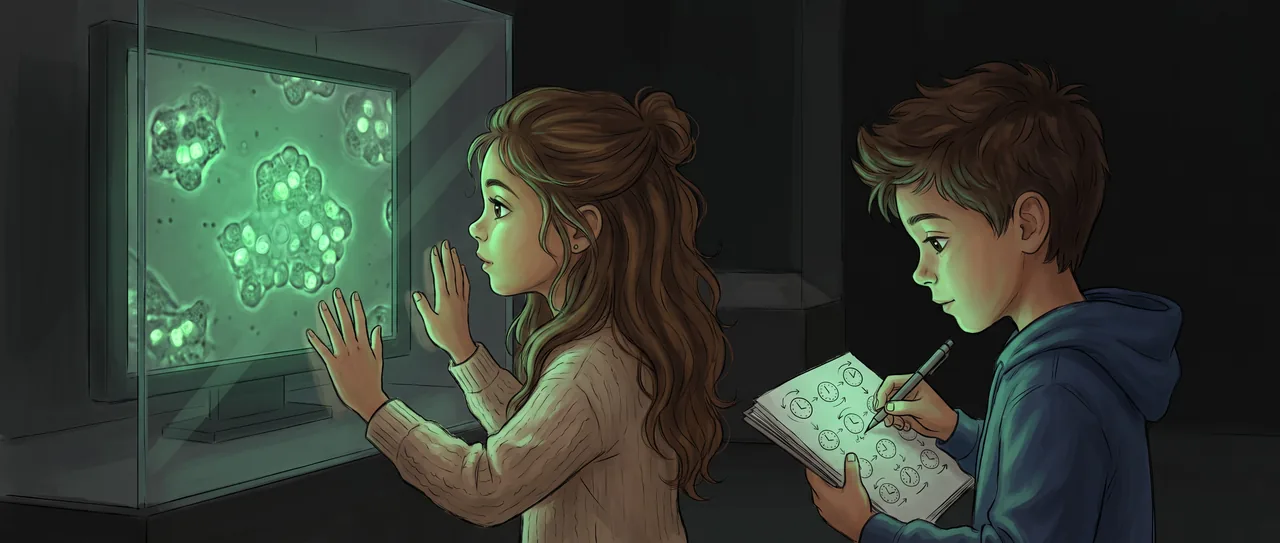
Maya pressed her face close to the exhibit glass. Behind it, a small screen still glowed, left on for the cleaning crew. It showed a dish of cells under a microscope, tinted green, brightening and dimming in a slow pulse.
"They're still going," she said.
"The video's just looping," Soren said. He checked the placard. "No. Look at the timestamp. It's live. That's a real dish in a lab somewhere feeding a signal here."
"So those cells are awake right now."
"They're not awake or asleep. They're in a dish. There's no brain in a dish."
Maya tapped the glass where the placard said the cells had been separated from a mouse eleven days ago. "Then why are they doing that. The glowing. It's on a beat."
Soren read further, following the words with his finger the way he did when he wanted to be sure. "The glow comes from a gene that switches on and off. It's a clock gene. When the clock says day, the cells make one protein. That protein tells the gene to shut off. Then it fades. Then it builds up again. Takes about a day to go all the way around."
"A day," Maya said. "In a dish. With no sun. No windows."
"That's the part that's weird."
Maya loved when he said that. It meant he'd stopped defending the easy answer.
Mr. Osei, the janitor, came around the corner pushing his cart. "You two are supposed to be by the doors. Your teacher's picking you up in ten."
"Mr. Osei," Maya said, not moving. "How long has this screen been on?"
He shrugged. "Long as I've worked here. Nobody turns the lab off. That's the whole point, they told me. Those cells don't quit."
"For how long?"
"Weeks, they said. They keep the same schedule for weeks." He wiped a smudge off the glass with his sleeve, right over the green pulse, then moved on. To him it was just another lit-up box.
Maya watched the glow rise. "Soren. If the cells were still connected to the mouse, what would tell them when it's day?"
"The mouse's eyes," Soren said. He said it slowly, building it. "Light comes in through the retina. But not the seeing part. There's a separate signal that goes to one spot in the brain. A little clump of cells above where the nerves from the eyes cross. It sets the time for the whole body. Every morning the light resets it."
"The master clock."
"Right. It sends the time out to everything. Heart, liver, skin."
Maya turned to face him. "But the dish got cut off from the eyes eleven days ago. No brain. No light. No master clock."
"Yeah."
"And it's still keeping time."
Soren stopped. He looked at the dish, then at the placard, then at the dish again, testing whether he'd read it wrong. "So the master clock isn't making the time," he said. "It's just. Agreeing on the time."
"Say that again."
"The little clump in the brain, the master one, it's not the only clock. Every cell already has its own clock. Every single one. The brain just, like, shouts the time so they all match. But if you take a cell away, it keeps counting anyway. On its own. It just drifts a little, because nobody's shouting anymore."
Maya put both hands flat on the cool glass. "There's a clock in every cell of me."
"In every cell of everybody."
"Right now. In my hands. In my thumb."
"Ticking," Soren said. "About once a day. All of them."
They stood there while the green pulse climbed toward its bright point. Maya was quiet, and then she wasn't.
"That's why," she said.
"Why what?"
"Why I wake up before my alarm. On Saturdays too. My mom says I'm broken. I always wake up at the same wrong time even when nothing's telling me to."
"Nothing's telling you to," Soren said, "except a couple trillion clocks that already know."
Maya laughed, but her eyes were stinging a little, and she didn't wipe them. "So I'm not doing it. My body's doing it without me. It was counting the whole night while I was asleep and didn't know."
"It counts whether you know or not." Soren pulled his notebook from his jacket. His hand moved fast across the page, drawing a small circle, then another, then a dozen more, each with an arrow chasing its own tail. "That's what the dish proves. You could take one cell out of you and put it in a jar and it would keep your morning. For weeks. Without you."
Maya watched the drawing fill up with tiny circling clocks. "How does one cell know what a day is if it can't see the sun?"
Soren's pen slowed. "I don't know," he said. "That's the actual question, isn't it. Where does it even keep the number. It's just proteins going up and down. And somehow up-and-down adds up to a day. The right length. Almost exactly."
"Almost."
"That's why the light matters. The clocks are close but not perfect. Every morning the sun nudges them back onto the same beat." He looked up. "But the beat was already there. Before the sun. Underneath it."
Headlights swung across the dark hall. Their teacher's car, pulling into the lot.
Maya didn't turn toward it. She kept her eyes on the dish, and the dish glowed, and dimmed, and began to glow again, counting out a day it had no way to see, in a room with no windows, on the eleventh night since it had last belonged to anything.
"It's about to be morning in there," she said quietly.
Soren checked the timestamp against the clock on the wall. The two numbers were hours apart. The cells didn't care. Under the green light they climbed toward their own private dawn.
Read the interactive version, listen to the narration, and earn a gold star →
A science-verified short story for curious kids · Curiosity Land