The Weather Report From Titan
The shop smelled of solder and cold. Soren's fingers had gone stiff around the drone's little frame, and outside the window the snow came down in the fat, slow flakes that fall when the air is barely freezing.
His uncle Piet was busy under the workbench, swearing gently at a motor that would not spin. Soren was supposed to be holding the propeller still. He was mostly watching the tablet.
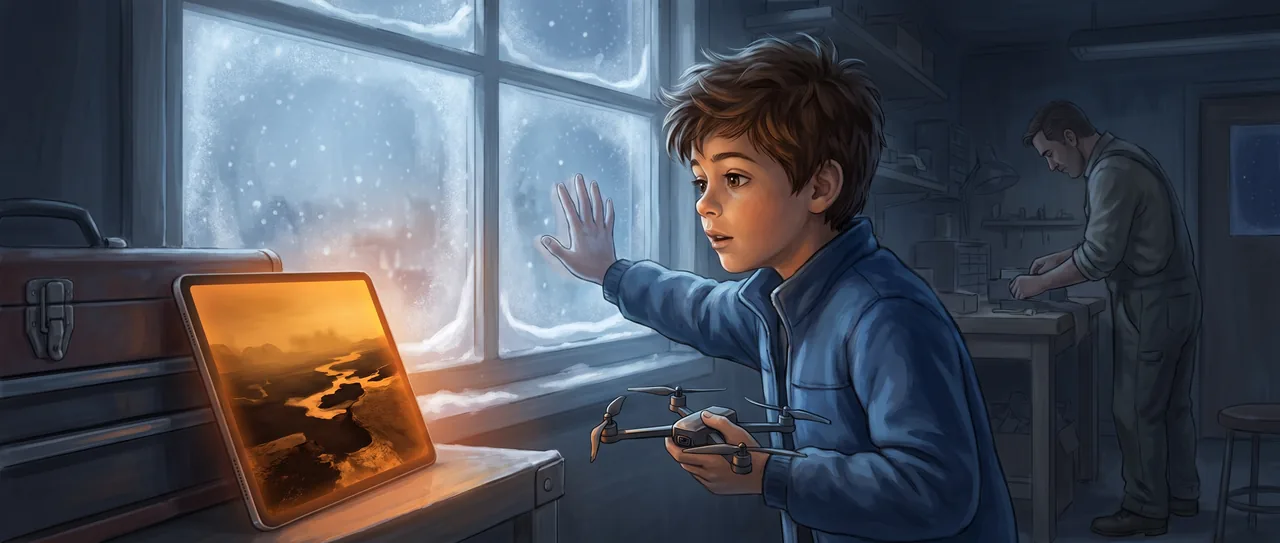
It was playing a slideshow of pictures from a spacecraft, one his uncle had downloaded and forgotten about. Orange. Everything on the screen was orange, a thick, soupy orange, like looking through a jar of honey.
"That's Titan," Piet said without looking up. "Saturn's big moon. Bunch of haze. Boring."
Soren did not think it was boring. He thought the haze looked heavy.
He scrolled. The next picture was not orange. It was taken from underneath the haze, close to the ground, and it showed a shoreline. A dark, flat shore, and dark liquid lapping against it, and channels branching back into hills like the veins on the back of a leaf.
"That's a river," Soren said.
"Can't be water." Piet slid out, wiped his hands. "Too cold out there. Minus one hundred seventy-nine. Water's rock at that temperature. Hard as the floor."
Soren looked at the branching channels. He knew what carves a channel like that. Something has to flow, and pool, and rain, and flow again. Something has to fall out of a sky.
"Then what's raining," he said. It was not really a question. His breath fogged in front of him.
He reached into his jacket and found the notebook, and he drew the shoreline. The pencil kept skating on the cold paper. He drew the hills, the veins, the flat dark sea.
"Methane," his uncle said, reading off the tablet's caption now, interested despite himself. "Lakes of liquid methane and ethane. Same stuff that's in the burner on the stove." He tapped the screen. "On Titan it's so cold the gas turns to liquid. Rains down, fills up lakes. There's a whole weather cycle. Just with the wrong liquid."
Soren held the drone up. The propeller drooped, unspinning, a dead thing in his palm. He thought about the snow outside, which was water, falling because the air here was cold enough to freeze it but not cold enough to freeze everything.
"So it's the same," he said slowly. "It's exactly the same. It's just colder, so a different thing is the liquid."
"Sort of." Piet took the drone back. "Except you'd freeze solid in a second out there. Nothing like here."
But Soren was still looking at the picture, and something was turning over in him, cold and enormous.
On Earth, water was the liquid and rock was the solid and air was the gas. Three roles. He had always thought the roles belonged to the actors. Water was wet because water was water.
On Titan the actors had traded places. It was so cold there that the methane, which was a gas in his kitchen, had come down to be the rivers. And the water, which was the sea here, had frozen so hard it had gone the other way. It had become the ground. The rock. The crust.
"The ground is ice," Soren said. His voice came out strange. "On Titan the hills are made of frozen water. Water is the rock there."
Piet paused. "Huh. Yeah. Water-ice crust. That's what it says."
Soren pressed his cold hand flat against the shop window, and the snow blurred through the glass, and the glass was so cold it almost burned.
He was not touching Titan. He knew that. But he was touching the idea of it, which was that wet and hard and airy were not fixed. They were just temperatures. Turn the dial down far enough and the sea climbs into the sky as haze, and the air comes down as rivers, and the water lies still under everything, holding up the hills, patient as a floor.
"There's an atmosphere too," his uncle said, still reading, warming to it now. "Thicker than ours. You could almost fly out there." He turned the drone over in his hands. "Air's denser. Gravity's weaker. You'd flap and go straight up."
Soren looked at the drooping propeller. Then he looked at the drone. Then he looked back at the picture of the orange sky, thick and heavy and slow, the honey-jar sky.
"You could fly this there," he said. "Easier than here. In that thick air, with barely any gravity, this could just." He lifted his hand off the window and floated it upward. "Go."
"NASA's actually sending one," Piet said. "A drone. Big one. Going to fly around Titan and land in different spots." He said it the way you mention the weather. Soren was thinking about a drone with eight blades beating against orange air a billion kilometers away, lifting off a beach of water-ice, over a black sea of methane, in the cold that turns the sky to rivers. He was thinking that somebody had looked at that orange soup and not called it boring. Somebody had looked and thought, I could fly there. I want to see the shore.
He knew that feeling. It was the one that made him keep a notebook when everyone thought that was strange. The feeling of standing at a window with your hand going numb because you could not put the thing down.
"When," Soren asked.
"Years. You'll be grown."
Soren looked at the picture of the river that was not made of water, on the moon where the sea was frozen into hills, under a sky heavy enough to swim in. Somewhere out there, right now, in the dark and the minus one hundred seventy-nine, it was raining. Slow methane rain, falling into a lake it had rained into a thousand times before, filling the channels, drop by patient drop, whether anyone was watching or not.
On the tablet the slideshow moved on. The shore vanished. The orange came back.
Soren picked up his uncle's screwdriver and reached for the drone's dead motor.
Read the interactive version, listen to the narration, and earn a gold star →
A science-verified short story for curious kids · Curiosity Land