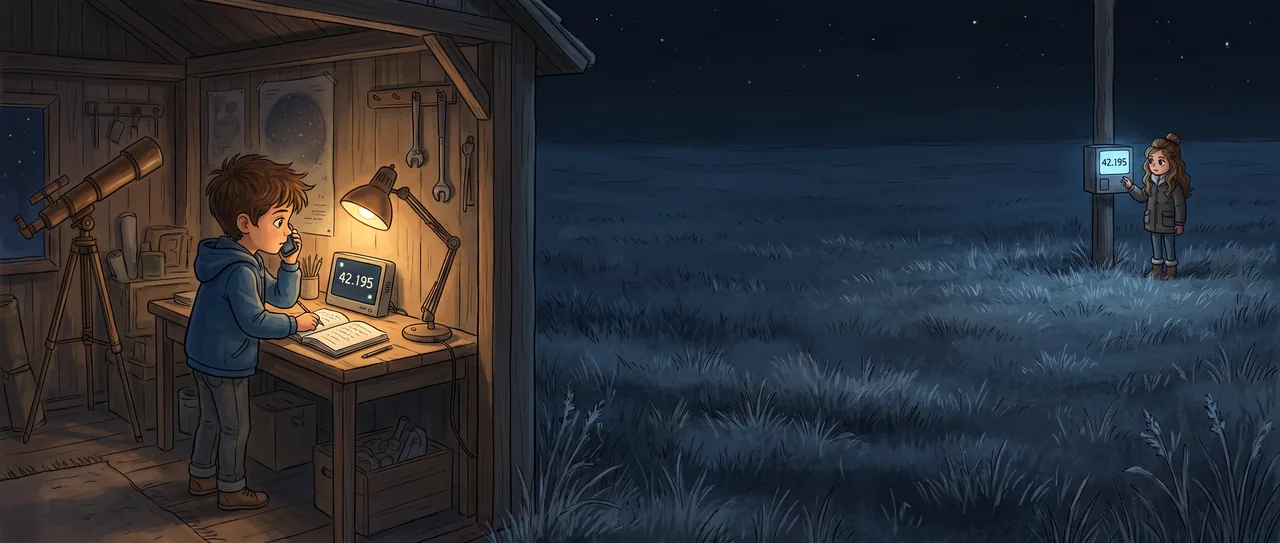
The Two Coins
The shed smelled like dust and cold metal. Somebody had left the heater off for a whole winter.
Maya found the switch by feel. A single bulb came on over a bench crowded with black boxes, coiled wire, and two small screens that were somehow still glowing.
"It's still running," Soren said. "Whatever it is."
On the wall, taped crooked, was a note in an adult's slanted handwriting: LEAVE ON. Do not unplug. That is all it said.
Maya leaned over the two screens. Each one showed a single dot, blinking. Left screen, right screen. Every second or so, both dots flashed a number. Sometimes zero. Sometimes one.
"Watch," she said. "They match."
Soren watched. Left flashed one. Right flashed one. Left flashed zero. Right flashed zero. Left one, right one.
"So they're wired together," he said. "Same signal going to both screens."
"Maybe." Maya was already following the cables with her finger. "But look. This one goes into that box. And that box has a fiber going out the wall."
Soren traced the other side. The right screen's box had its own fiber, running out a different hole in the wall, toward the field.
"They don't connect to each other," he said slowly. "They both go outside."
He pulled his notebook from his jacket and set it open on the bench. His pen moved. Left: 1. Right: 1. Left: 0. Right: 0.
"Okay," Maya said. "So the real things aren't the screens. The screens are just reading something out there."
They found the second note under the right-hand box. Smaller writing this time. Detectors are 400 m apart across the field. No cable between them. If you don't believe me, walk it.
Maya was already at the door.
"I'll go to the far one," she said. "You stay. Watch your screen. Say the numbers out loud, loud as you can."
"You won't hear me across a field."
"I'll bring my phone. Call me. Don't hang up."
He called. She answered, and her voice went tinny and small, and then he heard her boots crunching away over frozen grass, out past the bulb's reach into the dark.
"Talk," she said in his ear. "Read your screen."
"One," Soren said, watching the left dot. "One. Zero. One. Zero. Zero. One."
Her breathing. The crunch of grass. Then nothing but wind for a long time.
"I'm here," she said finally. "There's a box on a post. Little screen on it. Same as yours."
"Read it to me."
"Ready?"
"Go."
"One," Maya said. In the shed, Soren's left screen showed one. "Zero." His screen showed zero. "Zero. One. Zero."
Every number she read from four hundred meters away, his screen had already shown. Or shown at the same instant. He couldn't tell which came first. That was the thing that made the back of his neck go strange.
"Maya," he said. "We're reading the same numbers."
"I know. But there's no wire. I walked it. There is nothing between these two boxes but grass."
Soren looked at his notebook. Two columns of ones and zeros, identical the whole way down.
"Wait," he said. "Maybe they agreed ahead of time. Like two coins that were painted before we got here. Yours was always going to say one, mine was always going to say one. They only look connected."
"Two coins painted the same," Maya repeated. "That's clever. That would explain it with no wire."
"Right."
She was quiet. Wind in the phone.
"But then how do they pick," she said. "Your list isn't all ones. It's one, zero, one, zero, zero. It's random. Coins painted ahead of time can't be random and match. If it's random on your side, it has to disagree with mine sometimes."
Soren looked at his columns again. Random down the left. Random down the right. Identical the whole way.
"They never disagree," he said.
"Not once," Maya said. "I've read you forty numbers. Not once."
He felt the shed get bigger around him. Not the shed. The space past the shed. The field she was standing in, and the space past that.
"Then it's not paint," he said. "They're not deciding early. They're deciding at the same moment. Both of them. Right when we look."
"With nothing between them," Maya said.
"With nothing between them."
There was a third note. Soren found it folded inside the notebook the physicist had left behind, on the bench, under the left box. He read it out loud so Maya could hear.
"It says: You will want to send a message with this. You can't. You can't make your side say what you want. It's random on both ends. You only see it matched afterward, when you compare. The matching is real. The message is not possible. I checked for two years. I could not beat it. Nobody has."
"Read that again," Maya said.
He read it again.
"So the two boxes agree perfectly," she said, slow, working it in the dark. "Faster than anything could carry it between them. But you can't use it to send a single word. Because you can't control your own end."
"That's what it says."
"That's the strangest thing I've ever heard," Maya said, and Soren could hear that she was grinning, out there in the black field, alone with a box on a post. "It's connected and it's useless at the same time. It's connected in a way that doesn't let you do anything with it. It just is."
Soren wrote that down. Connected. No wire. No message. Just true.
"Soren," Maya said. "Read me your next number."
He looked at the left screen.
"Zero," he said.
Four hundred meters away, across a field with nothing in it but frozen grass and the two of them, Maya looked at the box on the post at the exact same second.
"Zero," she said. "Of course. Zero."
The two dots blinked together in the dark, one in his hand, one in hers, and neither of them had told the other a thing.
Read the interactive version, listen to the narration, and earn a gold star →
A science-verified short story for curious kids · Curiosity Land