The Stone That Remembers Rain
The guide had said do not touch anything and then walked forty children deeper into the mountain, and now the cave was quiet except for water counting itself somewhere in the dark.
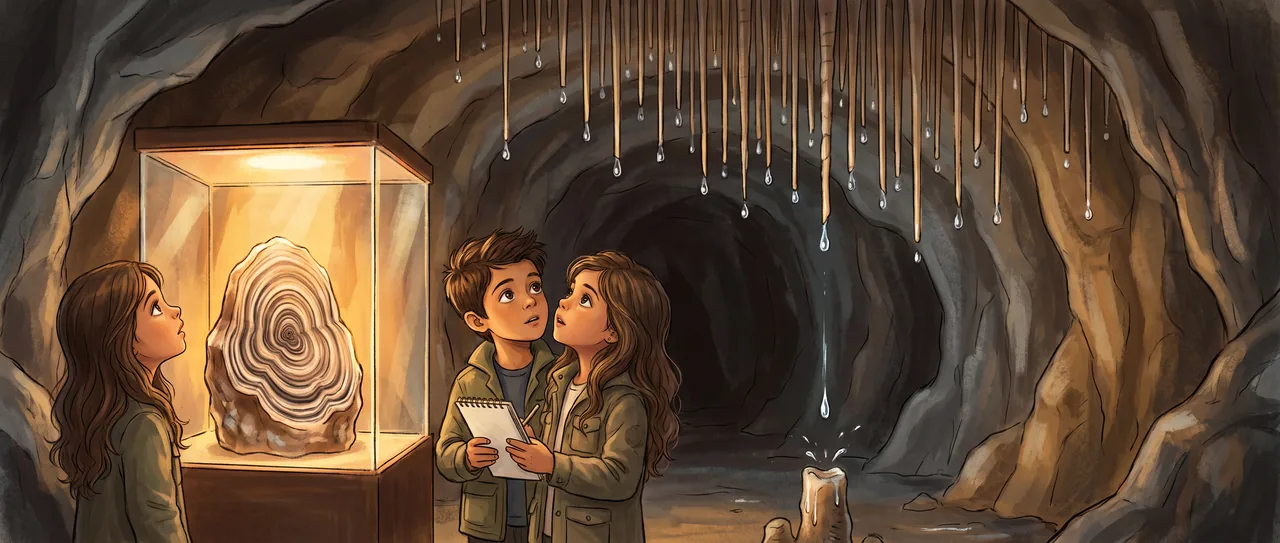
Maya had stopped at the glass case near the exit. Inside it lay a stalagmite that somebody had cut in half and polished, a stub of stone the size of a fire extinguisher lying on its side.
"Soren. Look at this."
He came back. He was always willing to come back.
The cut face was not gray. It was rings. Hundreds of them, thin as hairs, dark and pale and dark again, wrapped around a center point the way an onion wraps around nothing.
"It's like a tree," Soren said.
"It's not a tree. Trees are alive."
"I know it's not a tree. I said like." He leaned closer to the glass. His breath fogged it and he wiped it with his sleeve. "But the rings mean the same thing. One ring, one year. They have to."
"Why do they have to."
Soren thought about it. He did not answer fast, but he answered. "Because something has to change once a year to make a line. Trees do it with growing seasons. This thing." He stopped. "This thing is just stone. Stone doesn't have seasons."
Maya was already reading the little card bolted to the case. Her finger moved under the words even though nobody was making her.
"Precipitation," she read. "It grew by precipitation."
"Rain?"
"No. The chemistry kind. When something comes out of water and turns solid." She looked up at the ceiling of the cave, where a hundred thin points hung down, each one wet at the tip, each one holding a single trembling drop. "The water comes through the rock. It's carrying rock in it, dissolved, like sugar in tea. Then it drips here and lets a little bit of the rock go. Every drip leaves a speck."
Soren followed a single drop with his eyes. It hung. It swelled. It let go. It fell the whole height of the cave and landed on a stump of stone below with a sound like a clock.
"How long does one speck take," he said.
"The card doesn't say."
"Guess."
"Nothing. A hair of nothing." Maya pressed her nose almost to the glass. "But the rings. The dark ones and the pale ones. Something makes them different colors."
And here they both went quiet, because they had arrived at the same edge from two directions and neither of them was across it yet.
"The rain," Soren said slowly. "Wet years and dry years. In a wet year more water comes through the rock. It carries more stone. The ring is different."
"So the color is the weather," Maya said. "The color of the ring is what the sky was doing."
They looked at the polished face together. Hundreds of rings. Hundreds of years, stacked, each one a summer and a winter that some drop of water had carried down through the dark and set into stone one speck at a time.
"Count them," Maya said.
"I can't. They're too thin at the middle." Soren squinted. The rings crowded together toward the center until they blurred into a single dark smear no wider than a fingernail, and even that smear, he understood, was years. Dozens of them. Maybe hundreds. Pressed so tight his eye couldn't split them.
"This one's small," he said. "This one's only a piece. And it's already older than everybody I've ever met, added together."
Maya turned around.
She looked up at the ceiling again, at the forest of wet points hanging in the dark, and this time she did not look at one drop. She looked at all of them.
"Soren."
"What."
"They're still going."
He turned too.
Every tip up there held a drop. Every drop was carrying a speck of dissolved mountain. Every speck was landing, right now, in the dark, on stumps of stone that were writing this exact year into a ring nobody would cut open for ten thousand years.
"It's recording us," Maya said. "Right now. Tonight's ring. This is a wet year or a dry year and the stone is writing it down and it doesn't know we're here."
Soren pulled his notebook out of his jacket. He uncapped the pen with his teeth and drew a circle, and a ring around it, and a ring around that, his hand moving in the cave light while a drop above them let go and fell.
"There's rain in here from before there were people who could write," he said, not looking up. "The oldest rings. That rain fell on somebody's mountain and nobody wrote it down. Except this did."
"Tens of thousands of years," Maya said. She was reading the card again. Her voice had gone careful. "The oldest ones go back tens of thousands of years. Every wet year. Every dry year. All the way down."
"And we can read it." Soren finally looked up from the page. "Nobody was there. There was nobody there for most of it. But the stone kept the diary anyway, and now we showed up, and we can read a book that started before there was anybody to read it."
The cave dripped. Down the hall, far off, the guide's voice said something about the gift shop.
Maya did not move toward it.
"How many rings are being written right now," she said. "In this whole cave. This second."
Soren looked up at the ceiling and tried to count the drops and gave up somewhere past forty, because there were more points of water hanging in the dark than he could hold in his eyes, and every single one of them was a pen.
A drop swelled at the tip of the nearest stone straw, caught the light, stretched thin, and fell. It struck the stub below and left behind one more speck of a mountain that had not finished coming down yet.
Read the interactive version, listen to the narration, and earn a gold star →
A science-verified short story for curious kids · Curiosity Land