The Shrinking Letter
The classroom smelled like the whiteboard cleaner Mr. Okafor used when the bell rang, which meant everyone had gone and nobody had told Maya and Soren to leave.
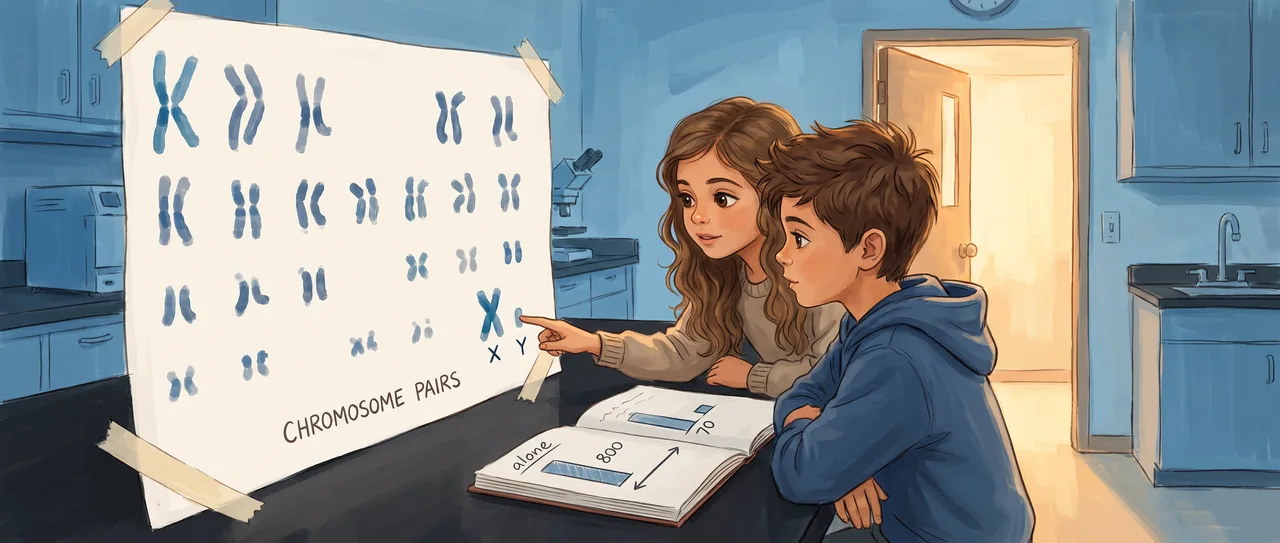
The printout was still taped to the wall, twenty-three pairs of chromosomes lined up like a family photo. Twenty-two pairs matched, twin to twin. The last pair did not.
"That one's broken," Maya said, pointing at the last pair. One chromosome was a fat blue bar. The one beside it was a stub.
"It's not broken," Soren said. He had the class handout, the one Mr. Okafor had waved around and then abandoned when the bell cut him off. "That's the Y. The little one. Says here it has fewer than seventy genes."
"Seventy." Maya looked at the fat one next to it. "How many does the big one have?"
Soren ran his finger down the sheet. "The X has around eight hundred."
Maya stopped. She looked at the two bars, then at Soren, then back.
"They were the same size once," she said.
Soren looked up. "What made you say that?"
"Because they're a pair. Everything else in the photo is a matching pair. So those two started matching too. And then one of them—" she flicked the stub with her fingernail, "—fell apart."
Soren flipped the page over. He read for a second, and his eyebrows went up in a way Maya had learned to trust.
"You're right," he said. "It says they used to be a matching pair. Three hundred million years ago. Same length. Same genes on both."
"So what happened."
"It lost them. The Y. It says it's lost about ninety-seven percent of the genes it started with."
Maya sat down on the edge of a lab stool. "Ninety-seven percent."
"Out of maybe a thousand. Down to under seventy."
"That's not losing a few," Maya said. "That's a whole chromosome falling off a cliff."
Soren was already pulling his notebook out of his bag. He opened it flat on the black counter and drew two bars, one tall, one short. Under the tall one he wrote eight hundred. Under the short one he wrote seventy. Then he drew a long arrow between a past he couldn't see and the stub in front of him.
"Here's what I don't get," he said. "Why does one shrink and not the other. They're a pair. Pairs are supposed to fix each other."
Maya leaned over his drawing. "How do they fix each other?"
"When you make new cells, the pairs line up and trade pieces. Swap. If one copy gets a typo, the other copy is right there to compare against. They repair by matching."
Maya went quiet. She was looking at the stub.
"The Y can't match," she said slowly. "Can it. It doesn't have a twin anymore. The X has a matching X to line up with. But the Y is the only Y in the whole cell. There's nothing next to it to compare against."
Soren's pen stopped.
"Say that again."
"It's alone," Maya said. "That's the whole thing. The X gets checked against another X every time. The Y has no partner to check against. So when a gene breaks, nobody catches it. And it just—" she opened her hand, "—goes. And the next one. And the next one. For three hundred million years."
Soren wrote the word alone in the margin and then looked at it like it had surprised him.
"That's actually why," he said. "That's the mechanism. No partner, no proofreading. Everything else in the photo has someone to check its work. The Y doesn't."
Maya was staring at the printout with a look Soren couldn't read.
"So it should keep shrinking," she said. "If nobody's checking it. It should go to sixty. Then fifty. Then zero. It should just disappear."
Soren flipped the page again, fast now, hunting. He found a paragraph near the bottom, the part Mr. Okafor never reached.
"Maya." His voice changed. "It doesn't disappear."
"Why not."
"It says the genes that are left aren't random. The junk fell off. But the ones still there are the ones you can't live without. They got protected. It says the Y folded part of itself into a shape like a hairpin, so a piece of it can bend over and check against its own other half. It made a partner out of itself."
Maya stood up off the stool.
"It built its own mirror," she said.
"Out of the same strand. It bends back and proofreads itself against itself." Soren read it twice to be sure. "The thing that had no partner grew a way to be its own partner."
They both looked at the stub on the wall. It didn't look broken anymore. It looked like something that had thrown away everything it didn't need and kept a grip on everything it did, alone, for longer than there had been flowers on Earth.
"Everybody thinks it's the little useless one," Maya said. "The leftover. The one that lost."
"It's the one that had to survive without anyone checking its work," Soren said, "and figured out how."
Maya put her finger on the seventy Soren had written, then on the eight hundred.
"Nobody knows if it's still shrinking," she said. "Do they. Right now. In us. Tonight."
Soren looked back at the handout. There was no answer to that on the page. He checked. He turned it all the way over. The back was blank.
"No," he said. "They're still arguing about it. Some of them think it'll go. Some think it already hit the floor and stopped."
"So it could be doing either." Maya's eyes were very bright. "And it's in half the people who ever lived, and we don't know which."
Mr. Okafor's keys jingled in the hall. Neither of them moved.
Soren reached up, peeled the tape, and slid the chromosome photo carefully into the back of his notebook, the fat bar and the stub side by side, and closed the cover over both of them.
Read the interactive version, listen to the narration, and earn a gold star →
A science-verified short story for curious kids · Curiosity Land