The Shoelace Count
The two dogs were the same age and Maya could not make herself believe it.
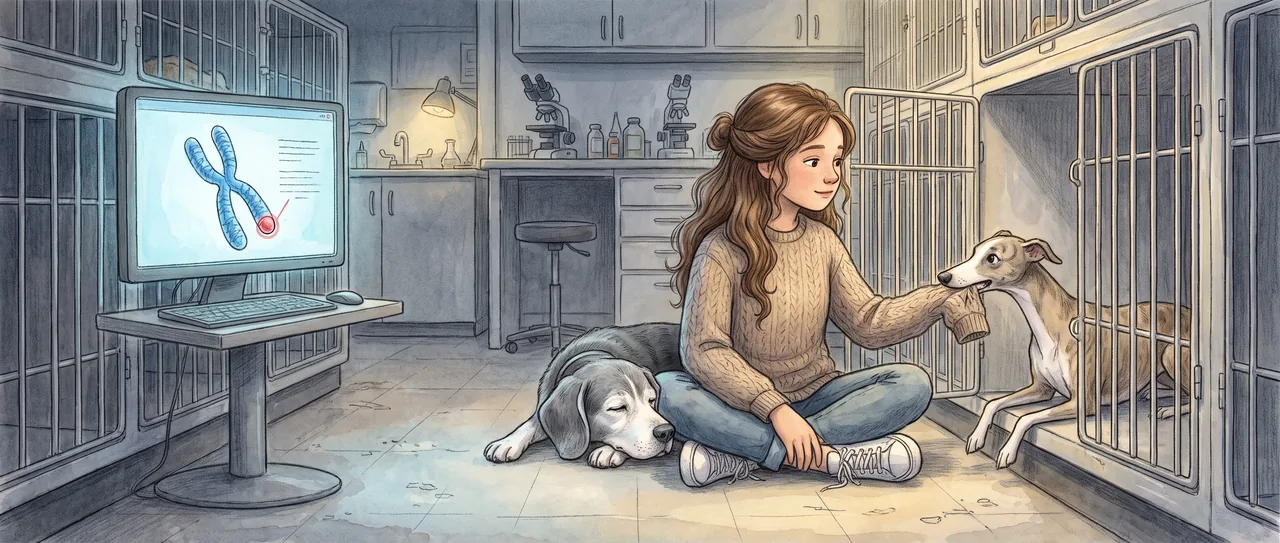
One was a beagle named Rufus who slept in a gray heap by the door, breathing like a broken accordion. The other was a whippet named Pin who kept trying to climb into Maya's lap, all elbows and heartbeat. The card taped to each cage said the same thing. Born the same spring. Nine years old.
"They can't be," Maya said.
Aunt Del did not look up from the centrifuge. "They can and are. I ran the paperwork myself."
"Rufus is old. Pin is not old."
"Rufus is a beagle," Del said, like that settled it. It did not settle anything. It only opened a new door, which is what most answers did, in Maya's experience.
She crouched by Rufus. His muzzle was frosted white. His eyes had that blue haze old dogs get. Nine springs had happened to both dogs, the exact same nine, the same number of winters, the same number of birthdays if dogs had birthdays. But nine had done something different to each of them.
"The calendar says nine," Maya said slowly. "But their bodies say two different numbers."
Now Del looked up. "That," she said, "is a better question than the one I get paid to answer."
Maya walked to the counter where Del had two printouts side by side. She did not understand most of it. But she understood that scientists measured things, and if a scientist believed a body could disagree with a calendar, then somewhere there had to be a number for the body's own count.
"Do you have a machine," Maya asked, "that measures how old a cell actually is? Not how many birthdays. How worn out."
Del put down her pipette. "Sit," she said. "I'll show you something, and then I have to tell you nobody fully understands it, and you have to promise not to be disappointed by that."
"I'm never disappointed by that," Maya said, and meant it.
Del pulled up a strand of chromosome on her screen, a fat blue X. She zoomed to the very tip. "Every time one of Rufus's cells divides to make a new one, it copies all of this. But the copying machinery can't reach all the way to the end of each strand. So the end doesn't get copied. It gets a little shorter."
Maya leaned in. "So the important stuff at the end would get eaten."
"It would. Except the end isn't important stuff." Del tapped the tip. "The end is a cap. A long, repeating, meaningless stretch that's there for exactly one reason. To be the part that gets shorter, so the real genes don't have to. It's called a telomere. Think of it like the little plastic bit on a shoelace."
Maya knew the shoelace bit. When it wore off, the lace frayed and stopped fitting through the holes.
"So every time a cell copies itself," Maya said, "it snips a little off the plastic tip."
"Every single time. And the tip only starts so long. When it's gone, the cell can't safely divide anymore. It stops. It retires."
Maya sat very still with that. "Then the tip is a counter," she said. "It's counting down. From the very first cell."
"From before you're born," Del said quietly.
Maya looked at Rufus, breathing in his gray heap. Then at Pin, chewing Maya's sleeve. Two dogs, nine calendars each. But inside Rufus, more cells had divided, more copies had been made, more of the shoelace tips had been snipped away. His count had run further down. Not because more birthdays had happened. Because more living had happened, faster, on the inside.
"That's why they're different," Maya said. "The calendar counts up the same for both. But the tip counts down at different speeds."
"We think so. We measure it. Beagles run their count down faster than whippets, on average. And here's the part I promised would bother you." Del crossed her arms. "We can measure the length. We can watch it shrink. We know it lines up with how worn a body is, better than a birthday does. But nobody can tell you exactly why one body burns through its tips faster than another. Stress does it. Food does it. Things we haven't named yet do it. Two people, same birthday, can have completely different amounts of tip left."
Maya's breath caught. "Two people."
"Same as dogs."
"So a person could be sixty on the calendar and their cells could be younger. Or a person could be twenty and their cells could be worn down."
"It happens," Del said. "There are people walking around right now whose birthday and whose body flat-out disagree about how old they are. Both numbers are real. They just measure different things."
Maya thought about every classroom she had ever sat in. Rows of kids, all the same age, all born the same year, everyone treating that number like it settled who you were. She had never once believed the number settled anything. She had watched two kids the same age be completely different animals and been told, always, that they were the same because the calendar said so.
The calendar had never been telling the truth about people. It had only been telling the truth about the sun going around once.
Inside every kid in every row, a different count was running down at a different speed, and not one of those counts had ever been printed on any card taped to any cage.
"So there are two ages," Maya said. "The one everybody uses. And the real one nobody can see."
"The real one nobody can see yet," Del said. "We're learning to see it. That's the whole job."
Maya went back and sat on the floor between the two cages. Rufus opened one cloudy eye. Pin flopped against the bars, still going, still snipping his tips fast because that was the animal he was.
She held up one hand and looked at it, at the skin over her own knuckles, at fingers that had been copying and dividing and snipping their own small counters since before she had a name, since before she had a face, since she was smaller than a period at the end of a sentence.
Rufus sighed and put his gray muzzle down on Maya's shoe, right on the little plastic tip of the lace, and closed his eye.
Read the interactive version, listen to the narration, and earn a gold star →
A science-verified short story for curious kids · Curiosity Land