The Number That Will Not Line Up
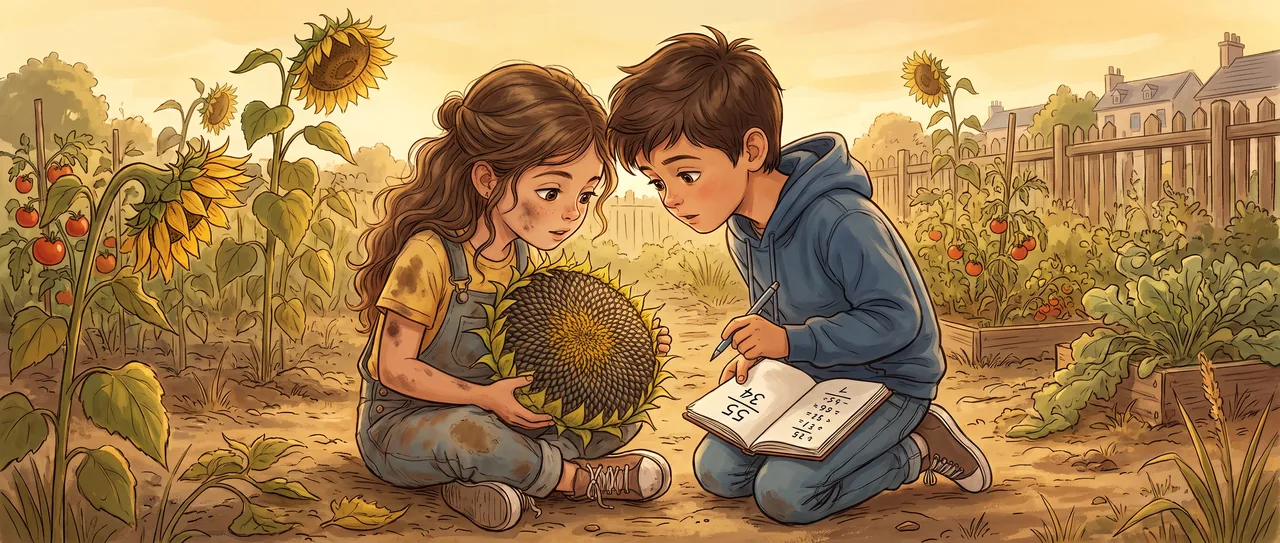
The sunflower was taller than Soren and its face was the size of a dinner plate, drooping now, heavy with seed. Maya's grandmother had said they could have the head if they cut it clean.
"Count the spirals," Maya said, not cutting anything.
"We're supposed to be harvesting."
"Count them first."
Soren tilted his head. The seeds weren't in rows. They curved. He traced one curve with his finger, then found it crossed by another curve going the other way.
"There's two sets," he said. "Spirals leaning left and spirals leaning right."
"Count the left ones."
He counted, lost his place, started over, pressed his thumbnail into each spiral as he went so he wouldn't count twice. "Thirty-four," he said. "I think. Give or take."
"Now the right."
This took longer. "Fifty-five."
Maya grinned. "Thirty-four and fifty-five."
"So?"
"So those are Fibonacci numbers. My cousin's puzzle book. You add the two before to get the next. Thirty-four plus fifty-five is eighty-nine. It's always those numbers. Pinecones. Pineapples. This."
Soren pulled out his notebook and wrote the two numbers with a slash between them. He divided. "Fifty-five over thirty-four is about one point six one seven."
"Okay," Maya said. "So the flower did math."
"No." Soren frowned at the seed head. "The flower didn't do math. It just grew each seed a little turn from the one before. The same turn every time. And this is what you get." He set his thumb on the center. "But why that turn? Why not a nice one? Like, half a circle. Or a quarter."
"Try it," Maya said. "On paper."
He drew a dot, then a dot half a turn around, then half a turn again. "Half a turn just goes back and forth. Two spokes." He tried a quarter turn. Four spokes, like a plus sign. "A fifth of a turn. Five spokes."
"They're all lines," Maya said, leaning over. "Straight lines coming out. That's terrible. Look at all the empty space between the lines."
"Because they line up. Every whole fraction of a turn lines up with itself eventually. The seeds land on top of the old seeds' paths."
Maya went quiet, looking at the real sunflower, where nothing lined up and nothing was wasted. Every gap was filled. "So a good flower," she said slowly, "needs a turn that never lines up. Ever. No matter how long it grows."
"A turn you can't write as a fraction."
"Can you not write it as a fraction?"
Soren chewed his pen. "Some numbers you can't. Like the square root of two. My brother said it goes on forever and never repeats."
"Then why this number? Why one point six one whatever, and not the square root of two?"
That stopped him. He looked at his own division again. Fifty-five over thirty-four. "These are fractions, though," he said. "Thirty-four spirals and fifty-five spirals. That's a fraction. The flower is made of fractions."
"But it keeps changing which fraction," Maya said. She was pointing now, fast, the way she did when something was arriving. "Thirty-four and fifty-five here. But a smaller flower would be twenty-one and thirty-four. A bigger one, fifty-five and eighty-nine. The fractions chase something. They never land on it."
"Chase what?"
"The turn. The real turn. Do your division a few more times. Fibonacci ones."
Soren wrote a column. Three over two, one point five. Five over three, one point six six. Eight over five, one point six. Thirteen over eight, one point six two five. Twenty-one over thirteen, one point six one five. Each one closer to the one below it, jumping over, jumping back, closing in.
"They're squeezing toward something," he said. "From both sides."
"But never reaching it."
"Never reaching it." He stared. "So the number the seeds actually turn by, the real one, isn't any of these fractions. It's the thing all the fractions are trying to be and can't."
Maya sat down in the dirt. "Say that again."
"It's the number that's hardest to reach with a fraction. Out of all the numbers. That's why the flower picks it." He was talking faster now, catching up to her. "A number that's easy to reach with a fraction, the seeds line up, because a fraction means lining up. But this one is the worst. The most impossible to pin down with any fraction. So the seeds can never line up. So they fill everything."
"The most irrational number," Maya said, trying the words out. "Not irrational like unreasonable. Irrational like, no fraction ever catches it. And it's the most that. The champion."
"There has to be a most," Soren said, half to himself. "Some number that resists fractions harder than every other number. And it turns out to be a real thing, and it turns out plants know it, and it turns out it's this." He held the seed head up between them, the whole crowded golden face of it. "They're all running from lining up. And running from lining up is the same as running toward this one number."
Maya took the sunflower from him and turned it slowly. The spirals seemed to breathe, thirty-four one way, fifty-five the other, when she moved it. "Every single seed," she said. "Every seed got told the same turn. The most stubborn number there is. And none of them knew."
"Trees do it with branches," Soren said. "So they don't shade themselves. Same reason. Don't line up."
"And that old temple. The Parthenon. My cousin's book had it in the same chapter." Maya laughed, but not because it was funny. "People built a whole building out of the number that runs away from you. On purpose. Because they thought it looked right."
"Maybe it looks right," Soren said, "because it's the one shape that can never repeat itself. So your eye never finishes it."
Maya looked at him. "That's the best thing you've ever said."
"I'm writing it down before it leaves." His pen was already moving.
Maya held the sunflower over her lap and pressed one seed loose with her thumb. Then another. She lined the two seeds up carefully, side by side, on her knee, the only two seeds in the whole flower that had ever been made to line up. Then she flicked them into the soil and picked up the knife to cut the head clean.
Read the interactive version, listen to the narration, and earn a gold star →
A science-verified short story for curious kids · Curiosity Land