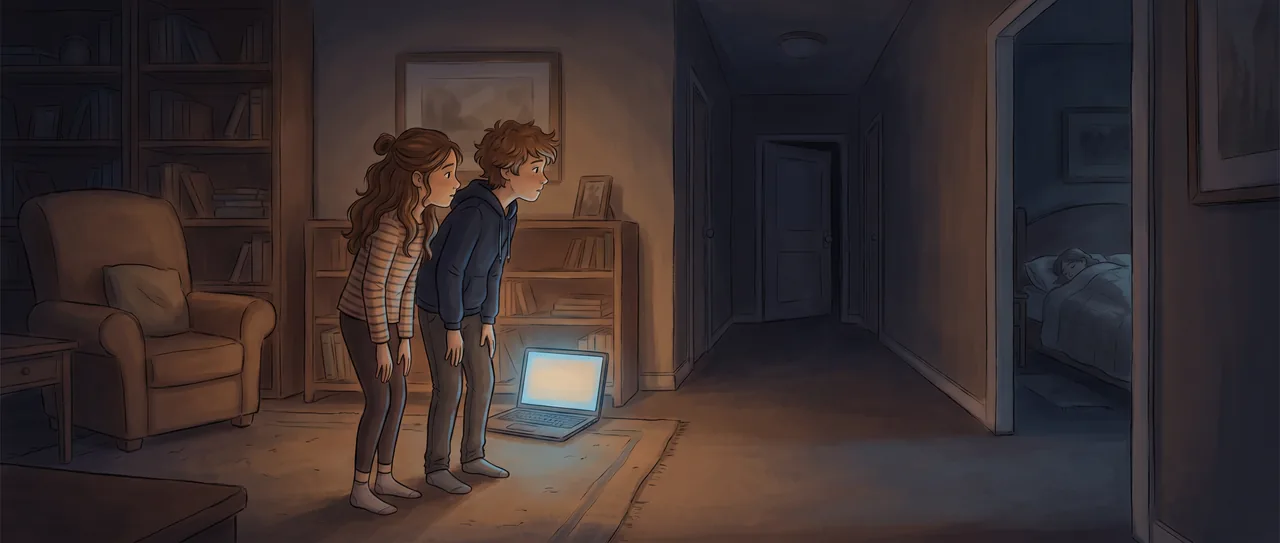
The Night Shift
"Sleep is a design flaw," Maya said. She was lying upside down on the couch with her feet up the wall. "A third of your life. Gone. You could learn Portuguese."
"You'd fall asleep learning Portuguese," Soren said.
"That's the flaw part."
From down the hall came a soft, even breathing. Soren's grandmother slept with her door open now. She forgot things sometimes. Yesterday she had called Soren by his father's name and then laughed at herself, but the laugh had come a half second too late.
"Think about it," Maya said. "An animal that's asleep can't run, can't eat, can't watch for anything trying to eat it. If sleep didn't do something huge, evolution would have deleted it a hundred million years ago. So it's doing something. We just can't see it because we're unconscious when it happens."
Soren sat up. "That's actually a good point."
"I have those."
He pulled his laptop off the floor. His grandmother's neurologist had sent his mom some links, and his mom had left them open in a tab, and Soren was the kind of person who read the tabs other people left open. He scrolled.
"Okay," he said. "Listen to this. Your brain doesn't have the drainage the rest of your body has. Everywhere else, you've got these little vessels that carry away garbage. Your brain skips them."
"Garbage from what?"
"From thinking. From being awake. Every cell that does work leaves behind junk. Broken proteins, leftover stuff. All day, awake, it piles up between your brain cells."
Maya rolled off the couch and landed on the floor next to him. "And it doesn't drain."
"Not while you're awake. Barely." He turned the screen toward her. "But when you fall asleep, the cells shrink. A little. It opens up space between them. And spinal fluid comes flooding through, in and out, in and out, rinsing the whole thing."
"Rinsing your brain."
"Rinsing your brain. And here's the number." He pointed. "During sleep it runs about ten times faster than when you're awake. Ten times."
Maya went quiet. Down the hall, the even breathing kept its rhythm.
"So it's not off," she said slowly. "When she's asleep. It's on. It's the most on it gets."
"That's what it says."
"Read the next part."
Soren read ahead, and his face changed, and Maya watched it change.
"What," she said.
"One of the proteins," he said. "One of the ones it flushes out at night. It's called amyloid. And when it doesn't get flushed, it builds up. Clumps." He stopped. "It's one of the things they find in the brains of people with Alzheimer's."
Neither of them said anything for a moment.
"Say it plain," Maya said. She always wanted it plain.
"When you sleep, your brain runs a night shift," Soren said. "It washes out the junk that piles up when you're awake. Including the junk that, if it stays, might be part of what makes people forget."
Maya looked toward the hallway. "So right now," she said. "Right this second. While she's breathing like that. Her brain is doing the thing."
"Right now."
"The cleaning."
"Right now."
Maya stood up. She walked to the mouth of the hallway and stopped, not going in, just listening. Soren came and stood beside her. The breathing was slow and deep and completely automatic, a thing his grandmother was not choosing to do and could not stop doing.
"I got it backwards," Maya whispered. "The whole time. I thought sleep was the off switch. I thought it was the part where nothing happens."
"Me too," Soren whispered. "Everybody does."
"It's the opposite. The busy part is the part we can't watch. That's why we can't watch it. You have to be unconscious for the doors to open." She pressed her hand flat against the wall, then took it away, because that felt like too much. "The room where the most important thing happens is the one you're never awake for."
Soren pulled his notebook out of his hoensack. He wrote for a while, three lines, then crossed one out and wrote it again.
"What'd you write," Maya asked.
"That she isn't losing time," he said. "When she sleeps. I keep hearing my mom say she sleeps too much now. Like it's the sickness taking her. But maybe some of it's the opposite. Maybe some of it's her brain reaching for the hose."
Maya thought about that. "You can't tell which," she said. "From out here. You can't tell if the sleep is the problem or the sleep is the fight against the problem."
"No."
"That's the part that gets me." She wasn't upset. She was leaning into it. "We're standing here and we genuinely don't know if what we're hearing is her getting worse or her getting cleaned. And neither do the scientists. Not all the way. It's still being figured out."
"It's new," Soren agreed. "They only found the system properly like ten years ago. There are people whose whole job, right now, tonight, is figuring out exactly this."
"That the flooding is real."
"That the flooding is real, and whether you could help it along. Whether better sleep could keep more of the junk from piling up. In her. In anybody."
Maya let out a breath she'd been holding. "So it's not a design flaw."
"No."
"It's the maintenance window." She almost laughed. "I called the maintenance window a waste of time."
They stayed at the edge of the hallway. Soren's grandmother breathed in, and somewhere under the bone, in the dark, the space between her cells was widening a hair, and the fluid was moving through it, in and out, carrying the day away.
"I don't think I want to sleep anymore," Maya said, and yawned in the middle of saying it, which ruined it completely, and she knew it, and she grinned.
"You should," Soren said. "Your brain's got a whole night of work lined up."
Maya went and lay down on the couch, right side up this time. She closed her eyes. She was quiet for so long Soren thought she'd gone under.
"Soren," she said, without opening them. "Listen to her breathe."
He listened. In the next room, slow and steady and busy as a tide, the night shift went on.
Read the interactive version, listen to the narration, and earn a gold star →
A science-verified short story for curious kids · Curiosity Land