The Map That Was Wrong
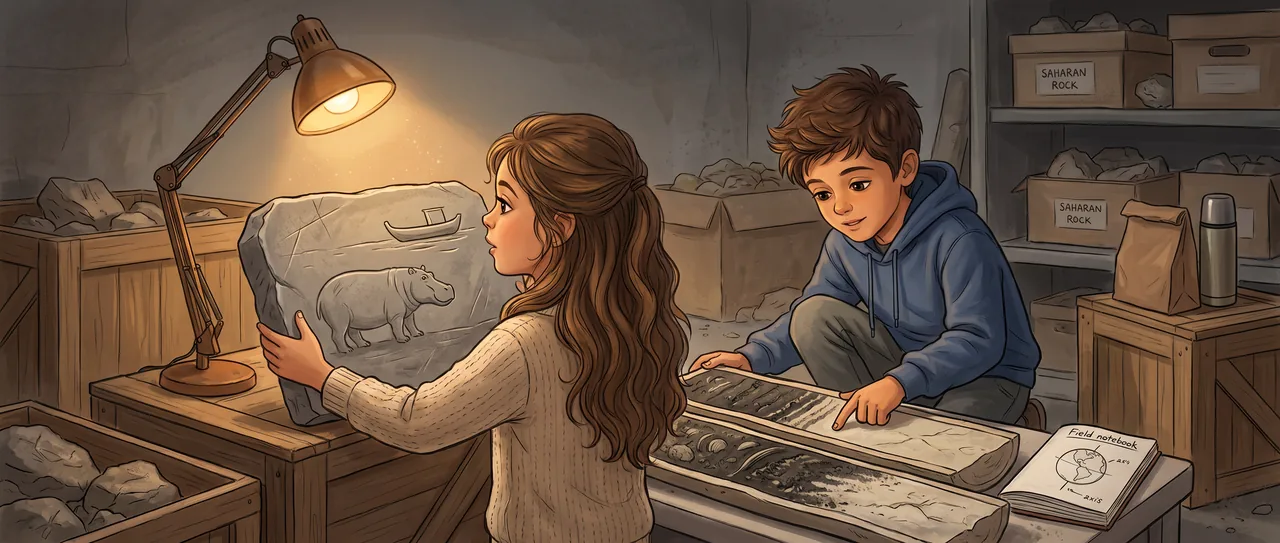
The storeroom smelled like old stone and floor wax. Maya had followed the wrong hallway looking for the bathroom, and Soren had followed Maya, and now there was a crate in front of them with the lid halfway off.
"These are rocks," Soren said.
"These are rocks with hippos on them," Maya said.
She was right. The slab on top had an animal scratched into it, fat body, short legs, a mouth like a suitcase. Someone long ago had carved a hippopotamus into the flat gray stone. Beside it, a smaller carving of a boat.
"Read the tag," Maya said.
Soren turned the paper label toward the one working light. "Sahara. Central Sahara. Collected nineteen thirty-something." He stopped. "The Sahara is the desert. The biggest desert."
"So who carved a hippo in the desert."
"Nobody. There's no water. Hippos need a whole river."
Maya crouched and put her face close to the carving. "Then this person was lying. Or drawing something they heard about."
"People don't carve rivers they heard about. They carve what they see." Soren said it slowly, testing whether he believed it. He decided he did. "You draw the deer you hunt. You draw the fish you catch."
"Then they saw a hippo." Maya stood up fast. "In the Sahara."
They looked at each other in the gray light.
There was a second crate. Soren lifted its lid because his hands wanted something to do. Inside were flat rock cores, long cylinders drilled out of the ground and sawed in half. Painted on the side of one, in careful white brushstrokes, was a wavy shape like a puddle seen from above. A curator's mark. The label under it said, in typed letters, ANCIENT LAKESHORE, and a number, and the word MEGALAKE.
"Mega lake," Maya read. "Somebody drew a lake here. On purpose. On a rock from the desert."
"They wouldn't paint a lake outline on a core unless the core showed a lake," Soren said. "You paint what the mud tells you."
"What does mud tell you?"
Soren ran his thumb along the halved cylinder. There were bands. Pale, then dark, then pale, like the rings inside a tree but flatter, stacked. "Layers," he said. "Bottom's oldest. You'd read up. Like reading a stack of pancakes from the plate up."
Maya leaned in. The bottom bands were dark and full of tiny flecks. Then, near the middle, the flecks stopped, and the stone went pale and dead and blank the rest of the way to the top.
"It's alive at the bottom," she said. "Then it's not."
"The dark stuff would be things that lived. Little shells. Plants. Life leaves dark. Then"
"Then nothing." Maya put her finger right on the line where it changed. The pale part was thick. The dead part was most of the rock. "So it was full of life for a long time. And then it stopped being. And it never came back."
They were quiet. Somewhere down the hall a teacher called a name that was not either of theirs.
"Something turned it off," Soren said.
"Slowly?"
He looked at the bands. The change from dark to pale wasn't one sharp line. It was a fade. A few thin bands trying to be dark, then thinner, then gone. "Not one day. But not a million years either. It's a squeeze. Like a fade at the end of a song."
Maya was already somewhere else. "What turns off a whole lake the size of a country? Not a drought. A drought ends. This didn't end." She pressed both hands flat on the cool stone. "The rain had to leave. Not for a bad year. Forever. The rain had to move somewhere else and never walk back."
"Rain doesn't decide," Soren said. "Rain follows the heat. The sun."
"Then the sun moved."
Soren opened his notebook. He drew a tilted circle, the Earth, leaning like a spun top starting to lose its lean. He'd read once that the tilt wandered, slowly, over thousands of years, a few degrees back and forth, and that where the sun struck hardest wandered with it. His pencil stopped. He looked at the tilted circle, then at the fade in the rock, and the two things reached across the dark and touched.
"The lean," he said. "If the Earth leans a different way, the hottest part of summer lands somewhere else. The rains chase the heat north. They water the whole desert. Green. Hippos." He tapped the dark bands. "Then the lean creeps back. A little each year. Nobody alive would feel it. Your grandmother's rains come a week later than hers. Her granddaughter's come later still."
"Until a kid your age is standing on grass," Maya said, "and her grandkid is standing on sand, and in between nobody ever had a single day they could point at."
"That's the fade," Soren said. He put his hand next to hers on the stone. "That's this whole pale part. That's the whole rest of the rock. That's the desert."
Maya was breathing fast. "The biggest desert on Earth was a garden. And the thing that killed it wasn't a storm or a fire. It was the planet tilting a couple of degrees, so slow you'd swear nothing was happening." She looked up. "Soren. It's still tilting."
"It's always tilting."
"Then somewhere on Earth right now the rain is already leaving. Or coming back. Just too slow to see."
Soren didn't answer. He was looking at the carved hippo, at the little carved boat beside it, at the person who had stood on green ground with a river in front of them and no idea that the ground was quietly agreeing to become the driest place on Earth.
Maya lifted the slab with both hands and turned it toward the light so the boat caught the shadow and looked, for a second, like it was floating.
Read the interactive version, listen to the narration, and earn a gold star →
A science-verified short story for curious kids · Curiosity Land