The Map That Grew Inside Him
The archive smelled like paper that had given up trying to stay white. Maya and Soren were supposed to be sorting one box, the box marked HALVERSON, into folders by year. They were on their fourth hour and their second box.
Gus Halverson had driven a taxi for fifty-one years. Somebody in his family had donated everything, and somebody at the archive had decided two eleven-year-olds could handle the boring parts. The boring parts turned out to be his brain.
Not really his brain. A photograph of a brain scan, clipped to a letter, near the bottom of box two.
"Look at this," Maya said. She held up the scan. Then she held up a second photo, a normal-looking man in a cardigan, squinting. "That's the inside of that."
Soren took the letter. It was from a university, thanking Mr. Halverson for participating in a study. Something about experienced drivers. Something about a region called the hippocampus.
"They measured it," Soren said. "They say his was bigger than average. This part in the back." He turned the letter over. There was nothing on the back. He wanted more than the letter was giving him.
Maya was already spreading photos across the table. Gus at twenty, leaning on a cab. Gus at forty. Gus older, thinner, still squinting. She wasn't looking at his face.
"Fifty-one years," she said. "How many streets is that."
"In a city? Thousands."
"Every dead end. Every one-way. Every shortcut when the main road floods." She tapped the scan. "Where does that go."
Soren understood the question she was asking, which was not the question she said. She meant, where does a city go when a person learns it. A whole city. It has to go somewhere.
"It's not like a hard drive," he said slowly. "You don't add a chip."
"So what did they measure. They measured something got bigger."
They both looked at the two photos side by side. The man. The map inside the man.
Soren opened his notebook and copied the word hippocampus, checking each letter against the letter. He drew a small box in the back of a bigger box and wrote bigger under it with an arrow.
"Muscles get bigger when you use them," Maya said. "Is it that."
"Sort of. Not exactly." He was guessing now and he said so. "I think if you use a part of your brain enough, the brain builds more there. More connections. Actual tissue. It changes shape to fit what you keep doing."
Maya went quiet. She picked up the photo of Gus at forty and held it very close to her eyes.
"So he didn't just remember the city," she said. "The city made a place for itself. Inside his head. It pushed the walls out."
"The study says the drivers who did it longest had the biggest change." Soren found the line in the letter and read it twice. "He grew it. By driving. By learning one more street, and then one more."
There was a third box. Maya opened it while Soren re-read the letter, and she made a sound.
It was full of maps. Hand-drawn ones. Gus had drawn his city over and over, on napkins, on the backs of receipts, on the cardboard from shirt packages. Early ones were shaky and wrong, streets that didn't connect, a river in the wrong place. Later ones were dense and sure, corrections layered over corrections, a whole neighborhood squeezed into a corner where he'd run out of room.
"He kept drawing it to learn it," Maya said. "And every time he drew it, the real one, the one inside, got a little bigger."
Soren laid the napkin maps in order by how wrong they were. The wrongness shrank as the dates climbed. So did the empty space. The last one had no empty space at all.
"Maya," he said. "We're doing it right now."
She looked at him.
"Sitting here. Figuring this out. Whatever part of us is doing this, it's building. A little. Right now." He put his hand flat on the notebook without meaning anything by it. "Everything you practice pushes the walls out somewhere."
Maya sat down slowly, like the chair had moved. "Everyone I know has a different shape inside," she said. "Not because they were born that way. Because of what they kept paying attention to."
"The violin kids. The kid who juggles. The one who does the crossword."
"Different bumps. Different maps." She looked at the squinting cardigan man in the photo with something close to awe. "He looks so ordinary."
"That's the part nobody could see," Soren said. "Until they scanned it."
Maya spread the napkin maps out in a long line across the table, the shaky ones on the left, the certain ones on the right, all the days of a man learning a city until the city became part of the shape of his brain. She wasn't sorting them by year anymore. She was sorting them by how much of him was in them.
"The thing that scares me," she said, and she didn't sound scared, she sounded lit up, "is that mine is changing too. Right now. And I don't get to see the picture."
"Not yet," Soren said.
He didn't finish the thought, because it went too far out. If a city could carve itself a bigger room in a man's head just by being learned, one street at a time, then everything Maya wondered about, every list of things that didn't make sense yet, was doing something to the actual shape of her. She was building a place for it. She would never know exactly where.
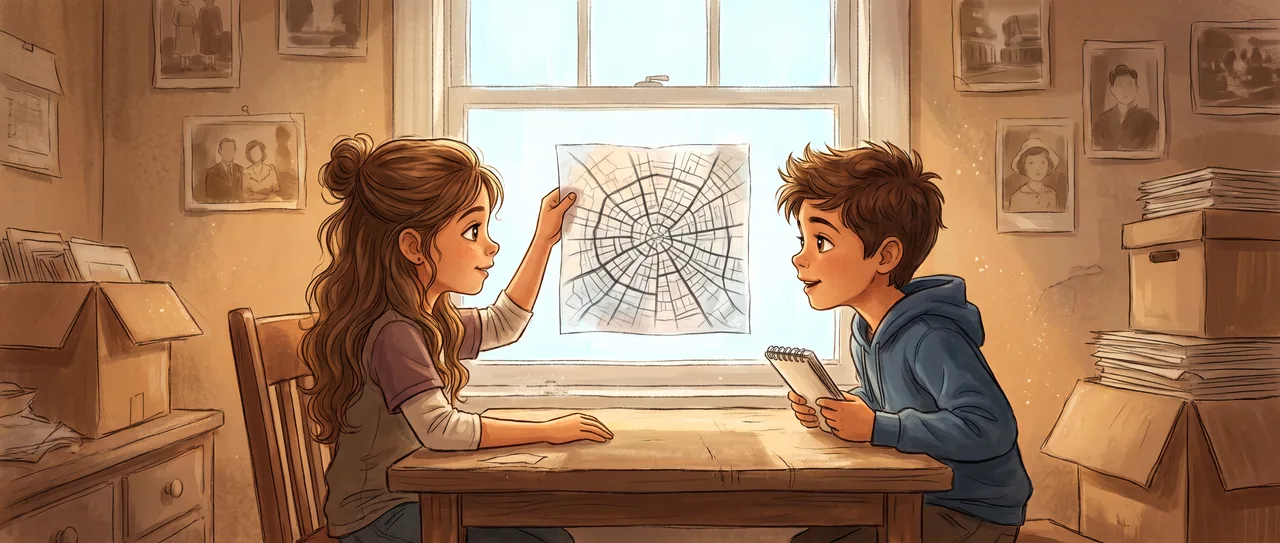
Maya picked up the very last napkin, the dense one with no empty space, and held it up to the window so the light came through the pencil.
All the streets went dark against the sky. Behind them, faint, you could see the earlier maps still showing through the thin paper, the wrong rivers, the streets that never connected, all of it still there under the finished one.
She turned the napkin toward Soren so he could see the layers through the light too.
Read the interactive version, listen to the narration, and earn a gold star →
A science-verified short story for curious kids · Curiosity Land