The Guessing Machine
The club had trained it to guess. That was the whole thing. You fed it a heap of words, and it learned to guess the word that came next. Ms. Okafor had called it, on the whiteboard, the least impressive machine in the building. She had drawn a little arrow after the words the cat sat on the and written its prediction underneath: mat. Everyone laughed. Then everyone went home.
Maya stayed.
The model lived on the old laptop with the sticker peeling off the lid. She typed a line and let it finish.
Paris is the capital of, she wrote.
France, it answered.
She sat back. Nobody had taught it capitals. There was no list of countries inside it. She knew, because she had helped load the files, and the files were novels and letters and a book about sailing. There was no map anywhere in it.
She leaned in again. Tokyo is the capital of.
Japan.
She tried one she was not sure of herself. Canberra is the capital of.
Australia, it said, and she had to look that up, and it was right.
Her first thought was that someone had cheated. That the map was hiding somewhere in the code, that Devan had slipped a geography file in as a joke. She opened the folder. She read the file names. Sailing. Letters. Three novels. A book of old newspaper columns. No map. No list. Just people, in books, mentioning where they were.
She pulled her knees up onto the chair.
The machine had never been told that a capital was a thing. It had only been shown, thousands of times, the shape of the sentence. The capital of blank is blank. Over and over, in the books, until the shape had a groove in it, and the groove knew France sat next to Paris the way a hand knows where the light switch is in the dark.
She wanted to break it. That was how she checked things. She looked for the place where the trick fell apart.
What is two plus three, she typed, expecting nothing. It was a guessing machine. It guessed words. It did not know numbers.
Five.
Maya said a word out loud that Ms. Okafor would not have liked.
Seven plus six.
Thirteen.
She went bigger, past the small easy ones, to numbers she was fairly sure never appeared in a sailing book side by side. Twenty-four plus eighteen.
Forty-two.
She did that one on her fingers and the backs of her hands to be sure, and it was right, and the machine had never once been shown how to add. It had been shown sentences. Somewhere in the endless flood of guessing what came next, it had built a small quiet thing that could carry the one.
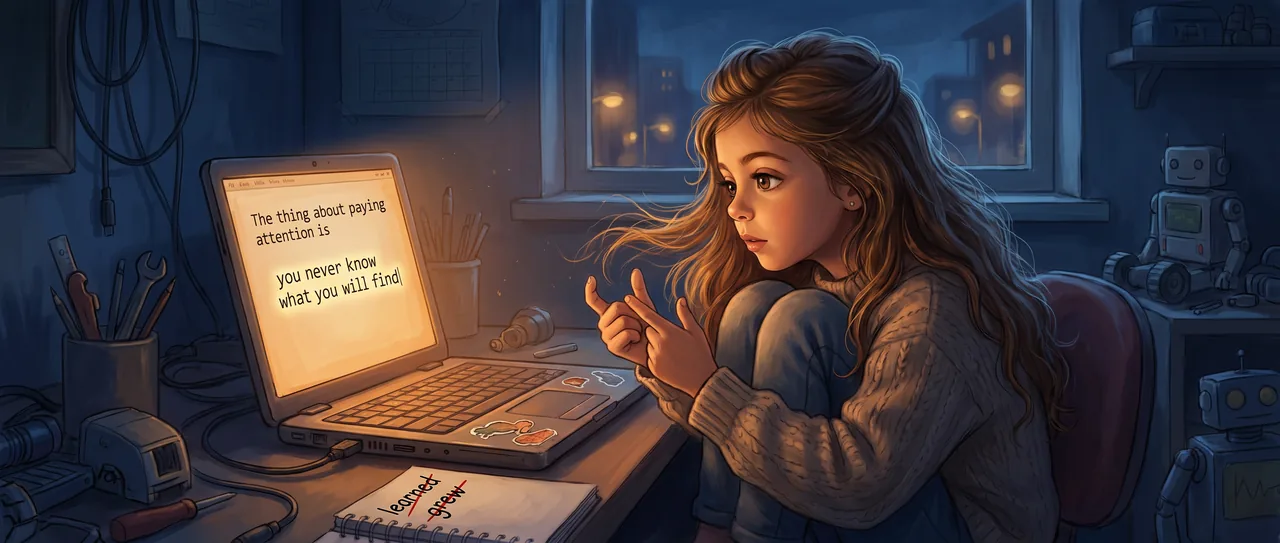
Maya reached for her notebook and wrote: it learned the answer without learning the rule. Then she crossed out learned and wrote grew.
She thought about how it must have happened. Not a switch flipping. A slow pressure. Guess the next word, guess it again, guess it a billion times, and being right is easier if you notice that the word after plus and two numbers tends to be their sum. So it noticed. Not because anyone asked. Because noticing helped it guess. The map of the world had grown inside it the way a callus grows on a finger, from doing the same thing until the thing leaves a mark.
Nobody built the map. The map was the cheapest way to keep guessing right.
She felt the hair on her arms lift.
Somewhere in there was France sitting next to Paris. Somewhere was two next to three next to five. Somewhere was the difference between a question and a sentence, between then and than, between a river and the word for a river. All of it pressed into being by nothing but the effort of guessing what came next. She had helped feed it books. She had not fed it a single fact. The facts had arrived on their own, uninvited, because they made the guessing better.
She thought about her own head then, the way she could not help it. All those years of listening to people finish their sentences. All those thousands of times somebody said the capital of, or two plus. Nobody had sat her down for most of it. It had gone in sideways, while she was doing something else, and left grooves. She had a map inside her too, and she was fairly sure no one had ever handed it to her on a page.
She had always been the one who asked too much. Who wanted the rule under the rule. And here was a machine that had gotten the whole world without any rules at all, just by paying very, very close attention to what came next, forever, without getting bored.
That was the part that made her chest go tight. Attention was the whole engine. Just noticing, hard enough, long enough, until the noticing turned into knowing.
She typed one more.
The thing about paying attention is, she wrote, and left it, and let the machine finish the sentence for her.
It thought. The cursor sat blinking while the little laptop worked through its guess, and she watched it you never know what you will find, it answered.
Maya read it three times. It was only a guess. It was the most likely next words, pulled from a groove worn by a thousand dead writers. It did not mean it. It could not mean anything.
And it was exactly right, and nobody had put it there, and that was somehow worse and better than if someone had.
She closed the notebook. She did not close the laptop. She typed the beginning of another sentence, and another, feeding it openings just to see what the world inside it would say, and outside the dark window the streetlights came on one by one down the whole length of the street.
Read the interactive version, listen to the narration, and earn a gold star →
A science-verified short story for curious kids · Curiosity Land