The Difference Machine
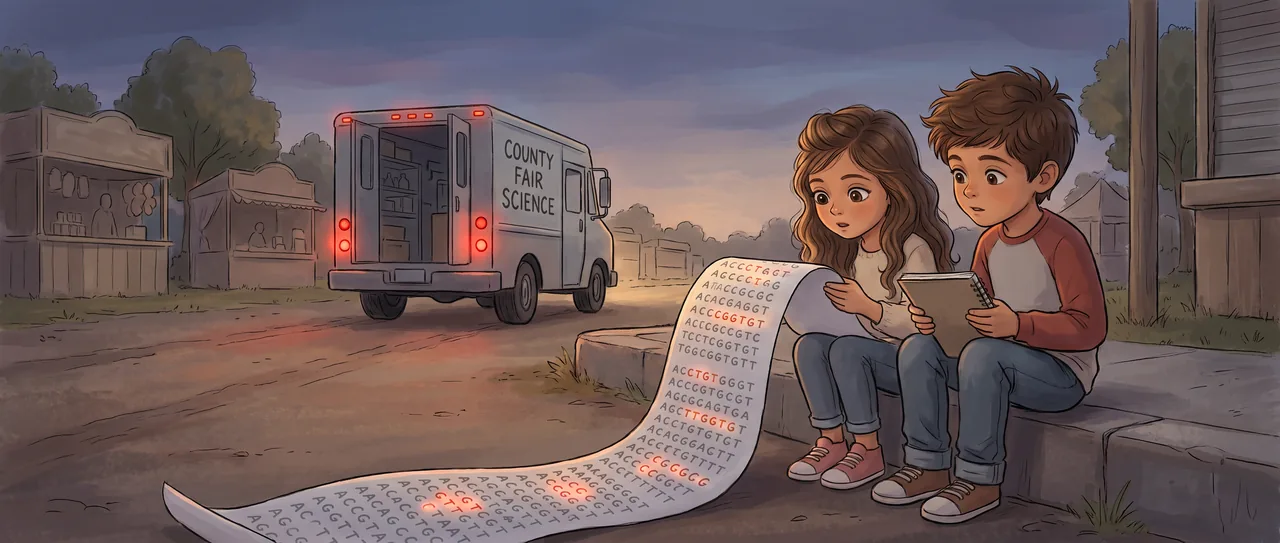
The science van had already started packing up when Maya pulled a long strip of paper out of the recycling bin.
"They threw this out," she said. "Look at all the red."
Soren took one end. The strip was a printout, columns of letters, mostly gray, and then here and there a letter glowing red like a stoplight. A, C, G, T, over and over. The red ones were scattered all through it.
"It says REFERENCE at the top," Soren said. "And then somebody's name got cut off. Just a bar code."
"The gray ones match," Maya said. "The red ones don't."
The woman folding up the kiosk cables looked over. Her lanyard said DR. OKAFOR and under that, in smaller letters, GENOMICS OUTREACH. She had the tired look of someone who had said the same sentences forty times since morning.
"That's a comparison strip," she said. "We compare a sample against the reference genome. The reference is a kind of standard spelling. The red marks are where the person's spelling is different."
"How many red marks?" Soren asked.
"On the whole genome? For anybody?" Dr. Okafor coiled a cable around her elbow. "Four to five million."
Maya stopped moving.
"Million," she said.
"Million," said Dr. Okafor. "It's the most normal thing in the world. Everyone's got them."
Maya was already unrolling more of the strip, hunting the red ones, her lips moving as she counted a handful before giving up. Soren watched her go and did the math out loud.
"This strip is maybe two hundred letters," he said. "And there's what, three red? If that keeps up for the whole thing..."
"It doesn't have to keep up," said Dr. Okafor. "They cluster in some places, they're rare in others. But yes. Millions."
"Which ones matter?" Maya asked.
Dr. Okafor smiled the smile of a person who had hoped nobody would ask that yet.
"That," she said, "is the interesting part. Most of them don't matter. As far as we know."
"As far as you know," Soren repeated.
"Some of these red marks, we know exactly what they do. A few change eye color. A few change how you taste certain vegetables. A handful, out of millions, are ones a doctor would want to look at." She snapped the cable case shut. "But the vast majority? We have no idea. They sit there. They don't seem to break anything. They just make you not the reference."
Maya held the strip up to the light so the red letters lined up like a row of far-off windows.
"So most of my difference," she said slowly, "nobody has a name for."
"Most of everyone's," said Dr. Okafor. "We mapped the whole book. We still can't read most of the notes in the margins."
She went to load a crate into the van, half-present now, already thinking about the drive home.
Soren sat down on the edge of the curb with the strip across his knees. Maya sat beside him.
"Four million," he said. "And they only understand a few thousand."
"Whose is this even?" Maya turned the barcode toward him. "Some stranger who came by this morning."
"Some stranger," Soren said, "who is different from the reference in four million places. And so are you. And so am I. And none of our four million are the same four million."
Maya went quiet. Then she grabbed his arm.
"That's the thing," she said. "That's the thing, Soren. There isn't a reference person."
"What do you mean, there isn't. It says REFERENCE right there."
"But whose spelling is it?" Maya jabbed the top of the strip. "They call it the standard. So somebody must match it. Somebody has zero red."
Soren looked at the gray columns. He looked for a long moment.
"No," he said. "No, nobody does."
"Nobody?"
"Think about it. If everybody has four million reds against the reference, then the reference isn't a person. It's a..." He searched for it. "It's an average. A stitched-together spelling that nobody actually is."
Maya was nodding fast now.
"So the standard human," she said, "doesn't exist."
"The standard human doesn't exist," Soren said. "There's a book they wrote it all down against, and not one single person on Earth matches the book."
They both looked at the strip. Gray, gray, gray, red. Gray, red, gray. A stranger's four million windows, glowing.
"So when they say normal," Maya said, "they mean the part where we match. And that part is smaller than the part nobody understands."
"For everybody," Soren said. "Every single person is mostly made of differences nobody has read yet."
Maya pressed the back of her hand against her own cheek, as if she could feel the four million red marks under the skin, sitting there, unnamed, doing whatever they did or didn't do.
"Some of mine could be things," she said. "Things that don't have names because nobody's found them yet."
"Probably are," said Soren. "Statistically. Out of four million, some of yours have never been looked at by anyone. Ever. In history."
Dr. Okafor came back for the last crate. She saw them still sitting there with the strip stretched between them.
"You can keep it," she said. "It's just a demo. The barcode doesn't lead anywhere."
"Do you ever look up the ones nobody understands?" Maya asked.
"That's most of the job," said Dr. Okafor. "People send us their differences. We compare millions of people, and slowly a red mark that meant nothing starts to mean something. A mark shows up in a thousand people who all sleep short, or all taste soap in cilantro, and suddenly it has a name. It used to be a mystery. Now it's an answer."
"So the answers are already inside people," Soren said. "You just haven't reached them."
"They're inside everyone," Dr. Okafor said. "We're a long way from the bottom of the list."
She got in the van. The engine started.
Maya took the strip and folded it carefully, red side in, until it was small enough to fit in her pocket. Soren pulled out his notebook and wrote a single number across the top of a blank page, four million, and then a question mark, and then he stopped and just looked at all the empty lines under it.
Down the road, the van's taillights turned red and got smaller, and did not disappear for a long time.
Read the interactive version, listen to the narration, and earn a gold star →
A science-verified short story for curious kids · Curiosity Land