The Wrong Order
The model was failing, and Maya had decided to find out whether it was failing on purpose.
She had fed it four thousand handwritten letters. Real ones, scanned from cards and grocery lists and the loopy cursive of people who learned to write eighty years ago. The task was simple. Look at the ink. Say which letter it is. A child could do it. Her model could not.
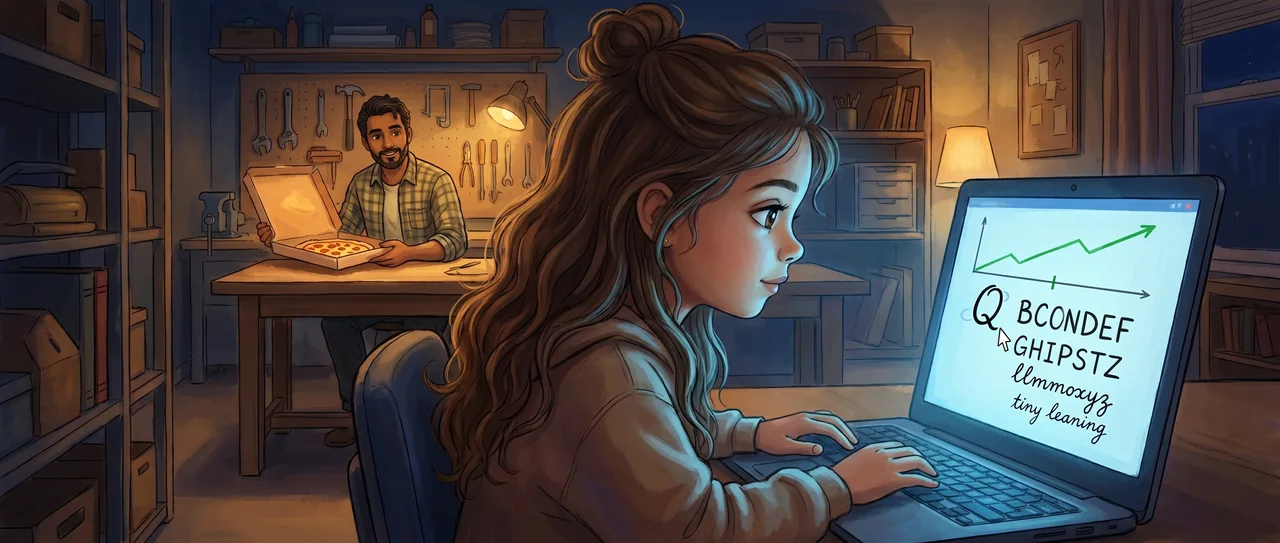
Across the makerspace, Ravi's laptop hummed. Ravi ran the Tuesday coding nights and had left his own model training before he went to answer the door for the pizza guy. His screen showed a green line climbing steadily. Hers showed a red line that jumped around like a trapped moth.
Same data. She had checked three times. Same code, almost. She had copied his and changed one thing.
Maya scrolled back through her setup. She had done something Ravi hadn't. She had shuffled her four thousand letters into random order before feeding them in, because that was what you were supposed to do, wasn't it, mix everything up so the model didn't memorize a pattern in the sequence.
Ravi's had not been shuffled. His letters came in a fixed order. She had assumed it was laziness.
She opened his file and looked at the order.
The first letters in Ravi's pile were enormous. Fat block capitals, a child's alphabet chart, the kind where the A takes up half the page. Clean lines. No ambiguity. Then, further down, the print got smaller and neater. Then, near the end, the cursive began, the eighty-year-old loops, the letters that leaned into each other and shared strokes and hid.
Easy first. Hard last.
Maya sat back.
She had taken the same four thousand letters and thrown them at her model in no order at all. So her model's very first lesson had been a scrawled cursive Q sitting next to a crisp block B sitting next to a smudge that might have been an E or might have been a bug. On the first day of school it had been handed everything at once and told: learn.
She stopped the red line. She reran her model with Ravi's order. Big letters first.
The green line climbed.
Not as high as his yet, but climbing, steady, none of the moth-jumping. She let it run and watched the number for how often it guessed right go up and stay up.
Ravi came back with the pizza box balanced on one hand. He looked at her screen, then at his, then at hers again.
"You fixed it," he said.
"I unfixed it," Maya said. "I had it in random order."
"Ah." He set the box down. "Yeah. Order matters more than people think."
"Why?"
Ravi shrugged in the way adults shrug when they know a thing works but not why it should. "It just trains better this way. Warms it up. Same reason you don't start a kid on long division."
That was not an answer. That was the shape of an answer.
Maya chewed and watched the number. It bothered her, and she followed the bother.
The letters were the same. The exact same four thousand images. She had not added one thing. She had not removed one thing. All she had changed was the sequence, the order in which the model met them. And that alone had turned a moth into a climbing line.
She thought about the cursive Q. On her random run, the model had seen it on the first pass, when it knew nothing, when it did not yet understand that letters had edges, that a curve was different from a corner. To that model, on that first pass, the Q was noise. It had tried to learn from noise and learned wrong, and every wrong thing it learned it had to unlearn later, dragging the whole red line around.
But give it the fat block A first. Give it the obvious thing. Let it learn what an edge is, what a curve is, on a letter that could not be misread. And then, only then, show it the leaning cursive Q, and now the model has somewhere to put it. It has a foundation. The hard letter arrives on top of the easy one and lands.
Maya put the pizza down.
The thing she was looking at was not really about handwriting.
The same information, in a different order, became a different lesson. The model that got everything at once learned less than the model that got the easy things first, even though the second model was given nothing extra. What it learned was shaped by the sequence as much as by the letters. Meet the hard thing too early and it teaches you the wrong lesson. Meet it after the easy thing and it teaches you the right one.
She thought about herself at seven, staring at a page of fractions that made no sense, deciding she was bad at math. She had not been bad at math. She had been handed the cursive Q on the first pass. The letters had not been the problem. The order had.
And she thought, slower, about everything she had ever failed to understand. Every subject she had walked away from believing she just didn't have the brain for it. How many of those had been the same four thousand letters in the wrong order. How many things she had decided she couldn't learn were things she had only met too early.
"Ravi," she said. "If I gave a person all the hardest stuff on day one, they'd think they were stupid."
"Probably," said Ravi, mouth full.
"But they wouldn't be. It'd just be the order."
Ravi swallowed and looked at her differently, the way people looked at her right before they said she asked a lot of questions. "That's," he started, and stopped. "Yeah. That's actually the whole idea. There's a name for it. Curriculum learning."
A name for the thing she had just felt in her chest. Somebody had noticed it too. Somebody had noticed it hard enough to name it.
Maya looked back at her screen. The green line had passed Ravi's now, still climbing, learning the hard cursive letters it would have called noise an hour ago.
She reached over and dragged the cursive Q back to the very front of the pile, alone, with nothing before it. She hit run and watched the line fall apart, just to see the difference with her own eyes.
Read the interactive version, listen to the narration, and earn a gold star →
A science-verified short story for curious kids · Curiosity Land