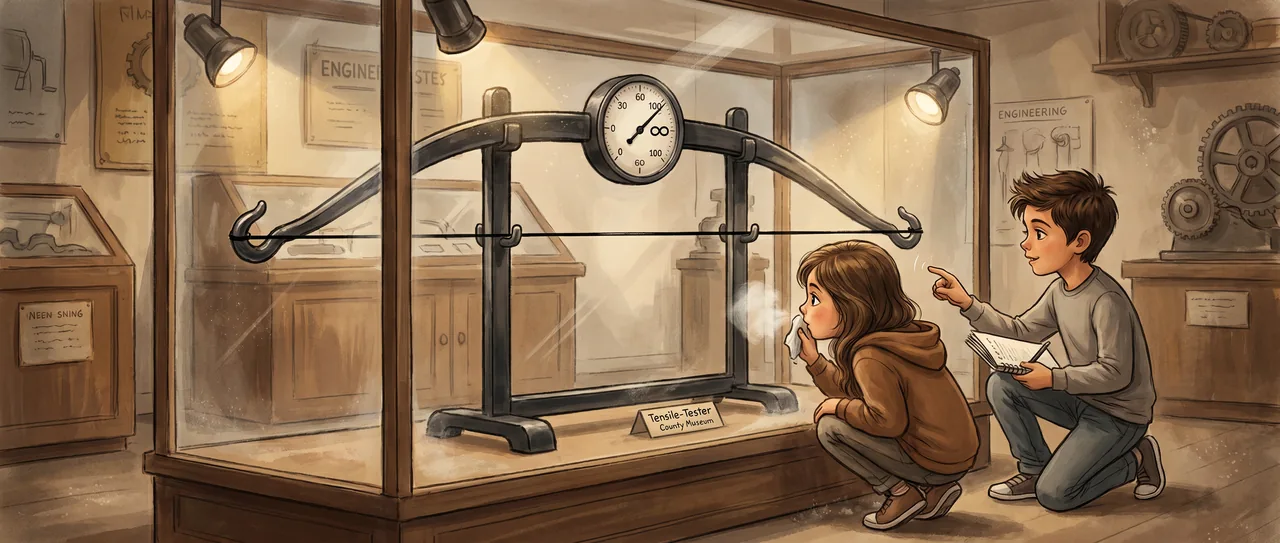
The Thread That Wouldn't Break
The sign said DO NOT SPIN THE HANDLE. Somebody had spun the handle so many times the paint was gone.
"It's a tug of war machine," Maya said. She crouched in front of the glass case. Inside sat a black metal frame with two hooks facing each other and a dial between them, the needle stuck at a number too high to be interesting.
"It's a tensile tester," Soren said. He was reading the little card. "They pull on a material until it snaps. The dial tells you how hard you pulled before it broke."
"So where's the material."
"That's the weird part." He tapped the glass. "There's still something in it."
Between the two hooks was a thread. Not a wire. A thread, thinner than the ones in Maya's hoodie, so black it looked like a scratch on the world. Both hooks were straining backward. The whole frame was bent slightly, the way a bow bends. And the thread just sat there.
"They left it pulling," Maya said. "They walked away and left the machine trying to break it."
"For years, maybe." Soren looked at the date on the card. "The lab closed a while ago. Nobody turned it off."
Maya pressed her nose to the glass. "That's the part that doesn't fit. Look at the frame. The frame is losing. The steel frame is bending and the little black thread is fine."
"Steel's strong, though," Soren said. He said it like a question.
"Right. So what's stronger than steel and thinner than my hair."
Soren went quiet. He crouched next to her. There was a second card, half hidden behind the frame, and he read it twice before he said anything.
"It says the fiber is spun from carbon nanotubes." He looked up. "Tubes of carbon. Rolled up. Really small. Like, you'd need a microscope that can see atoms."
"And they're strong?"
"The card says one gram of this could hold up something a steel wire that heavy couldn't come close to. A hundred times, by weight."
Maya sat back on her heels. "By weight. Say that part again."
"By weight. That's the thing they keep repeating. It's not just strong. It's strong for how little it weighs."
"Why does that matter more than just strong."
Soren pulled out his notebook. He drew a line straight up off the top of the page, past the edge, onto the desk. His pen ran out of page and kept going onto the wood.
"Okay. Say you want a cable. A really long one."
"How long."
"Longer than that. Say you wanted a cable that went up." He pointed at the ceiling and kept pointing, past it. "All the way up. Off the planet."
Maya's eyes moved to the ceiling and stayed there.
"The problem's never been the top," Soren said. "The problem's the bottom. Every piece of the cable has to hold up all the cable underneath it. A steel cable that long would snap under its own weight before it ever reached space. It's too heavy to hold itself."
"So it breaks itself," Maya said slowly. "Just by existing."
"Just by being long."
She looked back at the thread in the case, the one the machine had been failing to break for years.
"But that one wouldn't."
"That's the whole point of it." Soren's voice had gone up. "A cable made of this stuff could be strong enough to hold its own weight all the way up. That's the only material anybody knows of that could. Not steel. Not diamond. This." He tapped the black scratch. "They think you could climb it. Like an elevator. To space. No rocket."
Maya stood up so fast her knee hit the case.
"No rocket."
"No rocket. You just go up."
She walked one full circle around the display, looking at the thread from every side, the way you check whether a magic trick is really a trick.
"Then why isn't there one," she said. "If the thread works. If the machine can't even break it. Why is it in a museum and not, like, outside going up."
Soren flipped to the back of the card. He read for a long time.
"Because they can only make it short," he said finally. "That's it. That's the only reason. The little pieces are that strong. But nobody can spin it long yet. They get a thread this big." He held his finger and thumb apart, barely. "And then it gets weaker the longer they make it. Little flaws add up. The long version isn't as strong as the short version. Yet."
Maya looked at the thread. Then at the bent steel frame straining around it. Then at the word he'd said.
"Yet," she repeated.
"That's the word on the card. Not can't. Yet."
"So the thing that stops the elevator to space," Maya said, "is that nobody's figured out how to make a really long piece of string."
"A really long perfect piece of string."
Maya laughed, but it wasn't a joke laugh. "That's a solvable problem," she said. "That's not a magic problem. That's a how do we spin it problem."
"That's the part I keep thinking," Soren said. "It's not physics telling us no. Physics already said yes. That thread is physics saying yes." He nodded at the case. "It's just manufacturing saying not yet. And manufacturing changes every year."
Maya crouched back down, level with the thread, so close her breath fogged the glass. The machine had been pulling on it since before she could read. Some technician had clamped it in, cranked the dial past the number where steel dies, and gone home. The lab had closed. The building had been sold. And this small black line had spent all those years quietly refusing.
"Somebody made this," she said. "Somebody sat down and figured out how to roll up carbon that small."
"A lot of somebodies."
"And they made it this long." She measured the thread with her eyes. Maybe as long as her hand. "Somebody, someday, makes it longer. That's the whole thing. That's the only thing left."
She wiped the fog off the glass with her sleeve.
The needle on the dial hadn't moved. It was still pointing at the number too high to believe, where it had been pointing for years, where the thread held and the steel bent and the handle nobody was allowed to spin had already been spun all the way to the end.
Read the interactive version, listen to the narration, and earn a gold star →
A science-verified short story for curious kids · Curiosity Land