The Thing That Wasn't There
The machine on the bench had a sign taped to it that said BROKEN - DO NOT USE, which Maya read as an invitation.
The makerspace was closing in an hour. Her aunt Priya ran the laser cutter class two rooms over, and Maya had been told to sit quietly and wait, so she was sitting quietly next to the broken machine, which counted.
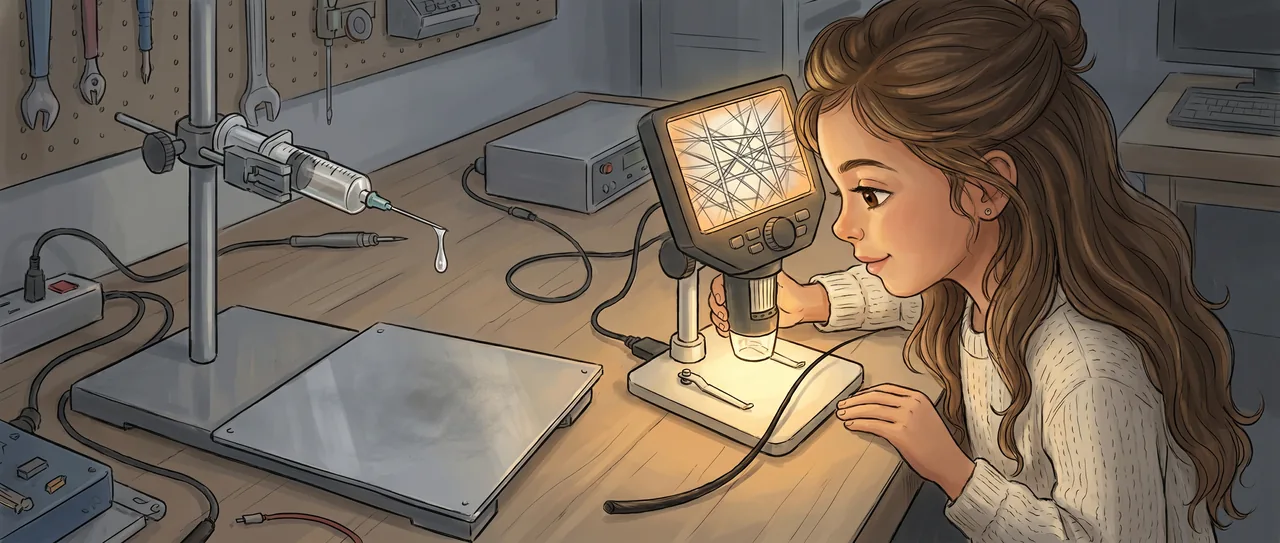
It did not look like much. A syringe held in a metal clamp, pointed at a flat metal plate. A box with a dial. A power supply with a warning triangle. Someone had written FIBERS in marker on the side of the box, and then crossed it out, and then written it again.
Maya turned the syringe. It was full of something clear and slightly gooey, like honey that had lost its mind about being honey. She pressed the plunger a little. A bead swelled at the needle tip and hung there, stubborn, refusing to drip.
Too thick to drip. That was the first thing that did not fit. Water dripped. Honey dripped, slowly. This just hung.
She looked at the plate. It was clean metal, but when she tilted it toward the ceiling light there was a faint gray haze across it, like the ghost of a breath on cold glass. She touched it. Her finger came away dry, but the haze smeared.
Something had been made here. Something that left almost nothing behind.
She found the machine's logbook, a spiral notebook with coffee rings. The last entry was in tidy engineer handwriting. Voltage too low, no fibers, only spitting. Fixed voltage. Got a mat but couldn't see individual fibers even at 40x. Gave up, tired. Then, underneath, smaller: the whole point is you can't see them, dummy.
Maya read that line three times.
She went and got the cheap USB microscope from the shared tools drawer, the one kids used to look at their own skin and scream. She scraped the gray haze off the plate with the edge of a card and pressed it onto the glass slide and put it under.
At low power, nothing. A smudge.
She turned the focus. The smudge did not resolve into dots or grains. It resolved into threads. Dozens of them, hundreds, crossing and looping, and they did not stop being thin no matter how far she pushed the little lens. A hair lay across the corner of the slide by accident, one of her own, and next to these threads it looked like a fallen tree trunk. The threads went under it and over it and kept going, thinner than the hair by so much that her brain did a small lurch trying to hold both in the same picture.
She sat back.
One needle. One clear bead that would not drip. And out of that one bead had come a tangle so fine that a single hair was a log beside it.
Where did the length come from. That was the second thing that did not fit. A drop of liquid was a drop. It had an amount. You could not get miles of thread out of a bead the size of a peppercorn unless the thread was almost nothing at all across.
And if it was almost nothing across, then a tiny pinch of it, the smudge she'd scraped with a card, was not a smudge. It was a landscape. All that crossing and looping meant surface, edges, sides, gaps. She thought about a crumpled ball of paper versus a flat sheet, how the crumpled one was so much more paper packed into the same fist. Now imagine the sheet is a thousandth as thick and there are thousands of them.
The amount of surface hiding in that gray nothing was enormous. She could not picture the number. She could picture that she could not picture it.
Maya looked at the syringe again, and the plate, and understood what the machine actually did. It did not make things. It made surface. It took a little bit of stuff and spread it into almost pure edge, almost pure in-between, threads with so much outside and almost no inside.
The logbook said the engineer had given up because she couldn't see the fibers. But that was the wrong test. You would never see them. Seeing was for logs and hairs, for the fat clumsy things. The whole point was that they had walked past the size where your eyes work at all.
Maya thought about what you would do with a fistful of surface. Something that was almost all edge would grab things. It would catch dust out of air, hold water, let cells crawl across it like a net you couldn't feel. She was not guessing at random. She was reading it straight off the threads. A net that fine, that full of gaps, air would go through and the dust would not.
A filter. A bandage. A scaffold you could not see, that a wound could grow into.
She pressed the plunger again. The bead swelled and hung, stubborn, full of miles it hadn't spun yet.
The voltage box had a dial and the warning triangle, and Maya was not stupid, she left it off. But she understood now why the engineer had needed it. Something had to pull. The liquid would not drip on its own because it was too stringy, too willing to hold together, so you had to reach out and drag it, and drag it, faster than it wanted, until the one fat bead lost the argument and flew apart into threads on the way to the plate. Stretched, on the trip through the air, into the thing too small to see.
That was where the length came from. Not from the amount. From the stretching. The bead didn't hold much. It just agreed to become very, very long instead of staying anything at all.
Aunt Priya appeared in the doorway with her keys, saying it was time, saying what are you even looking at, that thing's broken.
Maya didn't answer right away. She tilted the plate one more time under the ceiling light, and the gray haze caught it, the ghost of a breath, all edge and no weight.
"It's not broken," she said. "You just can't see when it's working."
Read the interactive version, listen to the narration, and earn a gold star →
A science-verified short story for curious kids · Curiosity Land