The Mice Who Never Met Anyone
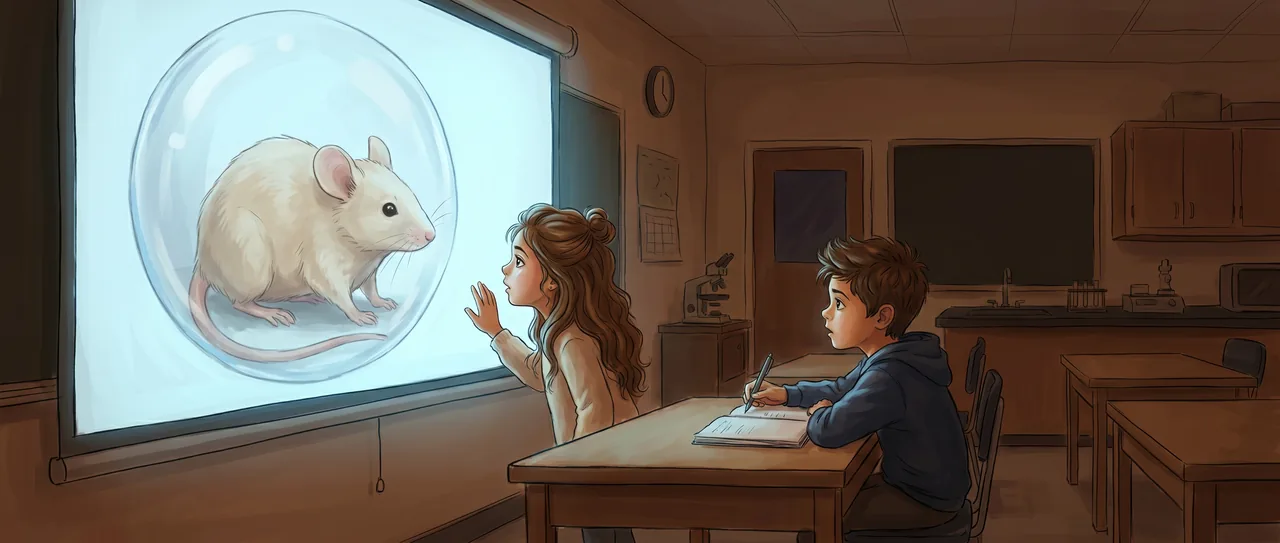
The classroom was empty except for the hum of the projector and the smell of old marker. Everyone else had gone to catch buses. The documentary was still paused on a mouse behind glass, its pink feet pressed to the wall of a sealed plastic bubble.
"Play it again," Maya said. "The part about the bubble."
Soren tapped the space bar. The narrator's voice filled the room. These mice, she said, are raised completely germ-free. No bacteria on their skin. None in their gut. Every breath they take is filtered. Every crumb they eat is sterilized.
"Why would anyone want a clean mouse?" Soren asked. He had his notebook open. He wrote the word gnotobiotic and stared at it, unsure he had the letters right.
"Not clean," Maya said. "Empty. There's a difference."
On screen, a scientist in a blue suit reached into the bubble with thick sealed gloves. The germ-free mouse did not run to a corner the way a regular mouse would. It just sat.
"Look at it," Maya said. "It's not scared enough."
"Mice are supposed to be scared," Soren said. "That's the whole thing about mice."
The narrator kept going. Germ-free mice have thinner intestinal walls. Their immune systems never learn to tell friend from enemy. And when you put two of them together, she said, they do not greet each other the way normal mice do.
Maya leaned forward. "Stop it there."
Soren paused it. Two mice on the screen, side by side, ignoring each other completely.
"Regular mice sniff," Maya said. "They check each other. These ones don't care."
"Maybe they're just calm," Soren said. "Maybe empty means calm."
"No." Maya shook her head. She had the look she got when a thing did not fit and she could feel the not-fitting before she could say it. "Calm is a thing your body decides. These mice can't decide. Something's missing that does the deciding."
Soren looked at his notebook. "The bacteria," he said slowly. "That's the only thing they took out. So the bacteria were doing something. Something to the brain."
"Bacteria in your stomach," Maya said. "Changing how a mouse feels about other mice." She said it like she was tasting it. "That's too far. The stomach's down here." She put a hand on her belly. "The being-scared part is up here." She tapped her head.
"Play the next bit," Soren said.
The narrator explained it. The gut and the brain are connected by a long nerve, and by chemicals the bacteria help make. Some of the same chemicals that carry signals in your brain, she said, are also made by bacteria in your gut. When the bacteria are gone, the signals change. And the stress response, the part of the body that decides how afraid to be, comes back wrong.
Soren stopped writing. "Wrong," he repeated. "Not gone. Wrong."
"That's worse than gone," Maya said quietly.
They were both quiet for a second. The projector fan whirred.
"Okay," Soren said. "So there are, what, trillions of bacteria in a person's gut?" He flipped back a page. He had written it during the film. "Trillions. More of them than there are of your own cells."
"More of them than us," Maya said.
"In us."
Maya stood up. She walked to the screen and put her face close to the paused mouse. "So it's not really one mouse in there," she said. "When it's a normal mouse, I mean. It's a mouse plus everything living in the mouse. And the everything is part of how it acts."
"That's the part I can't hold," Soren said. He pressed the pen into the paper. "If you took every bacteria out of me. Not to kill me. Just to make me empty. I'd still be me. I'd still have my whole brain."
"Would you though," Maya said.
Soren looked up.
"You'd have your brain," Maya said. "But your brain would be getting different signals. The scared signal, the calm signal, the go-say-hi-to-that-person signal. Those come partly from them." She pointed at the screen. "The trillions."
"So the me that decides to talk to somebody," Soren said, "isn't only me."
"It's a team," Maya said. "And you never met most of the team."
Soren wrote that down. His hand was moving faster than usual. He crossed out gnotobiotic and wrote it again correctly underneath.
"Here's the thing that gets me," Maya said, sitting back down on the desk. "That mouse isn't broken. Everyone would look at it and say it's broken, but it's not. It just grew up without meeting anyone. Not people. Meeting bacteria. It never got the little crowd that's supposed to move in."
"When does the crowd move in?" Soren asked. "For a person."
Maya stopped. "When you're born," she said. "It has to be when you're born. Where else would they come from."
Soren was already ahead of her, flipping pages, checking. "The film said it too. Right at the start. When we're born we pick them up. From everywhere. From the people around us."
"So a baby that never met anybody," Maya said, "and never picked up the crowd."
"Would be like the mouse."
"Not scared enough," Maya said. "Not friendly the right way. Because the team never showed up to help it decide."
They sat with it. Outside, a bus pulled away with a long sigh.
"I keep thinking I'm one person," Soren said. He said it almost like he was confessing something. "I always thought that was the one thing you knew for sure. That you're one."
"You're the biggest crowd you'll ever be in," Maya said.
Soren laughed, but it was a small shaky laugh, the kind you do when something is funny and also enormous.
"Play the end," he said. "I want to see if they fix the mouse."
Maya tapped the space bar. On screen, the scientist opened a small tube and let a single drop fall into the germ-free mouse's food. Just bacteria, the narrator said. From an ordinary mouse. And over the next weeks, the germ-free mouse began, slowly, to behave like a mouse again.
Maya and Soren watched the mouse on the screen turn toward the second mouse in its cage, lift its nose, and sniff.
Read the interactive version, listen to the narration, and earn a gold star →
A science-verified short story for curious kids · Curiosity Land