The Lighthouse That Isn't There
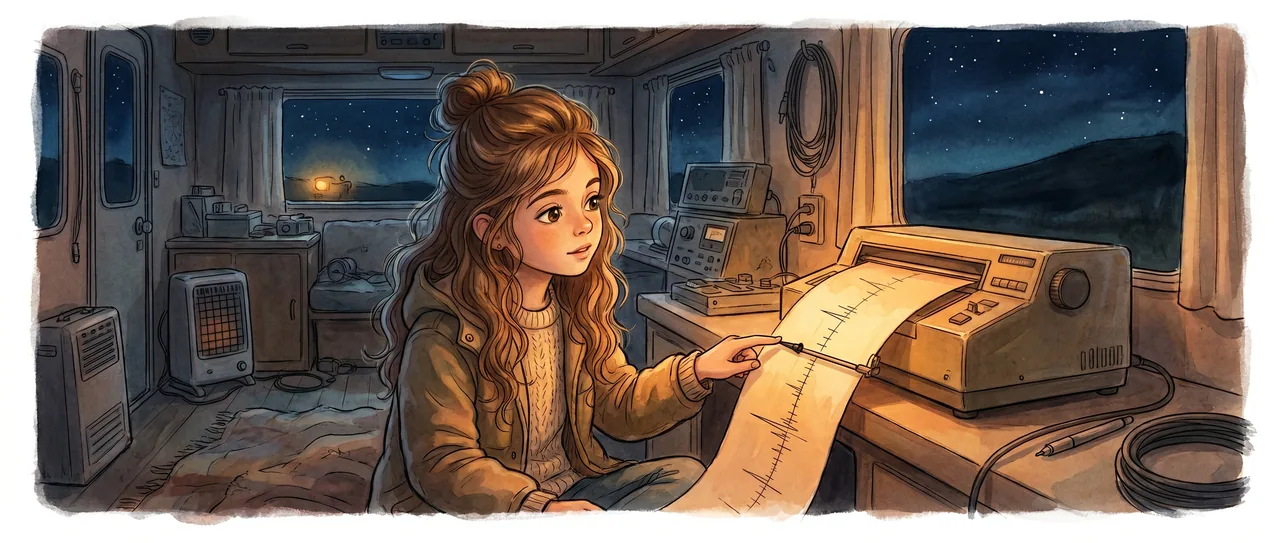
The generator smelled like hot oil and the grass smelled like cold, and Maya sat on the metal steps of the trailer with both smells fighting in her nose.
Her aunt Priya was somewhere up the dark hill with a headlamp and a bag of tools, saying words at the big dish antenna that Maya was not supposed to repeat. The dish had a bad motor. Nothing was going to get fixed tonight. Maya had been promised stars and had gotten instead a folding chair, a thermos of tea gone lukewarm, and the sound of her aunt losing a fight with a bolt.
Inside the trailer, though, something was still working.
A machine on the counter clicked. Not once. Over and over, faster than a clock, faster than her own heartbeat, a steady mechanical tick under the hum of everything else. She had noticed it the way you notice a dripping tap, and then she could not stop noticing it.
She went in.
The machine was old, a box with a roll of paper feeding slowly out one side. A thin pen rode back and forth across the paper, drawing a wobbling line. Every so often the line jumped, a sharp spike, then settled, then spiked again. The spikes came so evenly she could have set a metronome by them.
Maya put her finger lightly against the moving paper. It was warm from the pen. The spikes marched under her fingertip, tick, tick, tick, patient and exact.
Something was out there tapping.
Her first thought was a machine. Machines tap. Something on the site, a pump, a beacon, the generator itself throwing a signal into the antenna. She counted the spikes against the second hand of the clock on the wall. She lost count because they were too fast, so she counted just five seconds and multiplied in her head. Dozens of pulses. Dozens every second. Nothing she knew of ticked that fast and that evenly. Her own pulse in her ears was slow and sloppy next to it.
She went to the door. "Aunt Priya. What's the clicking machine drawing?"
"The recorder?" Priya's voice floated down the hill, distracted, half of it aimed at the bolt. "Leave it running. It's just logging one of the sources."
"One of the what?"
"Sources. It's fine. Don't touch the pen."
Not an answer. Adults gave you the shape of an answer and kept the middle for themselves. Maya went back to the paper.
A source. Something in the sky, then, not on the ground. She thought about the dish, dead on its motor, frozen pointing at one patch of dark. Whatever this was, it was sitting in that one patch, sending its tick down eleven billion trillion miles of nothing into a broken antenna and a pen that had no idea how impossible it was being.
She tried to imagine what could blink that fast. A light you turned on and off dozens of times a second, you would need a switch faster than any switch. Then she thought: not a switch. A turning. A lighthouse doesn't blink. It spins, and the beam sweeps past you, and from where you stand it looks like blinking.
So something was spinning. Something was turning dozens of times every single second, throwing a beam past the Earth each time it came around.
Maya stopped with her finger on the warm paper.
She knew how big stars were. She had seen the sizes in books, the sun a beach ball and the Earth a peppercorn rolled far across a room. Stars were enormous. You could not spin something enormous dozens of times a second. Swing your arm in a full circle even five times a second and it flies off your body. A whole star, a thing wider than a hundred Earths, turning hundreds of times a second, would tear itself into dust. It could not hold.
Unless it was small. Small and heavy in a way that let it hold on to itself no matter how fast it flew.
The pen spiked. Tick.
She thought about the word Priya had almost not said. Source. And she thought about what makes a source in the first place, what her aunt studied out here in the cold. Stars that ended. Stars that ran out and fell inward all at once and crushed themselves down.
How far down. Maya turned it over, testing the size against the speed. Down until a whole star, more stuff than the sun, was squeezed into something you could drive across in a few minutes. Down until a single spoonful of it weighed as much as a mountain. As much as a whole range of mountains. She tried to hold that in her hand, one teaspoon that weighed a billion tons, and her hand wanted to close around nothing, and the number would not fit inside her fingers.
A thing like that could spin however fast it wanted. Nothing could throw it apart. It was gripping itself with its own crushing weight, turning and turning in the dark, and each turn the beam came around and reached across everything and tapped the pen.
Tick.
Maya sat down slowly on the trailer floor with the paper still feeding past her face. But the smallest thing in the whole sky, the one crushed down hardest, the one everyone would have counted out, was the only kind of thing that could spin that fast and not fly apart. It held together because of how tightly it was made.
Up the hill, the bolt finally gave. She heard her aunt say something victorious.
"Got it! Maya, we'll have the dish back in ten. You still up?"
Maya did not answer. She was watching the pen come to the end of its swing and start back.
Tick.
Somewhere in that one frozen patch of dark, a thing the size of a city and heavier than the sun turned over again, and again, faster than she could count, and had been turning like that long before there was anyone to count, and would keep turning long after.
The pen crossed the paper. Maya reached out and let the warm strip run over the backs of her fingers, spike after spike, keeping the time of something that would never, ever stop.
Read the interactive version, listen to the narration, and earn a gold star →
A science-verified short story for curious kids · Curiosity Land