The Light From the Dead Bulb
The whole block went dark at once, and Maya heard the city sigh.
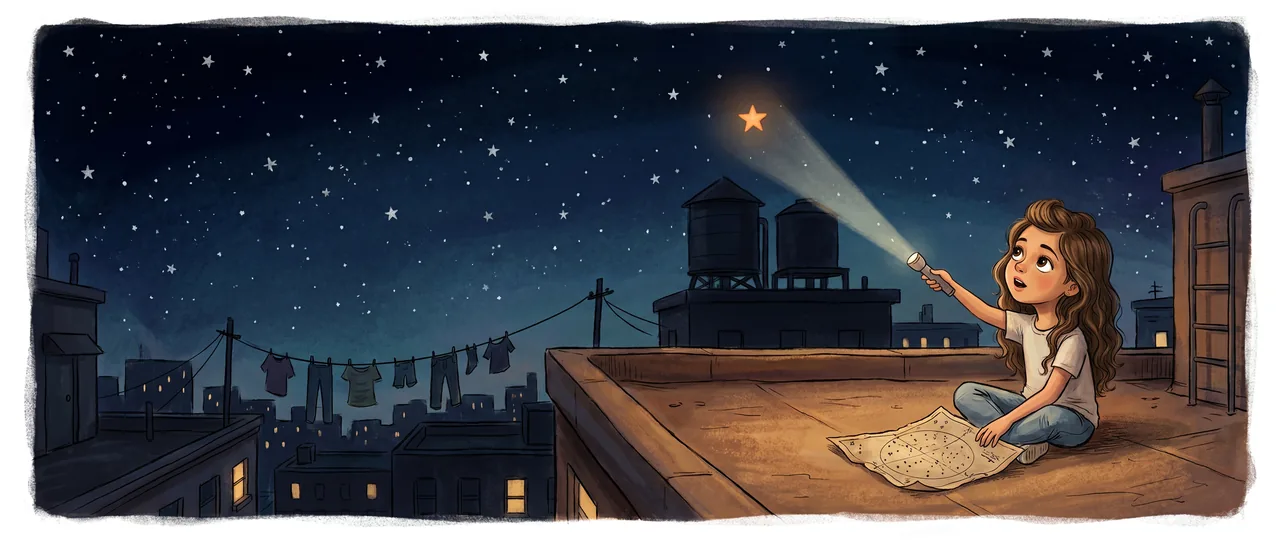
Air conditioners wound down. The refrigerator hum in the stairwell died. Even the streetlights, which never went off, blinked out like someone had pinched them. Maya climbed to the roof with a flashlight and her grandmother's star map, because the roof was the only place that smelled like cooler air and not like everyone's dinner at once.
Above her, the sky filled in.
It happened slowly, the way her eyes adjusted. First a few hard points. Then dozens. Then a spilled sugar of them, more than she had ever seen from this roof, because the whole city had stopped drowning them out. The dark was doing something. It was letting things arrive.
She lay back on the still-warm tar paper and let the flashlight rest on her stomach, off.
Her grandmother's map was old and soft at the folds. Little inked lines connected the stars into animals nobody could actually see up there. Maya found a bright orange one low over the water tanks. Beside it, her grandmother had written in tiny letters, red giant, dying.
Maya frowned at that. Dying now, or dying when the map was printed?
The orange star did not look like it was doing anything. It sat there. It burned steady. It looked about as alive as a star could look.
She thought about the flashlight on her stomach. If she clicked it on and off fast, the light still reached her eyes for the tiniest instant after her thumb left the button. Light took time. Not much, across a rooftop. But time.
And stars were not across a rooftop.
Maya sat up.
The orange one was far. She did not know how far, but her grandmother's neat handwriting had a number under the name, a number with the word light-years crammed at the end of it. She had read that word a hundred times and treated it like a fancy way of saying really far. Now it cracked open in her hands.
A light-year was not a distance you crossed. It was a distance that light crossed, and light took a whole year to do it. So a star ten light-years away was sending her light that left ten years ago. She had been one year old when that light started toward her. It had been traveling the entire time she had been learning to walk, learning to read, learning that adults said far when they meant something much stranger.
She looked at the orange star and felt the tar paper tilt under her.
The light hitting her eye right now was old. It was a package mailed a long time ago. And the thing that mailed it, the star her grandmother had marked dying, might have finished dying already. Might have collapsed or swelled or blown itself apart years ago, and the news of that ending was still crawling across the dark toward this roof, not here yet, still on its way.
Which meant she could be looking, right now, tonight, at a light with nothing behind it.
A sent letter from someone who was already gone.
Maya pressed both hands flat on the map to keep it from sliding, except it was not sliding. It was her. Her whole sense of now was sliding. Because every one of these stars was a different age of light. The orange one, ten years old. The white one near it, maybe eighty. The faint dust of them near the horizon, so far their light might have left before there were cities to darken.
She was not looking at the sky.
She was looking at a hundred different pasts, all stacked in the same window, all arriving at her eye in the same instant and pretending to be one single tonight.
Her breath came fast. She made herself test it, the way she tested everything. Pick a star. Believe the boring answer first. The boring answer was: they are all up there, right now, exactly as they look.
But the boring answer needed light to move infinitely fast, and light did not. She had felt light take its little instant across the flashlight beam. Light had a speed. A speed meant a delay. A delay meant the picture was old. There was no way around it, no boring answer that survived. The sky was a photograph, and some of the people in it had already left the room.
Maya laughed, once, alone on the roof, and it came out shaky.
Because the terrible part and the wonderful part were the same part. If the light was still coming, then somewhere out there, right now, real events were happening that she would not see for years. Stars being born in gas she could not yet detect. A dying star finishing its death in perfect silence, its last light already launched, already on the road, aimed at rooftops that did not exist yet and eyes that were not born yet.
The universe was not a place. It was a message that took forever to deliver, and everyone anywhere was always reading old mail.
She wanted to tell someone. She wanted to tell everyone. She wanted to grab the whole dark city by the shoulders and say the streetlights being off is why you can finally see how late all of this is.
Below her, a single window flickered. Then another. The power was coming back, block by block, the city relighting itself.
Maya did not want it back yet. She grabbed her flashlight, aimed it straight up at the orange star, and clicked it on.
Her thin little beam went up into the dark and did not stop. It kept going, past the water tanks, past the returning streetlights, out.
She held the button down and thought about how long her light would take to get anywhere, and who might be lying on some far roof, ten years from now, or ten thousand, when it finally arrived.
Read the interactive version, listen to the narration, and earn a gold star →
A science-verified short story for curious kids · Curiosity Land