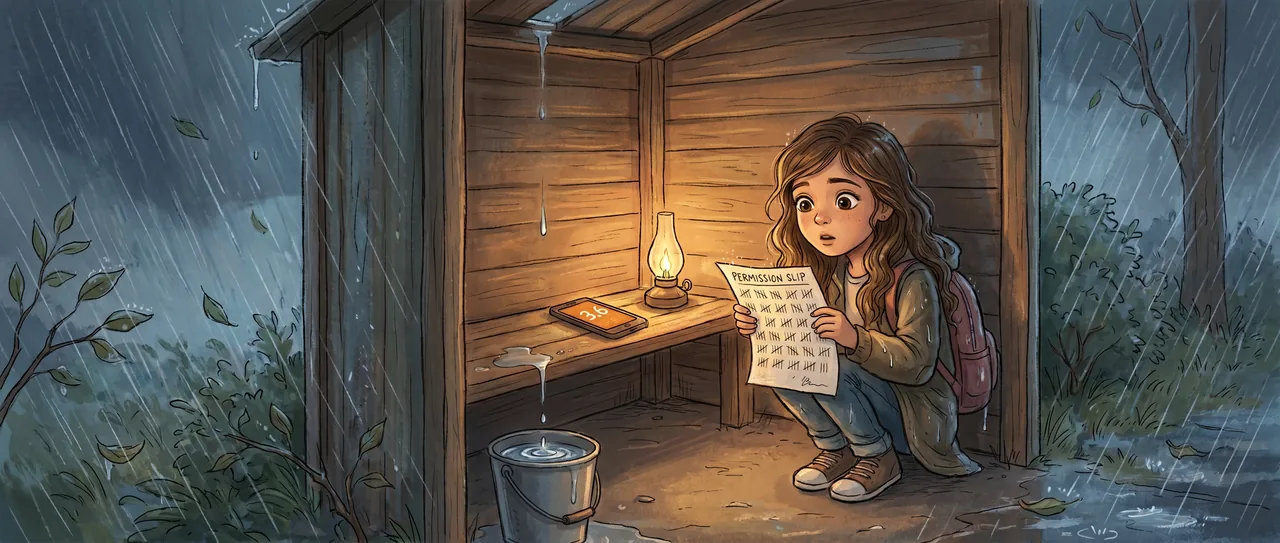
The Jar of Rain
The rain came sideways under the bus shelter roof, so Maya pressed into the dry corner with her backpack on her lap. The bus was twenty minutes late. There was nothing to do but listen.
Someone had left a metal bucket beside the bench, and the roof had a leak directly above it. Drips fell into the water one at a time. Plink. A long wait. Plink. A short wait. Plink plink, almost together.
Maya started counting the gaps. Not because anyone told her to. Because the gaps would not sit still.
One drip came after three heartbeats. The next after seven. Then two. Then five. Then one, so fast it startled her. There was no rhythm to grab onto. Every time she thought she had the pattern, the next drip broke it.
She pulled out her phone and started a stopwatch, thumbing the lap button each time she heard a plink. The screen filled with numbers. 2.1. 5.8. 0.9. 4.4. 3.0. 6.7. She let it run through fifty drips, then a hundred. Her thumb got tired. The cold made her fingers slow.
The drips did not care. They kept coming, each one its own surprise.
But something was happening at the bottom of the screen. The phone showed an average of all her laps, and the average had stopped jumping around. Early on it had swung wildly, from two seconds to five and back. Now, after a hundred drips, it sat almost still. Three point six. Another drip. Three point six. Another. Three point six.
Maya frowned at it. Each single drip was pure chaos. She could not guess the next one to save her life. Yet the pile of them together had a number, a solid number, and that number would not move.
She wiped rain off her face and thought about that. The individual drips were random. The heap of drips was not.
She wanted to see it better. She dug a pencil and the back of an old permission slip out of her bag and drew a row of boxes across the bottom. Under one she wrote a zero, then one, two, three, on up to eight. Seconds. Then she went back through the laps in her head, mostly, and started marking a tally in each box for how often a gap of that length had happened.
The tallies grew. The zero box got a few. The one box more. The two box more than that. The three and four boxes filled fastest of all, marks stacking on marks. Then five started thinning out. Six thinner. Seven, only a couple. Eight, almost none.
She held the paper up and tilted her head.
The marks made a shape. Low on the left, climbing to a fat hump in the middle around three and four, sliding down the right side. A hill. A smooth hill, built entirely out of things that had arrived in no order at all.
Maya's breath caught.
She had not drawn a hill. She had not decided on a hill. Nobody had arranged the rain. The leak in the roof did not know what a hill was. Every drip had fallen when it fell, for its own reasons, tangled up in wind and the shape of the crack and the weight of water she could never possibly track. And still, laid side by side, the drips had built the same rounded shape she had seen a hundred times without ever asking where it came from. On test-score charts taped to the classroom wall. On a graph of everyone's height in the nurse's pamphlet. The same hill. Always the same hill.
She looked out at the storm. Rain was falling on the whole street, on every roof, into every gutter, millions of drips, each one landing when it landed for reasons no one would ever write down. And she had the sudden, dizzying feeling that if she could tally all of them, the entire city's worth, they would pile up into a hill too. That the world was full of things nobody was steering, and the not-steering did not make a mess. It made a shape. A specific shape. A shape you could predict without predicting a single one of the pieces.
The next drip landed and she flinched, then laughed at herself for flinching. She could not have told anyone when it would come. That was the whole point. The single drip was allowed to surprise her forever.
But she could tell you, now, that most gaps would land near three and a half. She could tell you the fat middle and the thin edges. She could tell you the hill.
Maya turned the paper over, looking for more room, and found only the printed permission slip with her mother's signature on it. She flipped it back and drew a small arrow pointing at the tallest column, then a second arrow at the thin far edge where an eight-second gap had happened exactly once. That one lonely mark. A drip that had made everyone wait. It fit the hill too. The hill even knew about the rare ones. It gave them a place, out at the edge, small but not forbidden.
She wondered how many drips it would take before the eight-second box grew a second mark. She wondered if there was a box past eight, a nine, a ten, waiting for a gap so long it might come only once all winter. The hill would have a spot for that too. It just hadn't been filled yet.
Somewhere down the street the bus horn sounded through the rain. Maya did not move.
The average on her phone still read three point six. The bucket still had no idea. Water still fell into it with no plan and no memory, each drip free, each drip a coin toss she would lose every time.
She held the paper flat so the shelter light fell on the little hill of marks, and waited for the next drip to tell her nothing, and add itself to everything.
The bus pulled up, doors hissing open, wipers dragging across the glass. Maya stayed in the corner one drip longer, then one more, counting.
Read the interactive version, listen to the narration, and earn a gold star →
A science-verified short story for curious kids · Curiosity Land