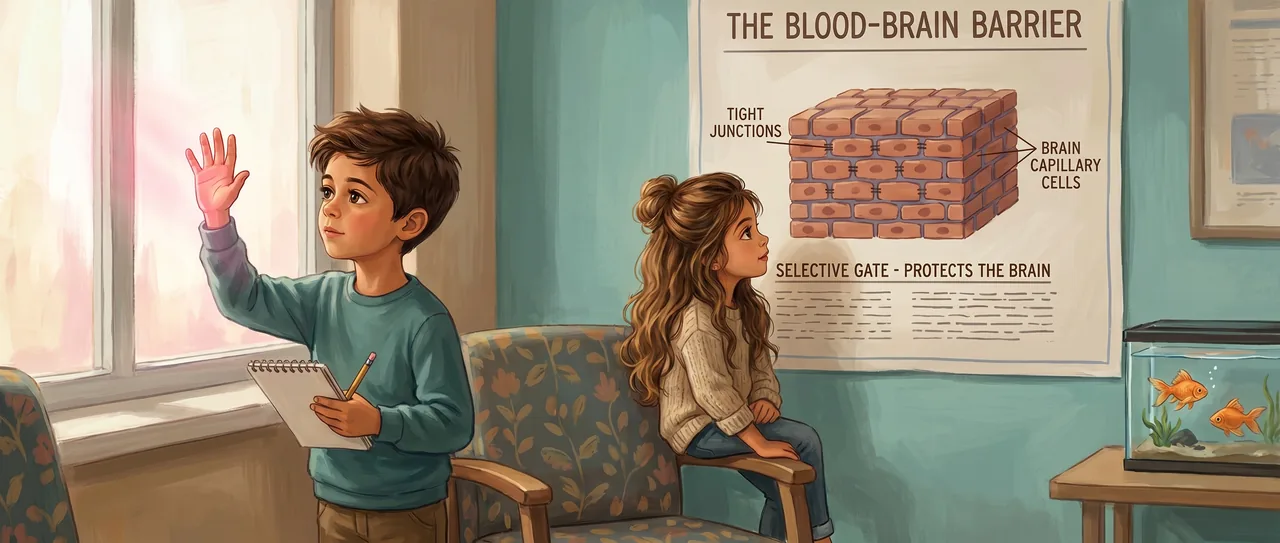
The Gate That Kept the Wrong Things Out
The waiting room had a fish tank with two fish and a poster with too many words. Maya had counted the fish four times. She started on the poster.
"Soren. Look at this. The brain has a wall."
Soren looked up from his notebook. He had been drawing the vending machine because it was the only interesting shape in the room. "A wall."
"A wall around its blood. It says the blood vessels in the brain are lined with special cells packed so tight that almost nothing gets through. It's called the blood-brain barrier."
"So the brain gets less blood?"
"No. Same blood." She tapped the glass of the poster frame. "Just fussy about what it lets out of the blood and into the brain part."
Soren came over. He read the way he always read, slowly, catching on the parts that did not fit. "Sugar goes through. Oxygen goes through. But it blocks bacteria. Blocks poisons." He stopped. "That's good, though. That's the brain protecting itself."
"Right. But read the bottom."
He read the bottom. Then he read it again.
"It blocks almost all medicine too," he said.
"Almost all of it."
They stood there. Somewhere down the hall a machine hummed, the one Soren's cousin was inside.
"That's backwards," Soren said slowly. "You build a wall to keep out the bad things. And then when someone's brain is actually sick, you make the medicine, you have the medicine, it's right there in the blood, and the wall keeps it out too. The wall can't tell the difference."
"The wall doesn't know it's medicine," Maya said. "It just knows it's a stranger."
Soren wrote something. His pencil moved and stopped and moved.
"How tight is tight," he said. It wasn't quite a question. "Most of the body's blood vessels are leaky on purpose. Little gaps between cells so things can slip in and out. I read that once. But not the brain."
"So somewhere in the body there's a gate that's basically always open," Maya said, "and up here there's a gate that's basically welded shut."
"Welded except for the guest list." Soren frowned. "Sugar's on the list. Oxygen's on the list. The cells actually carry those across on purpose, like usual. Everything not on the list bounces."
Maya sat on the arm of the chair, which she was not supposed to do. "Okay. So if you're a doctor and you have a medicine that would help a brain, you've got a problem no other part of the body gives you. You can fix a liver by putting medicine in the blood. The liver's gate is open. The brain's gate says no."
"So how do they ever treat anything in the brain?"
That was the good question. Maya could feel it was the good question because she didn't have the answer and neither did the poster.
A woman across the room lowered her phone. She had a badge clipped to her sweater, the kind that said she worked here but not what she did. "You two are reading the barrier poster," she said. "Nobody reads the barrier poster."
"How do you get medicine past it," Soren said, straight out, because he did that.
The woman laughed, but not in a way that was making fun. "That," she said, "is most of my job. And most days the answer is you don't. Not easily." She looked tired in a specific way, the way of someone who has lost the same argument many times to the same wall.
"But sometimes," Maya said.
"Sometimes we trick it," the woman said. "The barrier has doors for the things it wants. Sugar, certain proteins. So people are learning to build medicine that wears a costume, medicine shaped like something on the guest list, so the door opens for it." She shrugged. "Or you use sound. Focused ultrasound, aimed at one tiny spot, wiggles the barrier open just there, just for a little while, and then it closes again."
Soren stopped writing. "You can open it and it closes back?"
"For a few hours. Then it seals itself. It wants to be shut."
Then her phone buzzed and she stood and said good luck to nobody in particular and walked off down the hall, still tired, still losing to the wall but not all the way.
Maya and Soren looked at each other.
"She said trick it," Maya said quietly.
"Costume," Soren said. "You don't break the gate. You get on the list."
"Because the gate isn't the enemy. That's the part I keep getting stuck on." Maya pulled her knees up. "The whole reason your brain works is that this wall kept out ten thousand years of everything trying to get in. Every germ. Every bad thing you ever ate. It's why your thoughts are your thoughts and not whatever's floating in your blood that day."
"So it did its job too well."
"It did its job perfectly," Maya said. "That's different. It's not broken. It's just built for a world where nobody had medicine yet."
Soren was very still. Then he said, "So the problem isn't the wall. The problem is that the wall is smarter than us right now."
Maya grinned. "Right now."
"So somebody has to be smart enough to make something the wall wants to let in." He looked at the poster again, at the tight-packed cells drawn like bricks with no mortar gaps. "Somebody has to know the guest list better than the guard does."
"Somebody who reads the poster nobody reads," Maya said.
A door opened down the hall. Soren's cousin came out holding a paper cup of stickers, complaining that the machine was loud, completely fine, five years old and bored already. Soren's aunt was talking to a nurse about when to come back.
Soren didn't get up right away. He was looking at his own hand, turning it over.
"What," Maya said.
"There's a gate in there," he said. "Right now. In my head. In yours. It's letting the right things through and stopping everything else and it's been doing it every single second of our whole lives and we never once told it to."
He held his hand up to the light from the window and watched the pink of the blood under the skin, everything on the guest list moving through, everything else turned quietly away.
Read the interactive version, listen to the narration, and earn a gold star →
A science-verified short story for curious kids · Curiosity Land